














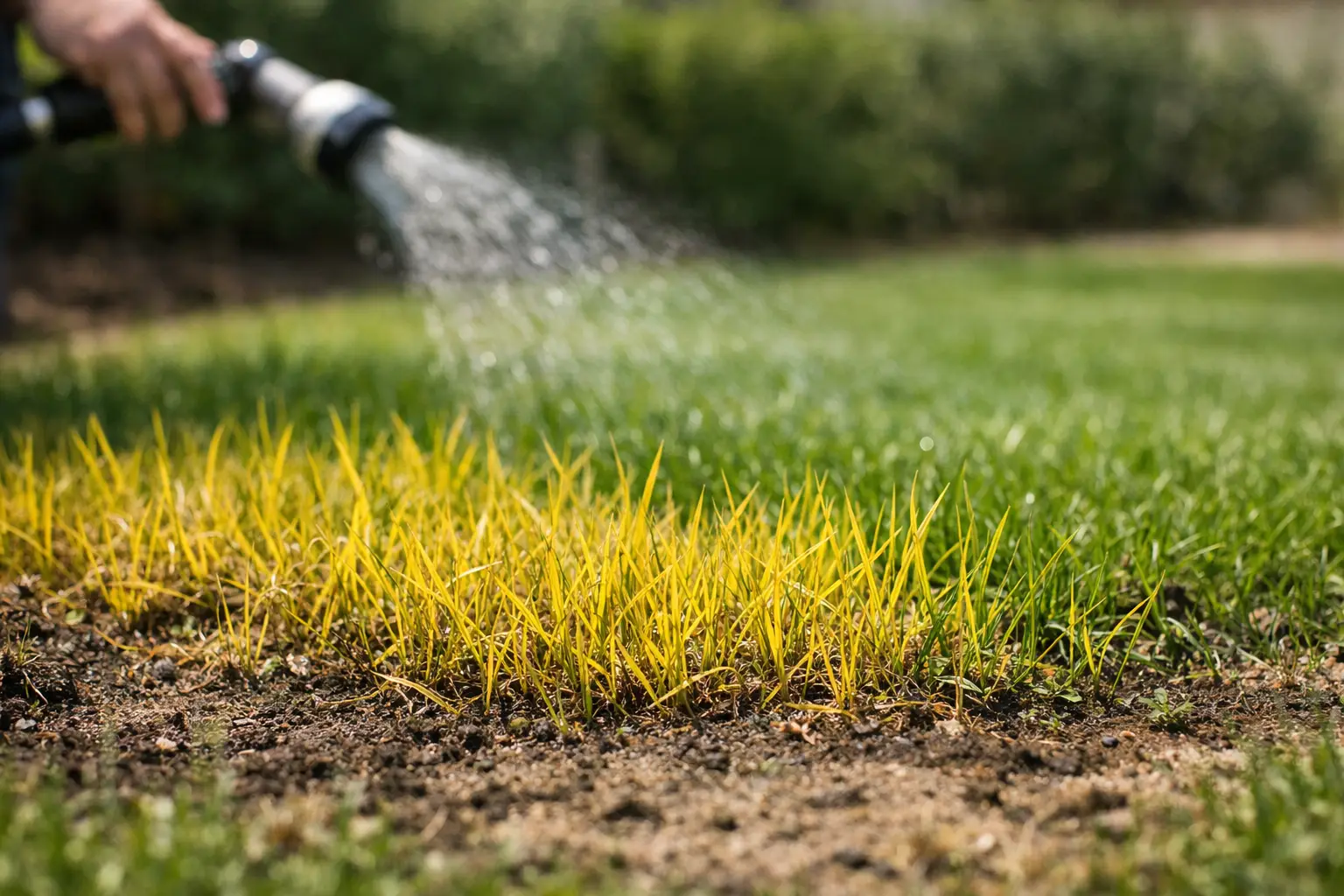
A newly seeded lawn can look promising one week, then pale, straw-coloured or unevenly yellow the next. So, why is new grass yellow? Usually, the seedlings are under stress rather than dying. Young grass has a shallow root system, limited stored energy and little tolerance for errors in watering, nutrition or soil preparation.
The key is to identify the pattern before applying anything. A pale lawn across the whole area points to a different problem from yellowing in wet patches, thin stripes or exposed areas. Correct the cause early and most new grass will recover well.
Why is new grass yellow after germination?
New seedlings rely initially on the energy held within the seed. Once the first leaf appears, they must begin photosynthesis and produce roots quickly. If light, moisture, oxygen or available nutrients are restricted, chlorophyll production falls and the grass loses its green colour.
The most common causes are inconsistent watering, low available nitrogen, compacted or poorly prepared soil, cold weather, poor drainage and mowing too soon. Seed mixture also matters. Fine fescues naturally establish more delicately and can appear lighter than perennial ryegrass, particularly during cool spring or autumn weather.
Yellow does not automatically mean fertiliser is required. Feeding a thirsty, waterlogged or newly germinated lawn with too much nitrogen can cause more damage than the original problem.
Check moisture first
Water management is the first place to look. During germination and the first few weeks of establishment, the top 10-20 mm of soil must stay consistently moist. It should not, however, remain saturated.
If the surface dries out between watering, fine young roots can be damaged. The grass may turn a washed-out yellow-green, stop growing and become sparse. This is especially common on sandy ground, in windy gardens and along sunny edges next to paving or fences. A quick surface sprinkle is rarely enough in dry conditions because it wets only the top crust of soil.
At the other extreme, waterlogged soil excludes oxygen. Roots cannot function properly without air spaces in the soil, so seedlings become pale yellow, weak and prone to fungal disease. If yellowing is concentrated in hollows or heavy-clay sections, poor drainage is more likely than a lack of feed.
Water lightly and regularly until the seedlings are rooted, adjusting for rainfall and temperature. In warm, dry spells, this may mean one or two light applications daily. As roots develop, reduce the frequency and water more deeply. The objective is to train roots downwards, not keep them at the surface.
A simple soil check
Push a finger or small trowel into the seedbed. If it is dry just below the surface, increase watering duration. If it is sticky, glossy and smells stale, pause irrigation and allow the ground to drain. This check is more reliable than following a fixed watering timetable.
Lack of nutrients, especially nitrogen and phosphorus
Pale new grass can indicate a shortage of available nutrients, particularly on poor topsoil, recently imported soil or ground where turf and weeds were removed before sowing. Nitrogen supports leaf growth and chlorophyll, while phosphorus is particularly useful for early root development.
A properly prepared seedbed benefits from a balanced pre-seeder fertiliser. A 6-9-6 NPK formulation, for example, supplies moderate nitrogen without forcing soft, excessive top growth, alongside a higher phosphorus content to support rooting. This is a better fit for establishment than a high-nitrogen summer lawn feed.
Timing matters. Fertiliser can be incorporated during final seedbed preparation or applied carefully after sowing in line with the product rate. If grass has already germinated, use only a suitable establishment feed and avoid guessing the dose. Young seedlings are vulnerable to scorch where granular fertiliser is over-applied or left dry on the leaf.
If a pre-seeder feed was used correctly, do not assume more fertiliser is the answer after a few days of pale growth. Cool soil can temporarily limit nutrient uptake even where nutrients are present. Give the lawn warmth, adequate moisture and time before making another application.
Cold weather and slow establishment
Grass seed does not germinate and grow at the same speed throughout the year. Perennial ryegrass often germinates in 7-14 days in favourable conditions, but cold nights, low soil temperatures and prolonged cloud can slow both germination and greening.
Spring-sown lawns can look yellow after a sharp cold spell. Autumn seedlings may establish pale as daylight levels fall. In these cases, the lawn is often healthy but inactive. Avoid trying to force colour with a strong nitrogen feed when growth is slow. It can encourage vulnerable leaf growth while roots remain underdeveloped.
Patience is particularly worthwhile if seedlings are upright, evenly distributed and gradually producing new leaves. Once soil temperatures improve, colour normally deepens. If frost is forecast, keep foot traffic off the new lawn and avoid mowing until conditions become milder and the ground has dried.
Soil preparation problems beneath the surface
A good-looking seedbed can still hide a poor rooting environment. Compaction, rubble, a hardpan beneath imported topsoil, or an abrupt change between soil layers can all restrict root development. The visible symptom is often patchy yellow grass that fails to thicken.
New lawns need a friable, firm seedbed. Soil should be cultivated sufficiently to remove compaction, levelled, then lightly firmed so seed has close contact with the ground. It should not be worked into a powder, particularly on clay, as fine particles can cap over after rain and restrict air movement.
Where yellowing follows distinct lines, investigate the preparation work. Construction traffic, buried service trenches and the joins between different loads of topsoil are common causes. A feed may improve colour temporarily, but it will not solve a compacted layer or standing water below the surface.
For badly affected areas, it is often more efficient to remedy the soil and overseed than repeatedly fertilise weak grass. Use a suitable seed blend for the conditions. A durable ryegrass and fescue mixture gives rapid cover and resilience, while a specialist shade-tolerant blend is the better choice beneath dense tree cover.
Shade, competition and seed mixture differences
Not every yellow patch has a soil problem. New grass under trees, beside hedges or against north-facing boundaries receives less usable light and competes with established roots for water and nutrients. It may also be kept damp for longer, creating a less favourable environment for seedlings.
Standard lawn seed can struggle here, especially if the area receives only brief direct sunlight. Fine fescues tolerate lower light better than ryegrass, but even shade-tolerant grass needs reasonable air movement and moisture control. Thin branches where appropriate, clear fallen leaves promptly and do not expect the same deep green, dense finish as a fully open lawn.
Different grass species also emerge at different rates. Ryegrass often appears first, while fescues can be slower and finer. An uneven colour during the first month may simply reflect normal establishment of a mixed seed blend. Resist the temptation to rake out lighter seedlings before the lawn has had time to mature.
Mowing too early or too low
The first cut is useful because it encourages tillering, the side growth that creates a denser lawn. Done too early, or at an aggressive height, it can set seedlings back and leave them yellow at the tips.
Wait until the grass is roughly 50-75 mm high and rooted firmly enough that a gentle tug does not lift it from the soil. Use a sharp mower and remove only the top third of growth, leaving the lawn at around 40-50 mm for its first few cuts. Mow only when the surface is dry.
A blunt blade tears rather than cuts. The damaged tips dry out and turn pale or yellow, giving the lawn a dull appearance even where roots are healthy. This is easy to diagnose: look closely at the leaf ends. Cleanly cut tips are straight, while torn tips look ragged or shredded.
What not to apply to a yellow new lawn
Avoid using weed and moss killers on newly germinated grass unless the product label specifically confirms it is safe at that stage. Selective herbicides can stress young seedlings, and moss treatments are not a remedy for yellow grass caused by poor drainage or shade.
Do not use a total herbicide anywhere near the lawn area. These products are intended for clearing unwanted vegetation and will kill grass. Likewise, avoid applying a strong seasonal fertiliser simply because it promises fast green-up. New grass needs measured nutrition and stable growing conditions, not a short-lived surge.
A practical recovery plan
First, inspect the lawn's moisture and drainage. Keep the seedbed evenly moist, but allow waterlogged ground to dry and investigate low spots. Next, assess whether a balanced pre-seeder or establishment fertiliser was applied at the correct rate. If not, use an appropriate product carefully rather than a high-nitrogen feed.
Then leave the lawn enough time to root before its first light cut. Keep pets, children and unnecessary foot traffic off the area while seedlings are vulnerable. Where a few patches remain thin after establishment, lightly rake the surface, add seed suited to the site and keep it moist until it germinates.
New grass is not judged in its first fortnight. Give it sound soil, steady moisture and the correct nutrition, and the pale early growth will usually develop into the stronger, greener cover the seed mixture was engineered to deliver.