














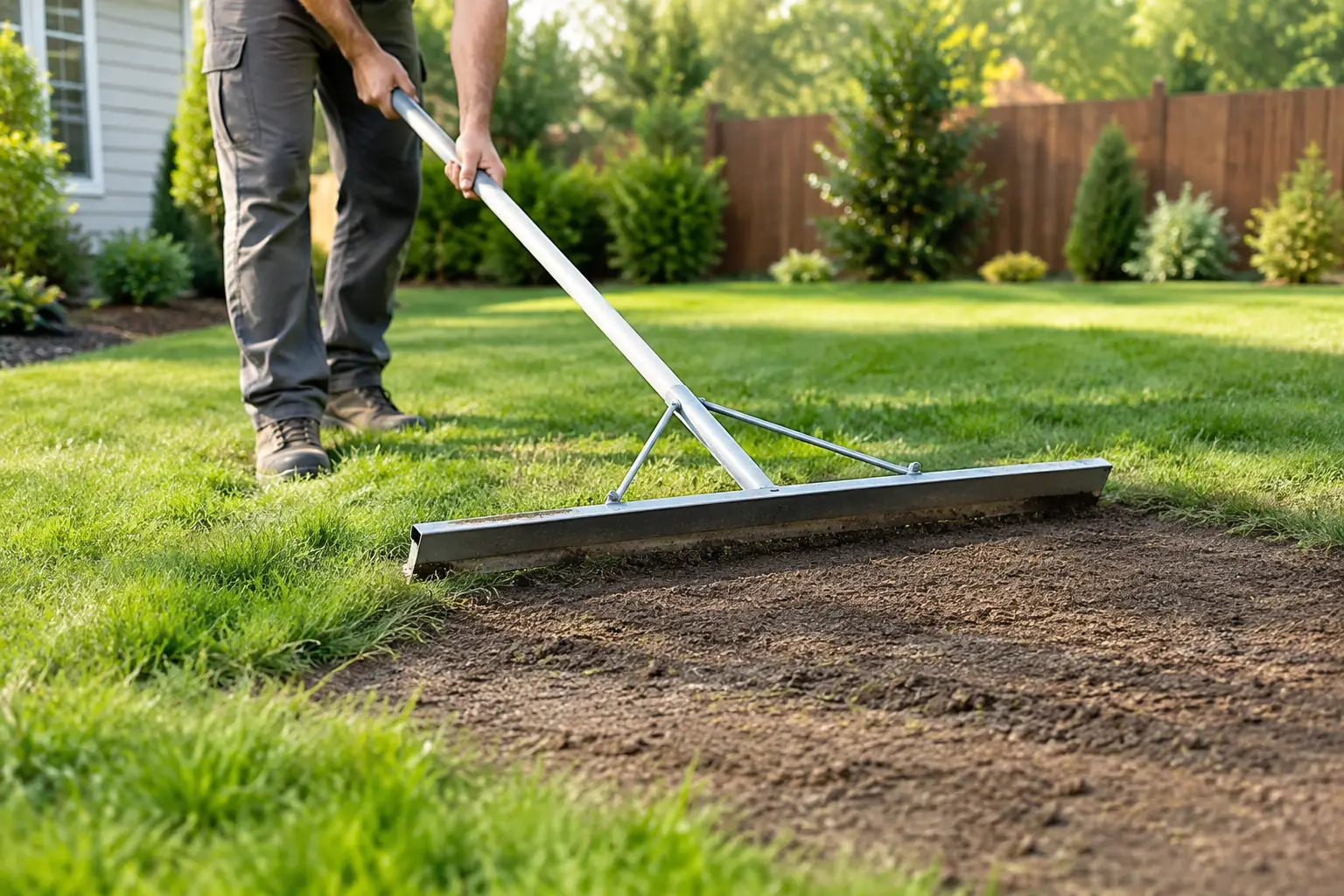
A lawn can look healthy from the patio yet feel like a ploughed field underfoot. If you need to level an uneven lawn, resist the temptation to simply tip soil into every hollow. The correct method depends on whether the surface has minor dips, deep settlement, poor drainage or damage from building work. Get that diagnosis right and the repair will last.
Find the cause before you level an uneven lawn
Walk the area after rain and again when the ground is dry. Mark low points with canes or line-marking paint, then lay a straight timber board across the lawn to judge their depth. A shallow dip of 10-20mm is a topdressing job. A hollow of 50mm or more usually needs turf lifting and soil reinstatement.
The cause matters. Small undulations often develop through worm activity, repeated mowing patterns, children’s play or gradual settling of old topsoil. Localised depressions may indicate a decayed tree root, an old trench, poorly compacted builders’ spoil or a drainage issue. If a hollow repeatedly fills with water, levelling the surface alone will not cure it. The underlying soil may be compacted, or the lawn may fall towards a wall, path or patio.
Check for buried services before digging, particularly on recently developed plots. Also investigate sudden or expanding dips. These can occasionally point to a leaking drain or a void beneath the soil, which needs professional attention before any lawn work begins.
Choose the right repair method
For slight unevenness across an established lawn, topdressing is the least disruptive option. It preserves most of the grass cover and steadily improves the surface over one or more growing seasons. It is not the fastest route to a perfectly flat lawn, but it is usually the right route for a sound, mature turf.
For deeper hollows, lifting the turf is more effective. You can refill and firm the soil underneath, then relay the grass at its original level. Where the lawn has widespread ruts, severe compaction or poor-quality subsoil, full renovation may be more economical than patching dozens of individual dips.
The trade-off is straightforward: light topdressing gives a gradual correction with minimal disruption; turf lifting gives a faster correction but requires more labour and careful aftercare. Do not apply a thick layer of soil over healthy grass in one go. Burying the leaf blades restricts light and air, weakens the turf and can leave a patchy finish.
When to carry out the work
Early autumn is normally the strongest window for levelling in the UK. The soil remains warm enough for root activity, rainfall is more reliable and weed pressure is lower than in spring. It also gives newly repaired turf time to settle before summer drought.
Mid-spring can work well once the lawn is actively growing and the soil is no longer saturated. Avoid working on frozen, waterlogged or bone-dry ground. Heavy foot traffic and barrow wheels on wet soil will compact it further, creating the very problem you are trying to solve.
If you intend to overseed after levelling, allow enough growing time for seedlings to establish. Fine fescue and ryegrass mixtures respond best when there is consistent moisture and daytime temperatures are mild.
Method one: correct shallow dips with topdressing
Start by mowing the lawn slightly lower than usual, without scalping it. Collect the clippings. If thatch is heavy, scarify lightly first so the dressing can reach the soil rather than sit in the grass canopy.
Use a free-draining, screened lawn dressing suited to your existing soil. A sandy dressing can improve surface drainage on heavy ground, but using large quantities of pure sand over clay can create an unstable layered profile. For most domestic lawns, a properly blended sandy loam dressing is the safer choice. It should be screened finely enough to work between the grass plants without leaving stones or large lumps on the surface.
Apply the material sparingly, concentrating on the marked low spots. A layer of around 5-10mm at a time is sufficient. Work it into the turf with the back of a rake, a lute or a stiff broom until grass tips remain visible. The aim is to fill the void beneath the canopy, not smother the lawn.
Water the area if conditions are dry, then allow the grass to grow through. Reassess after two to four weeks. A dip that is still visible can receive another light application. Deep hollows may take several rounds across the season, but the result is more dependable than trying to force the correction in one application.
Overseed thin areas after dressing
Topdressing can expose weak turf, especially where moss, shade or compaction has already reduced grass density. Overseed these areas immediately after dressing so seed has direct contact with the soil. Keep the seedbed moist until germination, then gradually reduce watering frequency as roots establish.
For hard-wearing family lawns, a ryegrass-led mixture offers rapid establishment and good wear tolerance. ProGrow Tetraploid Ryegrass is engineered for vigorous rooting and can germinate in approximately 7-14 days in suitable conditions. In shaded lawns, choose a blend with appropriate fine fescues rather than relying on ryegrass alone.
A balanced pre-seeder feed, such as a 6-9-6 formulation, supports early root development without applying excessive nitrogen to young grass. Follow the application rate precisely. More fertiliser will not produce faster establishment and can scorch tender seedlings.
Method two: lift turf to repair deep hollows
For a depression deeper than roughly 50mm, cut around its perimeter with a sharp spade. Divide larger areas into manageable strips, then ease the turf up with as much rootzone soil attached as possible. Roll or fold it back rather than breaking it into pieces.
Fork the exposed base to relieve any compaction, especially if the soil feels dense and polished. Add screened topsoil or compatible lawn dressing in layers, firming gently as you go. Do not compact it as hard as a path. The soil needs to be stable enough to prevent future settlement while still retaining pore space for air, water and roots.
Build the repaired base fractionally proud of the surrounding lawn, usually by 10-15mm. It will settle after watering and use. Lay the turf back into place, press the joins together and firm it with the back of a rake or a light roller. Water thoroughly to settle the roots onto the new soil.
If the turf has torn, is heavily weedy or does not fit neatly back into place, reseed the repaired section instead. Rake the surface level, sow evenly and protect it from birds and foot traffic while seedlings establish.
Do not ignore drainage and compaction
An uneven lawn that stays wet is often dealing with more than a surface-level problem. Compacted soil prevents rainwater moving down through the profile, leaving puddles in every low point. Hollow-tine aeration removes cores of soil and is more effective than simply spiking with a garden fork where compaction is persistent.
After aeration, brush a compatible sandy dressing into the holes. This maintains the channels and improves oxygen exchange around the roots. Repeating the process annually on heavy clay lawns can make a marked difference to drainage, rooting depth and surface firmness.
Take care around lawn edges. Soil should not be raised above the damp-proof course of a property, and finished levels should continue to fall away from buildings. A level-looking lawn is not necessarily a truly level lawn. A subtle, controlled fall is often necessary to direct water safely away from the house.
Keep the repaired lawn even
Once the lawn has recovered, mow regularly with sharp blades and avoid removing more than one-third of the leaf at a time. Scalping exposes soil, weakens roots and makes every undulation more obvious. During dry spells, raise the mowing height slightly to protect the crown of the grass plant.
Avoid repeatedly turning heavy machinery in the same place, especially when ground conditions are soft. Rotate the route of wheelbarrows, mowers and football goals. If pets or children wear one route into the lawn, reinforce that area with a hard-wearing seed mixture rather than allowing the turf to thin and the soil to sink.
A firm, even lawn is built in stages: correct the cause, use the right material, and give the grass time to root through the repair. Done properly, the surface becomes easier to mow, safer to use and far more capable of carrying a dense, healthy sward through the seasons.