














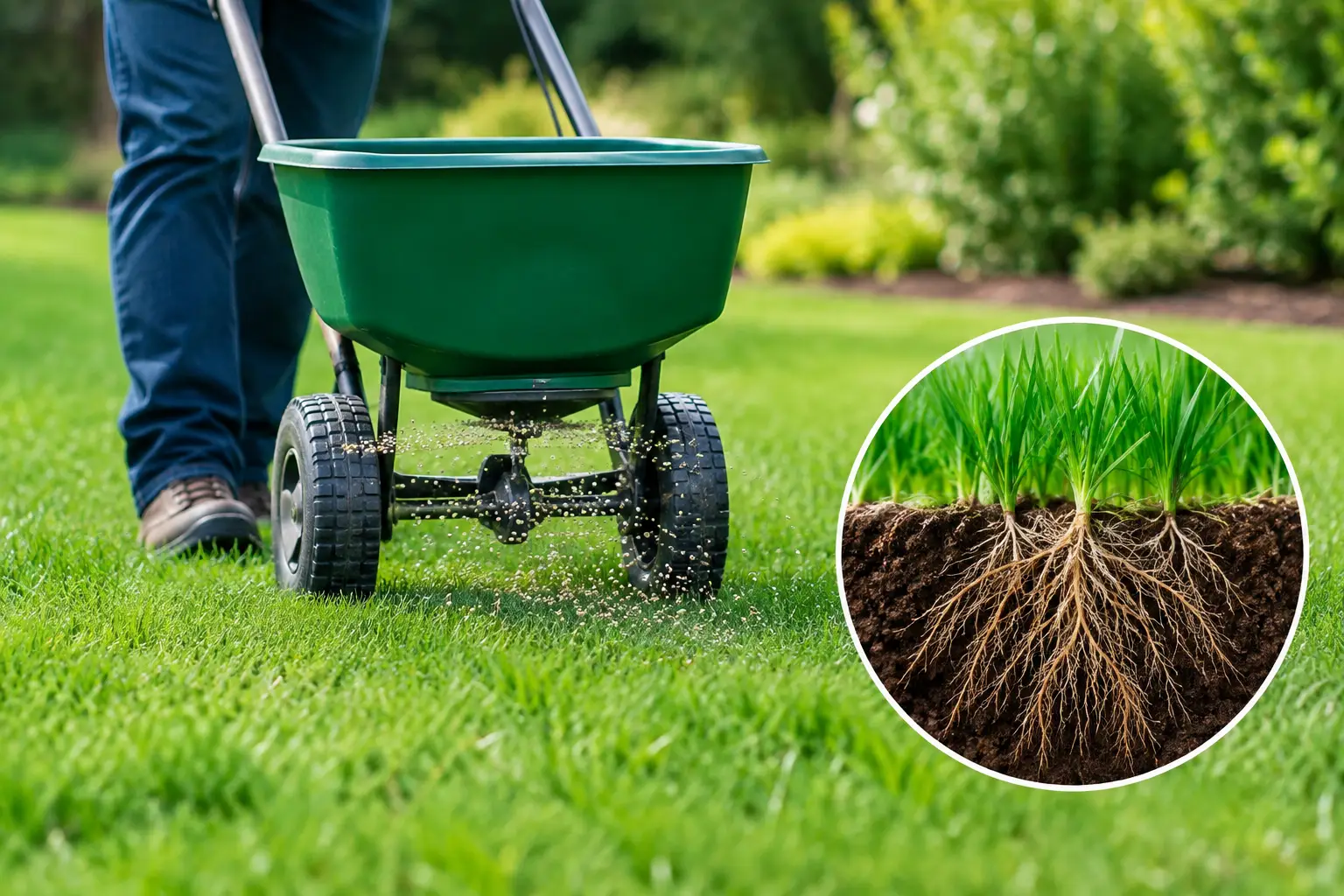
A lawn that greens up quickly but wilts at the first dry spell has usually been fed for leaf growth, not built from below. If you are asking which fertiliser encourages roots, look first at the middle number in the NPK analysis: phosphorus. For new lawns and recently overseeded areas, a balanced fertiliser with slightly higher phosphorus, such as a 6-9-6 pre-seeder feed, is the practical starting point.
That does not mean phosphorus alone creates a deep-rooted lawn. Root development depends on moisture, soil structure, oxygen around the roots and the grass variety as much as fertiliser. The right feed gives young plants access to the nutrients they need at establishment. Good ground preparation gives those roots somewhere to go.
Which fertiliser encourages roots best?
For lawn establishment, choose a pre-seeder fertiliser with a higher phosphorus content than nitrogen, ideally applied into the soil before sowing or used at the recommended rate immediately after sowing. An NPK ratio of 6-9-6 is a sound example. It supplies moderate nitrogen for early leaf growth, elevated phosphorus to support rooting, and potassium for plant strength.
NPK stands for nitrogen, phosphorus and potassium. Each nutrient has a different job:
- Nitrogen (N) drives green leaf growth and chlorophyll production.
- Phosphorus (P) supports early root development, energy transfer within the plant and establishment.
- Potassium (K) helps regulate water use and improves tolerance to wear, drought, cold and disease pressure.
A high-nitrogen spring or summer lawn feed may make grass look greener within days, but it is not the best choice for bare ground or newly germinated seedlings. Too much nitrogen encourages soft, top-heavy growth before the root system has properly anchored. This can make young turf more dependent on frequent watering and more vulnerable to stress.
For an established lawn heading into autumn, the answer changes slightly. A lower-nitrogen fertiliser with useful potassium is often more appropriate than a high-phosphorus starter feed. At this stage, the aim is not to force new roots from seed but to help existing grass harden off, retain water efficiently and withstand winter conditions.
Why phosphorus is useful at sowing
Grass seedlings have limited stored energy. Once germination begins, they need to produce roots quickly enough to reach moisture and nutrients in the surrounding soil. Phosphorus is involved in that energy transfer, which is why it is a standard component of quality pre-seeder fertilisers.
The benefit is most noticeable where soil is low in available phosphorus or where newly cultivated ground has little organic matter. On a new-build garden, for example, the topsoil may be thin, compacted or disturbed by construction traffic. A correctly applied 6-9-6 fertiliser gives seedling roots a measured nutrient supply while the lawn establishes.
There is a limit. Adding more phosphorus than the lawn can use will not produce proportionately deeper roots. It can also be wasteful, particularly where a soil test shows phosphorus levels are already sufficient. Use the product’s stated application rate, spread evenly and avoid applying fertiliser to hard surfaces where it can wash into drains.
Prepare the soil before reaching for fertiliser
Fertiliser is often blamed when grass fails, but soil condition is commonly the real issue. Roots cannot travel through compacted, waterlogged or rubble-filled ground simply because it has been fed.
Before seeding, cultivate the top 75-100 mm of soil where practical, remove stones and building debris, then level and firm the surface. The finished seedbed should be firm enough to walk on without sinking, yet open enough for water and air to move through it. A fine, loose surface layer helps seed make contact with the soil.
If your ground is heavy clay, it may hold water around the root zone for too long. If it is sandy, it may dry rapidly and struggle to retain nutrients. Incorporating suitable organic matter or a quality soil conditioner before sowing can improve structure in either case, but do not overwork wet clay. Smearing and compacting it during preparation creates a problem that fertiliser will not solve.
Soil pH matters too. Lawn grasses generally perform well in slightly acidic to neutral soil, roughly pH 6.0 to 7.0. Outside this range, nutrients may be present but less available to the plant. A basic soil test is more useful than guessing, especially on ground that has been heavily landscaped, imported or neglected for years.
Apply root fertiliser at the right time
For a new lawn, apply pre-seeder fertiliser during final seedbed preparation, working it lightly into the top layer of soil. Alternatively, some products can be applied after sowing, provided the label permits it. Do not bury grass seed deeply. Most lawn seed should sit close to the surface, with only a light covering of soil or dressing where needed.
Early autumn is usually the strongest sowing window in much of the UK. The soil retains warmth from summer, rainfall is often more reliable and annual weeds are less aggressive than in spring. Spring sowing can work well, but it demands closer attention to watering and may coincide with faster weed germination.
After sowing, keep the top surface consistently moist until germination. That means light, regular watering in dry weather rather than occasional flooding. Once seedlings are established, water less often but more deeply to encourage roots to follow moisture down through the profile. Daily shallow watering trains roots to remain near the surface.
On an established lawn, avoid using a pre-seeder feed as a routine monthly fertiliser. Use a seasonal programme instead: a controlled or higher-nitrogen feed during active spring and summer growth, then a lower-nitrogen, higher-potassium feed in autumn. The lawn’s growth stage should determine the fertiliser, not the calendar alone.
Grass variety affects rooting as much as feed
No fertiliser can turn a naturally shallow-rooting grass into a drought-proof lawn. Seed selection sets the potential; nutrition and maintenance help it reach that potential.
Perennial ryegrass establishes quickly and stands up well to family use, while fescues contribute finer texture and can perform well in lower-fertility conditions. Tetraploid ryegrass varieties are valued for their larger seed, rapid establishment and deeper root systems, making them a sensible option where dry summers or hard use are expected.
A mixture is often more dependable than a single species because it spreads the risk. A sunny, well-used lawn needs a different blend from a shaded ornamental area beneath trees. Shade reduces photosynthesis and tree roots compete for both water and nutrients, so simply increasing fertiliser rarely solves thinning turf there.
Common mistakes that weaken lawn roots
The most frequent mistake is applying a strong nitrogen feed to newly sown grass because the lawn looks pale. Young seedlings need time to establish. If they have been given a suitable pre-seeder fertiliser, focus first on moisture, mowing correctly and protecting them from traffic.
Cutting too low is another root-limiting habit. Grass leaves capture energy for the whole plant, including its root system. Once a new lawn reaches mowing height, take only the top third of the leaf at the first cut and use a sharp mower. Gradually reduce to the appropriate height over subsequent cuts rather than scalping tender grass.
Compaction also deserves attention. On established lawns, aeration in suitable conditions allows air, water and nutrients to reach the root zone. It is particularly worthwhile where children, pets, regular footfall or machinery have sealed the surface. Follow aeration with appropriate seasonal feeding, not a blanket dose of starter fertiliser.
Finally, do not mistake moss for a lack-of-fertiliser problem. Moss thrives where grass is weak due to shade, dampness, poor drainage, compaction or close mowing. Killing the moss may clear the surface, but correcting the underlying condition is what gives grass roots the chance to reclaim the area.
For dependable establishment, treat fertiliser as one part of the job: use a measured 6-9-6 pre-seeder feed, choose seed suited to the site, prepare an open seedbed and water with discipline. That is how a lawn develops roots capable of carrying it through a British summer, not just leaves that look green for a fortnight.