














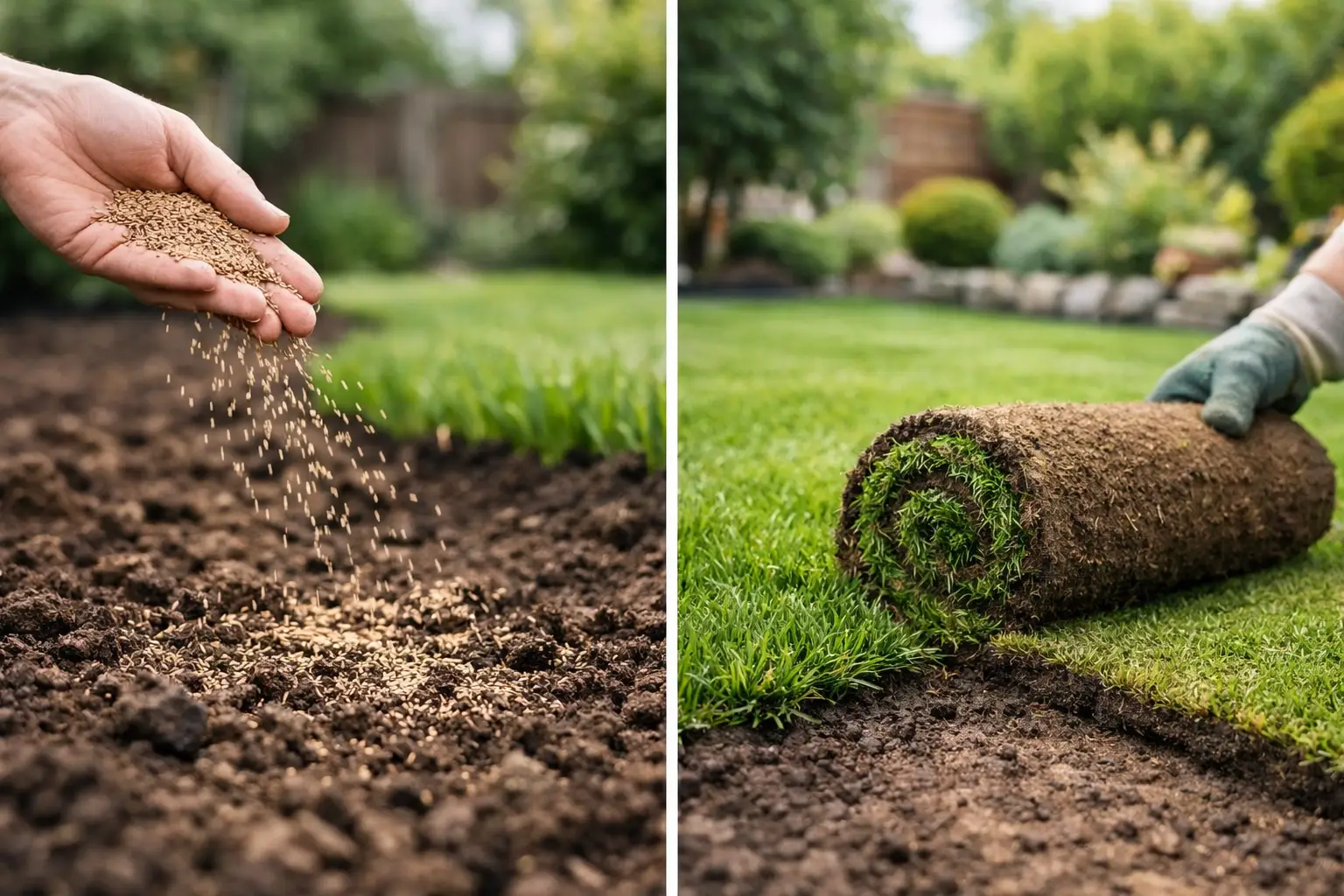
A newly levelled garden can look deceptively simple: bare soil, a boundary fence and a clear decision to make. Should it be a seed or turf lawn? The answer is not merely a question of speed. It depends on how the lawn will be used, the condition of the soil, the time of year and how much aftercare you can realistically provide during the first six to 12 weeks.
Turf gives an instant green finish, which matters on a completed landscaping project or a family garden that needs to look presentable quickly. Seed costs less, offers more choice in grass species and often establishes a better long-term fit for the site when the correct mixture is selected. Both can produce a dense, hard-wearing lawn. Both can also fail if laid or sown onto poorly prepared ground.
Seed or Turf Lawn: The Practical Difference
The central difference is establishment. Turf is mature grass, grown elsewhere, cut with a thin layer of rootzone and laid on your prepared soil. It provides immediate cover, helping to reduce soil erosion and suppressing some annual weeds from day one. However, it is not instantly established. The roots must grow down from the turf into the ground beneath it, and that process relies on moisture, soil contact and suitable temperatures.
Seed begins its life in your garden. It germinates, develops its first roots and adapts directly to the soil profile it will grow in. This takes longer, but it allows a tailored approach. A sunny family lawn may need dwarf perennial ryegrass for wear tolerance, while a lightly used ornamental area may benefit from a finer fescue-led blend. For difficult conditions, such as partial shade or dry, free-draining ground, specialist seed mixtures give you options that standard turf does not always provide.
For most UK gardens, seed is best sown in spring or early autumn. Autumn is often the stronger window because the soil remains warm after summer, while cooler air reduces moisture stress. Weed germination is also generally less aggressive than it is in late spring. Turf can be laid through much of the year, provided the ground is not frozen, waterlogged or baked hard. That longer installation window is one of its strongest advantages for contractors working to a programme.
When Turf Is the Right Choice
Choose turf when time matters more than variety. It is the sensible route for a property sale, a new-build handover, a landscaped garden nearing completion or any site where exposed soil would soon become muddy and untidy. A correctly laid lawn can look finished on the day, although it should not receive heavy use until it has rooted properly.
Turf is also useful on slopes, where seed can be washed away in heavy rain, and on sites exposed to wind. The existing mat of grass protects the surface while roots knit into the soil. That said, turf will not correct poor drainage, compaction or an uneven formation. If water sits beneath the turf, it will remain a weak lawn, however green it appears on installation day.
Quality and freshness matter. Turf should be laid promptly after delivery, especially in warm weather. Rolls left stacked for too long generate heat, yellow at the centre and lose vigour. Lay them in a staggered brickwork pattern, butt the edges together without stretching them, and use boards to work from rather than walking repeatedly on the new surface.
Watering is the critical task. The aim is to wet the turf and the soil beneath it, not simply dampen the leaf. Lift a corner after watering: if the ground below is dry, the job is incomplete. In dry spells, newly laid turf may need thorough watering daily for the first week, then less frequently but more deeply as roots begin to move down.
Turf has a higher upfront cost because you are paying for growing, harvesting, handling and delivery, as well as the material itself. There can also be more waste on irregular gardens with tight curves, narrow borders or numerous obstacles. On a straightforward rectangular lawn, installation is fast. On a complex garden, seed can be more economical and easier to distribute accurately.
When Seed Is the Better Investment
Seed is the stronger choice when you want control over the finished lawn. This is particularly relevant where the lawn has a specific job to do. A children’s play area, a dog-friendly garden and a frequently used access route need a hard-wearing blend with ryegrass. A front lawn that is mostly viewed rather than walked on can prioritise finer texture and appearance. Areas beneath trees need a mixture with species that can tolerate reduced light and root competition.
It is also the practical option for large areas and for repairing existing turf. Overseeding allows you to introduce new grass plants into thin or worn ground without removing the whole lawn. This is often more cost-effective than lifting and replacing turf, provided the underlying issue has been addressed. Moss, compaction, persistent shade, poor drainage and close mowing will all continue to thin a lawn if left untreated.
Germination times vary with soil temperature, weather and species. In suitable spring or autumn conditions, a vigorous tetraploid ryegrass blend can show germination in around 7-14 days. Fine fescues may take longer, and cooler soil will slow every mixture down. Do not mistake slow emergence for failure too early. Keep the surface consistently moist, protect it from birds where practical and avoid walking on it until seedlings have rooted.
The initial appearance of a seeded lawn is less uniform than turf. Some species emerge faster than others, and bare patches may need a light second sowing. That is normal establishment work, not a defect. With good seed-to-soil contact and measured watering, seedling density builds over successive cuts.
Preparation Decides the Result
Whether you lay turf or sow seed, spend most of the effort below ground. A quality lawn needs at least 100-150mm of workable, reasonably stone-free topsoil, shaped to drain away from buildings. The finished level should sit below paving and thresholds, allowing for the thickness of turf where applicable.
Remove perennial weeds before cultivation. Couch grass, bindweed and brambles are not solved by burying them under fresh topsoil. Where a total herbicide is used for clearance, follow the product label carefully and allow sufficient time before cultivation or sowing. Do not apply selective lawn weedkiller to newly sown grass or newly laid turf: young plants are more vulnerable than established lawns.
Cultivate compacted ground, then rake out large stones and debris. Avoid overworking wet clay, which smears into dense clods that restrict drainage and rooting. On light, sandy soils, incorporate suitable organic matter to improve moisture retention. On heavy ground, focus on structure and drainage rather than adding sand without calculation. A thin layer of sand mixed badly into clay can create a dense, concrete-like layer.
Once levelled, firm the ground by treading or rolling lightly, then rake again to create a fine, even tilth. The surface should be firm enough that a heel leaves only a shallow impression. Seed needs close contact with soil; turf needs a flat bed without hollows that later scalp under the mower.
A pre-seeder fertiliser can support early root development when used at the specified rate. A balanced 6-9-6 formulation supplies nitrogen for early leaf growth, phosphorus for rooting and potassium for plant resilience without forcing soft, excessive growth. Apply it evenly and incorporate it lightly into the surface before sowing, or use as directed after sowing. More fertiliser is not better. Over-application can scorch young grass and create uneven growth.
The First Mow and the First Season
A new lawn is not ready for normal use just because it is green. Seeded grass should receive its first cut when it reaches roughly 50-75mm, using a sharp mower set high enough to remove no more than one-third of the leaf. Turf should be mown once it has rooted, which you can check by gently lifting a corner. If it resists, roots are beginning to establish.
Keep mowing high during the first season. A 40-50mm cut supports stronger roots and provides more leaf area for photosynthesis. Cutting very low may look tidy for a few days, but it weakens young plants, exposes soil to drying and gives moss an opportunity in shaded areas.
For a seeded lawn, light foot traffic may be possible after the first few cuts, but postpone football, garden furniture and regular dog activity until the grass has thickened. For turf, rooting generally takes two to four weeks in favourable conditions, though the lawn needs longer to build resilience against repeated wear.
Cost, Speed and Long-Term Value
Turf wins on immediate visual impact and installation speed. Seed wins on initial material cost, species choice and suitability for large or awkwardly shaped areas. Neither is automatically the premium option. The premium result comes from matching the grass to the site, preparing the rootzone correctly and maintaining it with sensible mowing, feeding and watering.
For a trade-standard finish, do not let the deadline dictate the grass choice. A lawn installed quickly but placed on compacted, uneven soil will cost more in repair work later. Equally, a carefully chosen seed mixture can outperform generic turf where shade, drought, wear or fine appearance are the defining conditions.
Ransley Pro Grow supplies professional-grade seed mixtures and establishment products for both routes, but the best starting point is always an honest assessment of the ground. Measure the area, inspect drainage after rain and decide how the lawn will be used. That small amount of planning is what turns bare soil into a lawn that still performs after its first winter.