














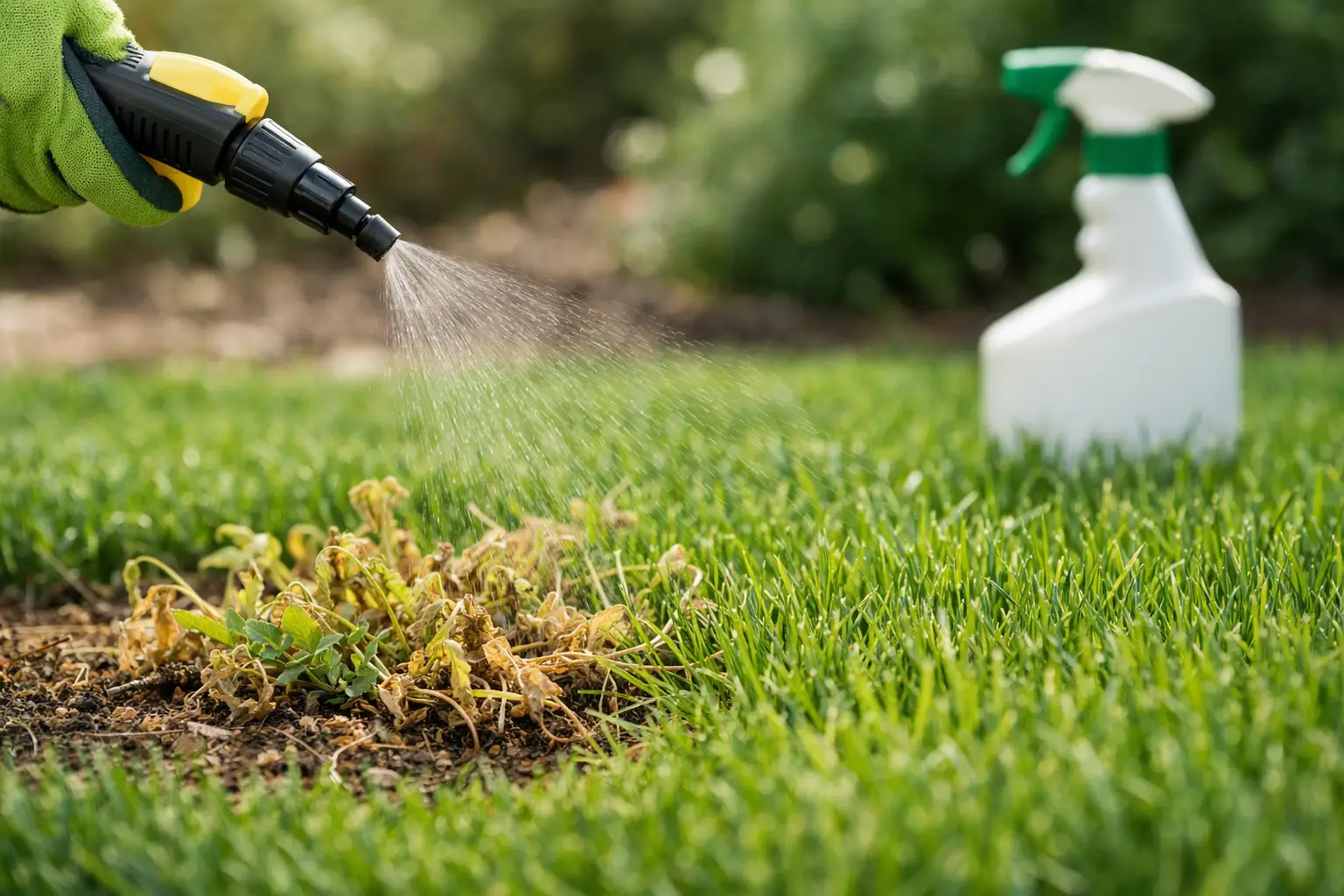
You spot a flush of dandelions, clover or plantain in an otherwise decent lawn, reach for a weed killer, and then hesitate. Will weed killer kill grass? The honest answer is yes, some will - and some are specifically designed not to. The difference comes down to the active ingredient, whether the product is selective or total, and how accurately it is applied.
That distinction matters more than most gardeners realise. Lawn grasses and lawn weeds are both plants, but they do not all respond to herbicides in the same way. A product that clears broadleaf weeds from a ryegrass and fescue lawn can work very differently from one intended to strip all vegetation from a driveway edge or building site.
Will weed killer kill grass in a lawn?
If you apply a total herbicide to turf, it will usually kill the grass along with the weeds. These products are non-selective. They are formulated to control most green, growing plants and are best reserved for hard surfaces, fence lines, bed preparation and full lawn renovation where complete kill-off is the goal.
By contrast, a selective lawn weed killer is designed to target broadleaf weeds while leaving established grass largely unharmed. This is the type used for common lawn invaders such as daisies, dandelions, white clover and buttercups. The chemistry exploits the biological differences between broadleaf plants and narrow-leaved grasses.
That said, selective does not mean impossible to damage grass. Over-application, spraying in unsuitable weather, treating stressed turf, or using the wrong product on the wrong grass species can still lead to yellowing, temporary checking of growth, or patchiness.
The difference between selective and total weed killers
This is where most confusion starts. If the label says total, non-selective or complete vegetation killer, assume it will damage or destroy grass. Products in this category are not for routine lawn weed control.
Selective herbicides are a different tool entirely. They are specially formulated for use on lawns and grassed areas, where the aim is to remove broadleaf competition without sacrificing the sward. Many professional lawn formulations combine more than one active ingredient to widen the weed spectrum and improve control of mature or waxy-leaved weeds.
There is also a third category worth mentioning: feed, weed and moss products. These are multi-action lawn treatments that combine fertiliser with selective herbicides and, in some cases, iron for moss suppression. Used properly, they can tidy a tired lawn efficiently. Used badly, particularly in hot weather or on drought-stressed grass, they can produce scorch or uneven colour.
Why grass sometimes dies after weed killer
When a customer says the weed killer killed the grass, the cause is often not the fact that they used weed killer at all, but that one of several practical errors crept in.
The first is simply using the wrong chemistry. A glyphosate-based product, for example, is not a lawn-selective herbicide. It is intended for total vegetation control. If that goes onto grass foliage, the grass will absorb it.
The second is rate. Herbicides are tested and approved at specific dilution rates and application volumes. More is not better. Exceeding the label rate can overwhelm the grass tolerance built into a selective product.
The third is timing. Grass that is struggling with frost, drought, waterlogging, disease pressure or recent mowing is less able to tolerate treatment. Young grass is especially vulnerable. Newly seeded lawns and fresh turf need time to establish before any herbicide is considered.
The fourth is application quality. Overlapping passes with a sprayer, applying granules unevenly, or letting drift carry product into beds and borders can all create visible damage. In lawn care, calibration matters.
When selective weed killer is safe for grass
A selective lawn weed killer is generally safe for established turf when the grass is actively growing, the soil has reasonable moisture, and temperatures are moderate. In the UK, that usually means spring into early autumn, avoiding very hot spells and cold snaps.
The grass should have enough leaf to metabolise the treatment and enough root strength to recover from any temporary stress. As a rule, a lawn should be well established, not newly germinated, and not cut immediately before or after treatment unless the product label advises otherwise.
Healthy turf also resists weed ingress better after treatment. Once the weeds thin out, grass can tiller into the space if fertility, moisture and mowing are in order. This is one reason trade-standard lawn care rarely stops at weed control alone. If the lawn is thin, compacted or underfed, weeds often return because the underlying weakness remains.
When weed killer is likely to harm grass
There are a few situations where caution is sensible.
If the lawn was seeded recently, hold off. Young grass plants have limited root mass and can be badly checked by herbicides that established turf would tolerate. The same applies to newly laid turf that has not properly rooted into the soil below.
If the lawn is under drought stress, postpone treatment until moisture returns and growth resumes. Herbicide uptake and plant response become less predictable in dry conditions. You may get poorer weed control and more turf stress in the same pass.
If moss is the real problem, a standard weed killer will not solve it. Moss needs a different approach, usually involving iron treatment, scarification, and correction of shade, drainage or compaction. Throwing the wrong product at the lawn tends to waste time and money.
And if you are dealing with a neglected patch full of coarse weeds, bare ground and weak grass, there comes a point where selective treatment is less efficient than full renovation. In that case, a total herbicide may be appropriate, followed by soil preparation, pre-seeder fertiliser and a quality seed blend suited to the conditions.
How to avoid damaging your lawn
The label is not small print to ignore. It is the operating manual. Check whether the product is selective or total, which weeds it controls, whether it suits your grassed area, and any restrictions around newly sown lawns, pets, children or rainfast periods.
Apply only to a dry leaf with suitable soil moisture beneath. That sounds contradictory, but it is not. You want the foliage dry enough for adhesion and uptake, without the lawn itself being parched.
Keep your spreader or sprayer calibrated. Professionals do not guess output, because uneven application is one of the fastest ways to stripe or mark a lawn. Granules should go on evenly. Liquid sprays should be applied at a steady walking speed with no overlap heavy enough to double-dose the turf.
It also helps to leave enough leaf on the weed for the herbicide to work. Scalping the lawn just before treatment reduces target area and can increase stress on the grass.
What if you have accidentally killed the grass?
If a non-selective product has hit part of the lawn, there is rarely a chemical undo button. The practical route is to wait and assess the extent of damage. Grass may yellow first, then brown off over one to three weeks depending on product and growing conditions.
For small patches, rake out the dead material, loosen the surface, and overseed with a suitable lawn seed once the herbicide has finished acting. A pre-seeder fertiliser can help root development, particularly where the soil is tired or disturbed.
For larger areas, it is worth asking whether the patch failed because the herbicide drifted, because application rates were too high, or because the lawn was already weak. Repairing the symptom without correcting the cause often leads to another patchy result six weeks later.
A practical repair programme usually means three steps done properly: prepare the surface, seed with a blend matched to sun, shade or wear, and feed at the correct rate. Good recovery is not just about getting green back quickly. It is about rebuilding density so weeds have less room to return.
A better way to think about lawn weed control
The useful question is not simply will weed killer kill grass, but which weed killer, on which lawn, at what stage of growth. That is how groundsmen and experienced landscapers avoid expensive mistakes.
A strong lawn is always easier to treat than a weak one. Dense turf crowds out weed seedlings, balanced feeding supports recovery, and appropriate seed selection improves long-term performance. Fine fescues behave differently from hard-wearing ryegrass mixtures, and a shaded back garden needs a different strategy from a sunny front lawn.
For many UK lawns, the best results come from a measured approach: control weeds with a selective product when conditions are right, improve vigour with seasonally appropriate fertiliser, and overseed thin areas before they become open invitations for fresh weed growth. That is the steady, trade-standard method - less dramatic than quick fixes, but far more reliable over a full season.
If you are ever unsure, pause before you spray. A lawn usually forgives slow, careful decisions far more readily than fast ones made with the wrong bottle.