














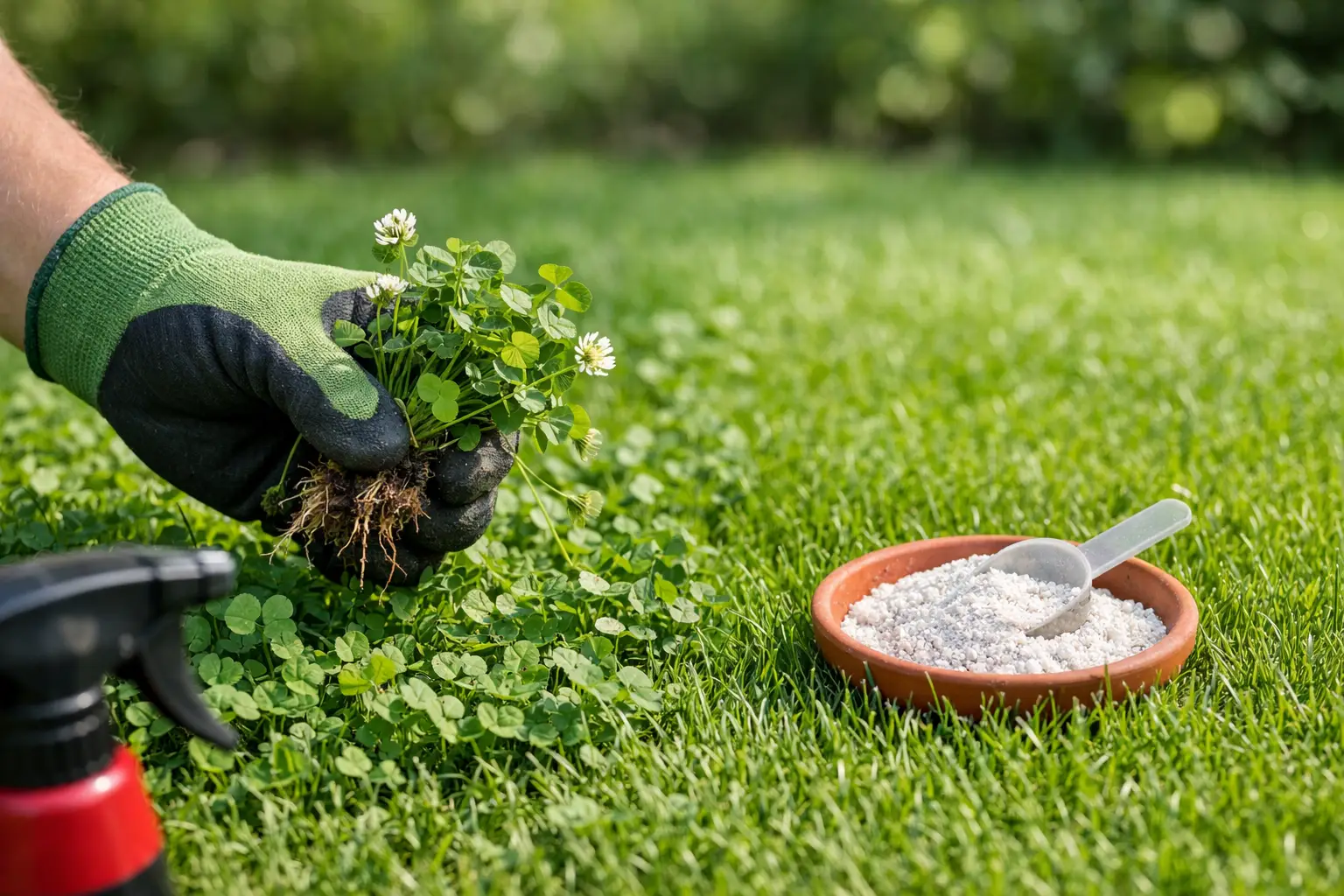
White clover spreading through a lawn is rarely just a weedkiller problem. It is usually a sign that the grass is thin, underfed, compacted or being cut too close. If you are asking what kills clover not grass, the direct answer is a selective broadleaf lawn weedkiller approved for use on established turf. The longer-term answer is to remove the clover, then correct the conditions that allowed it to take hold.
What kills clover not grass?
Clover is a broadleaf perennial, while lawn grasses are narrow-leaved monocot plants. This difference is what allows a selective herbicide to control clover without killing suitable turfgrass species. The key word is selective. A total weedkiller containing glyphosate will kill both clover and grass, so it is the wrong tool for a lawn you intend to keep.
Look for a lawn weedkiller specifically labelled for clover control on established grass. Active ingredients commonly found in selective broadleaf weedkillers include MCPA, mecoprop-P, 2,4-D and fluroxypyr. Different formulations vary in their effectiveness, permitted uses and application timings, so the product label is the working instruction, not a suggestion.
A good selective treatment moves into the clover through its leaves and down into the root system. You may see the plant twist, yellow or lose colour before it dies back. This is normal. It is not an instant burn-off treatment, and it should not be judged after a day or two.
Why grass survives a selective weedkiller
Established lawn grasses can metabolise certain active ingredients at a rate that broadleaf weeds cannot. Clover absorbs the treatment and gradually fails, while properly established ryegrass, fescue and smooth-stalked meadow grass remain unharmed when the product is used exactly as directed.
That protection has limits. Newly sown grass, stressed turf, lawns suffering drought and recently scarified areas can be more vulnerable. Never assume that a product safe for a mature lawn is safe for a lawn that germinated three weeks ago.
Choose the right treatment for the lawn stage
The best product depends on whether the lawn is mature, newly established or due for renovation.
For a mature lawn with scattered white clover, a dedicated selective liquid weedkiller is usually the most precise option. It allows targeted coverage and is particularly useful where clover sits in patches rather than across the full lawn. Apply evenly to the leaves, rather than soaking the soil or spraying indiscriminately over borders.
For a lawn with clover, moss and weak colour, a granular multi-action treatment can be practical. These products may combine a selective weedkiller, fertiliser and moss control. The trade-off is timing: a multi-action feed is not suitable simply because weeds are visible. Applying extra nitrogen during a hot, dry spell or late in the season can create more mowing, softer growth and unnecessary stress.
For a lawn that needs reseeding, deal with the clover first and allow the herbicide interval stated on the label before sowing. Many selective weedkillers require a waiting period before overseeding. Ignore that interval and the new grass may establish poorly, leaving exactly the open ground that clover exploits.
Apply when clover is actively growing
In most UK lawns, late spring and early autumn are the most reliable treatment windows. Clover must have enough leaf area and be actively growing to take in the herbicide. A mild, dry day with little wind is preferable.
Avoid treatment during drought, frost, waterlogging or prolonged heat. Stressed clover does not translocate herbicide efficiently, and stressed grass is less able to recover from any temporary check. Do not spray before heavy rain, either. Rain soon after application can wash treatment from the leaf before absorption.
Mowing matters as well. Give the lawn a few days without mowing before application so the clover has sufficient foliage, then leave it uncut afterwards for the period specified on the label. Scalping the lawn immediately before treatment removes the very leaf surface needed for effective control.
Use a calibrated sprayer or watering-can applicator designed for lawn chemicals, and apply the stated rate. More concentrate does not mean better control. Over-application can mark turf, increase the risk to nearby plants and breach the product instructions.
Protect borders, children and pets
Selective does not mean harmless to every plant. The same chemistry that controls clover can damage roses, vegetables, shrubs and other broadleaf plants. Keep spray away from beds and ponds, do not apply in wind, and wash application equipment thoroughly after use.
Follow all label instructions on personal protective equipment, storage, re-entry and pet access. Keep children and pets away until the treated area is dry, or for longer where the label requires it. Also check whether grass clippings should be composted after treatment. Some herbicide residues can damage sensitive plants if treated clippings are used as mulch.
Why clover keeps returning
Clover has a useful biological advantage: as a legume, it works with bacteria in its roots to obtain nitrogen. In a hungry lawn, grass slows down while clover can continue to compete. That is why clover is often most obvious on pale, sparse turf rather than thick, well-managed grass.
Compaction is another common cause. Thin soils, heavy footfall, children’s play areas and repeated mowing in the same pattern can reduce air and water movement around grass roots. Clover is low-growing and quick to colonise gaps. Killing the visible plants without improving the turf simply creates room for new seedlings or surviving runners.
Mowing too low also favours clover. Most domestic lawns perform better when cut around 35-50 mm, with the higher end sensible in dry weather, shade or on newly recovering turf. A slightly taller sward shades the soil, supports deeper roots and reduces light reaching weed seedlings.
Rebuild grass density after clover control
Once the clover has died back and the label interval has passed, help the grass reclaim the space. Rake out dead material lightly, especially if the lawn is already thin. If soil is compacted, aerate when conditions are suitable. Hollow-tine aeration is particularly effective on heavy ground, while solid-tine aeration can provide a useful lighter intervention.
Overseeding is the practical next step where bare patches are visible. Use a seed mixture that matches the lawn’s conditions rather than buying on price alone. A hard-wearing ryegrass and fescue blend suits family lawns and regular traffic, while a fine fescue-led mix is better for lower-wear ornamental turf. In shade, choose a shade-tolerant formulation rather than expecting a sun-loving ryegrass mix to solve the problem.
Seed-to-soil contact is critical. Mow, remove clippings, rake or scarify lightly, spread seed evenly and keep the surface consistently moist through germination. A vigorous tetraploid ryegrass blend can establish in around 7-14 days in suitable conditions, helping fill gaps quickly, though cooler temperatures and dry weather will slow progress.
Feed according to season and need. A balanced pre-seeder fertiliser such as a 6-9-6 analysis supports root development around new grass without forcing excessive top growth. Established lawns generally benefit from a higher-nitrogen spring or summer feed when growth conditions are favourable, then a lower-nitrogen, higher-potassium feed in autumn to strengthen roots ahead of winter.
Should you remove clover at all?
Not every lawn needs to be clover-free. Clover can support pollinators, stays green in dry periods and fixes nitrogen. For a relaxed family garden or wildlife-minded patch, a small amount may be entirely acceptable.
However, if the objective is a uniform, hard-wearing lawn for presentation, play or professional maintenance, clover competes with the desired grass cover and disrupts the finish. In that case, selective control followed by overseeding and sound feeding is the dependable route. Ransley Pro Grow’s approach is simple: treat the symptom accurately, then build the turf density that prevents a repeat.
A selective weedkiller will remove existing clover, but dense grass is what keeps the lawn looking like a lawn. Treat at the right time, respect the label, and give the grass enough roots, nutrition and leaf cover to win the next competition.