














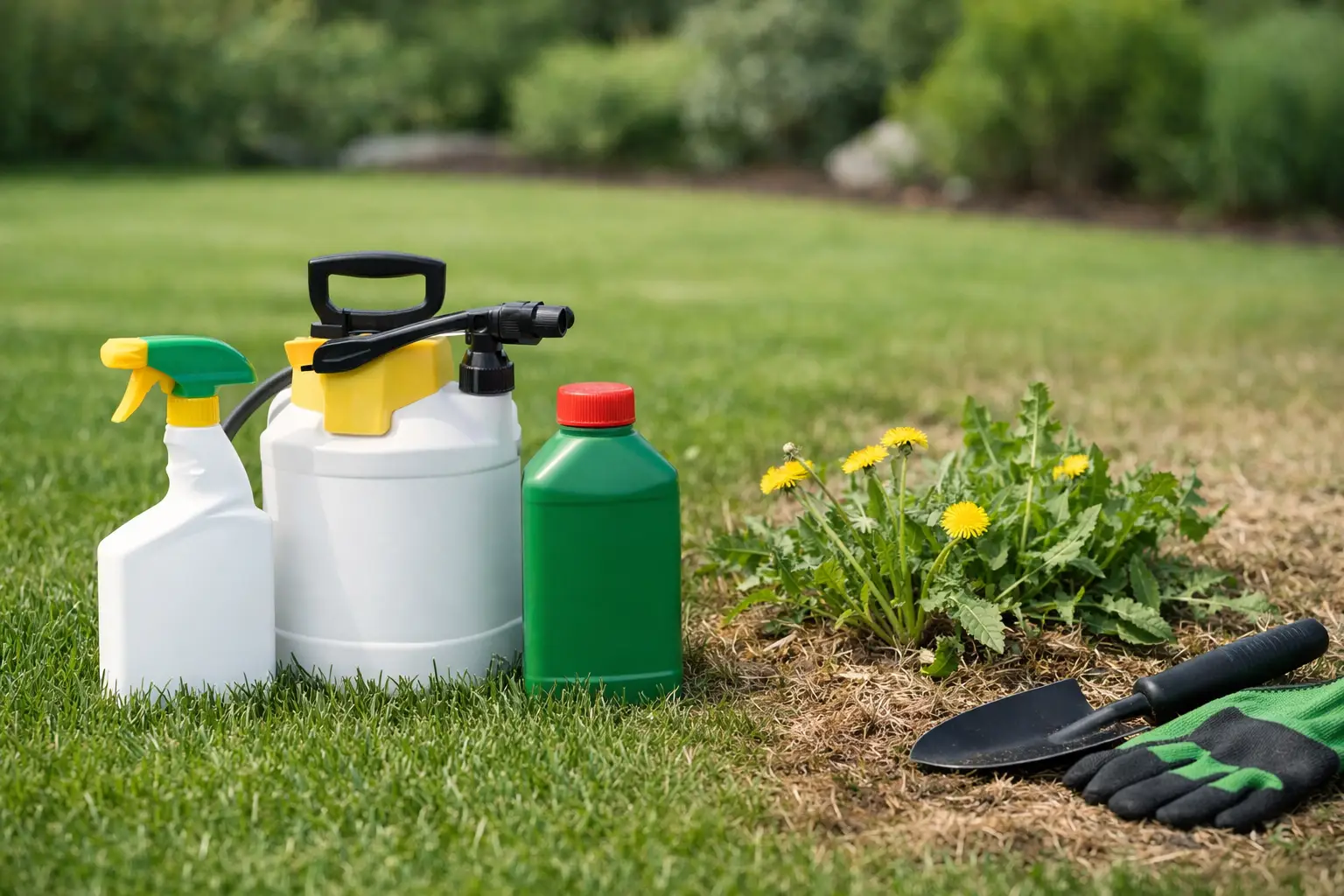
A weedkiller product review should begin with one question: what are you trying to remove, and where is it growing? A dandelion in an established lawn needs a very different treatment from weeds pushing through block paving or a neglected border due for clearance. Choose the wrong chemistry and the result can be disappointing at best, or a damaged lawn at worst.
For homeowners and contractors, the most useful way to assess weedkillers is not by the size of the bottle or the boldness of the claim. It is by active ingredient, selectivity, formulation, application window and the condition of the turf beneath it. The right product is one that solves the stated problem without creating another.
Weedkiller product review: the main treatment types
There are three broad categories worth separating before comparing individual products: selective lawn weedkillers, total herbicides and granular combination treatments. Each has a proper place in a lawn care programme.
Selective lawn weedkillers
Selective herbicides are engineered to control broadleaf weeds while leaving established grasses largely unaffected when used as directed. They are the correct choice for lawns carrying dandelions, daisies, clover, plantain, buttercups, selfheal and similar weeds.
Most professional-style selective products use a blend of active ingredients rather than one chemical alone. This matters because lawn weeds vary in their susceptibility. Clover may respond differently from ribwort plantain, for example, so a broad-spectrum selective formulation generally gives more dependable coverage than a narrow, single-purpose treatment.
The chief advantage is obvious: you can treat weeds without sacrificing the lawn. The trade-off is patience. These products work through active growth, often taking days or weeks to show a complete effect. Tough perennial weeds may need a follow-up application within the label limits, particularly where mowing, drought or poor fertility has weakened the grass and allowed weeds to establish deeply.
A selective weedkiller is not a cure for thin turf. If the lawn is open, compacted or starved of nutrients, new weed seed will continue to find bare soil. Control the existing weeds, then address the underlying cause with suitable feeding, aeration and overseeding.
Total herbicides for hard surfaces and clearance
Total herbicides, commonly based on glyphosate, are non-selective. They are designed to kill green vegetation they contact, including lawn grass. That makes them highly effective for clearing unwanted growth from paths, driveways, fence lines, gravel areas and beds before renovation, but entirely unsuitable for spot-treating weeds in turf.
Their strength is thoroughness. Applied to healthy, actively growing foliage, a systemic total herbicide travels into the plant and root system. This gives it a clear advantage over simply scorching the leaves of established perennial weeds. For clearing ground before sowing a new lawn, it can be the sensible route, provided enough time is allowed for the product to work and for all label instructions to be followed.
The limitation is precision. Spray drift onto a lawn edge, shrub or ornamental plant can cause injury. Use a calm day, a coarse spray pattern where appropriate, and protect nearby desirable plants. More product does not make a treatment more effective. Accurate dilution and complete leaf coverage are what count.
Granular weed, feed and moss treatments
Combination granular treatments appeal because they tackle several visible lawn problems in one pass. A product such as Renovator Pro combines fertiliser, selective weed control and moss control, making it useful where turf is carrying broadleaf weeds, moss and a general lack of vigour.
This is a practical option for a lawn that needs renovation rather than isolated spot treatment. The fertiliser component supports grass recovery, while the weedkiller and moss control reduce competition. High-iron ingredients used for moss control can blacken moss quickly, after which it should be raked out once dead and dry enough to remove. That opens the surface for light, air and grass growth.
However, multi-action products are not automatically the best value for every lawn. If there is no moss, a dedicated selective weedkiller and a seasonally appropriate fertiliser may be more precise. Likewise, if only a few dandelions are present, spot treatment avoids applying herbicide across the entire lawn.
What separates a good lawn weedkiller from a poor choice
A good product is not simply the strongest one. It is correctly matched to the weed, the surface and the season.
First, check whether the target is a broadleaf weed or a grass-like weed. Selective lawn herbicides are generally intended for broadleaf weeds. They will not reliably remove coarse grasses, couch grass or annual meadow grass from a fine lawn because those plants are grasses too. Removing unwanted grass species often requires physical removal, careful localised use of a total herbicide, or renovation of the affected area.
Second, consider the lawn’s age. Newly sown grass is more vulnerable than mature turf. Many lawn weedkillers have a stated waiting period before use on new grass, often until the lawn has established and been mown several times. Applying too early can check establishment or thin the sward. This is especially relevant after using fast-establishing ryegrass blends, where visible germination in 7-14 days is not the same as full tolerance to herbicide treatment.
Third, judge conditions rather than the calendar alone. Herbicides perform best when weeds are actively growing, temperatures are moderate and rain is not imminent. A lawn stressed by drought, frost, waterlogging or recent close mowing is a poor candidate for treatment. In these conditions, uptake can be weak and the turf may show unnecessary stress.
Finally, look at the formulation. Ready-to-use sprays suit small gardens and isolated weeds. Concentrates are more economical for larger lawns and professional users, but demand careful measuring. Granules are useful for even treatment across a broad area, although they require attention to application rate and often need watering in or application to moist grass, depending on the label.
Application standards that protect the lawn
Most weedkiller failures are application failures. Mowing immediately before or after spraying reduces the leaf area available to take in the treatment. As a general working practice, leave sufficient growth before application and avoid mowing again until the product has had time to move through the plant, following the product label for exact intervals.
Do not treat on windy days, in hot dry spells or when heavy rain is expected before the spray has dried. Keep children and pets away from the treated area for the label-specified period, and never allow spray or granules to enter drains, ponds, watercourses or planted areas. Product labels are legal documents, not optional reading.
For granular treatments, calibration is vital. A spreader that applies unevenly can leave stripes: over-application may mark or scorch turf, while under-application leaves weeds untouched. Measure the lawn area first, set the spreader conservatively and apply in two crossing passes if the product instructions permit. Professionals should record product, rate, weather and treatment date, particularly on contract sites.
When weedkiller is not the first answer
Some weeds indicate a management issue. Daisy and clover can tolerate close mowing and lean soil. Moss points towards shade, compaction, poor drainage, acidity, close cutting or weak grass cover. Plantain commonly thrives in compacted ground. Killing these plants improves appearance, but lasting control comes from correcting the conditions that favour them.
Raise mowing height during stress, sharpen mower blades, feed according to the season and aerate compacted ground. Overseed bare or thin areas promptly so desirable grass occupies the space. A dense, well-rooted lawn is the most reliable long-term weed suppressant available.
Ransley Pro Grow’s approach is to treat weed control as one part of turf management, not a substitute for it. Selective chemistry has an important role, but it performs best alongside sound mowing, nutrition and renovation work.
The verdict: choose precision over convenience
For established lawns with scattered broadleaf weeds, a selective liquid weedkiller remains the most targeted choice. For a lawn carrying moss, weeds and poor colour across a larger area, a properly applied granular multi-action treatment can save time and support recovery. For paths, driveways and full site clearance, a total herbicide is effective only when kept well away from wanted vegetation.
Before opening the container, inspect the lawn closely. Identify the weed, assess the grass, check the weather and read the label from start to finish. That five-minute inspection usually does more for the final result than buying a stronger product.