














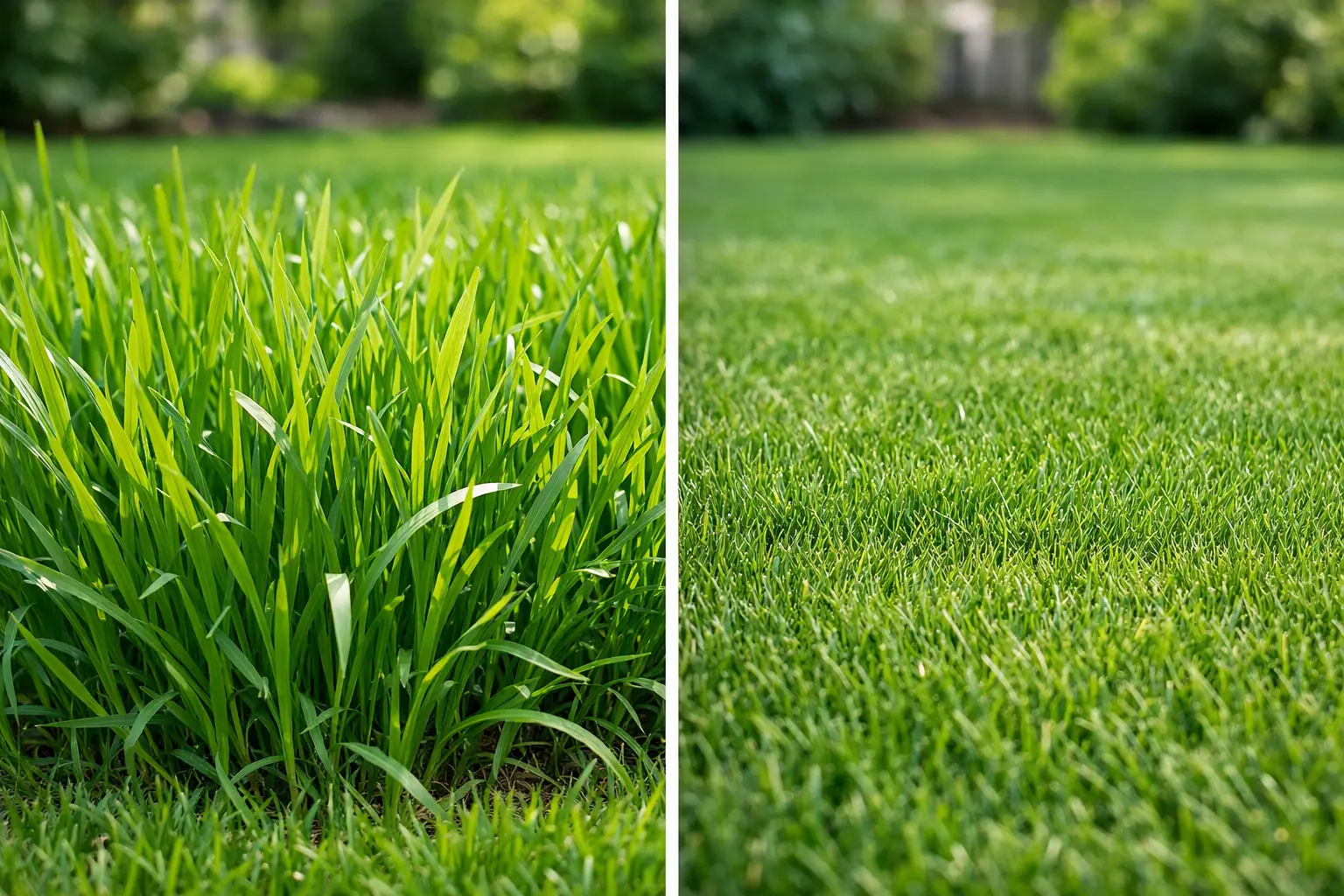
If you are weighing up tetraploid ryegrass vs fescue, you are really deciding what matters most in your lawn - speed, durability, fineness of leaf, drought performance, or a balance of all four. That matters in the UK, where one garden might be baking in full sun by July while another stays damp and shaded well into autumn.
The short answer is this: tetraploid ryegrass is chosen for rapid establishment, strong recovery and hard wear, while fescue is valued for finer appearance, lower input and dependable performance in less-than-perfect conditions. Neither is universally better. The right choice depends on how the lawn will be used, what the soil is like, and how much maintenance you are prepared to give it.
Tetraploid ryegrass vs fescue: what is the real difference?
At species level, these grasses behave differently from the outset. Perennial ryegrass is naturally quick to germinate, vigorous in growth and hard-wearing. Tetraploid ryegrass is a selected form with four sets of chromosomes rather than two, which gives larger seed, broader leaves, strong early vigour and, in many cases, better stress tolerance than standard diploid ryegrass.
Fescue is a broader group. In lawn seed mixtures, you will usually see slender creeping red fescue, strong creeping red fescue, chewings fescue or hard fescue. These are generally finer in leaf, slower to establish and less aggressive than ryegrass, but they earn their place through density, visual quality and their ability to perform with less feeding and less irrigation.
So when comparing tetraploid ryegrass vs fescue, think less in terms of winner and loser and more in terms of use case. One is engineered for quick results and traffic. The other is often selected for refinement and efficiency.
Germination and establishment speed
This is where tetraploid ryegrass makes its first strong case. Under suitable soil temperatures and with consistent moisture, it can establish in roughly 7 to 14 days. That speed is useful when you are repairing worn sections, filling dog damage, renovating after scarifying, or trying to secure bare soil before weeds move in.
Fescue is slower. It does not usually give the same instant visual response, and that can test the patience of homeowners expecting a fast green-up. For contractors, it also means a longer window before the sward looks fully knitted together.
That slower start is not a fault, just a trait. Fescue tends to build more gradually, and once established it can produce an attractive, even surface. If speed is the first requirement, ryegrass has the advantage. If the brief is a finer ornamental finish and the client can wait, fescue remains a sound choice.
Appearance and leaf texture
If your eye goes straight to striped lawns, crisp mowing lines and a finer finish, fescue usually comes out ahead. Its narrower leaf blade gives a more refined look than ryegrass, particularly in mixed lawns managed at slightly lower mowing heights.
Tetraploid ryegrass is not coarse in the agricultural sense when bred for lawns, but it is still typically more substantial in leaf than the finer fescues. That can be an advantage on family lawns because it brings visual density and substance quickly. It can also mean the lawn looks stronger and greener sooner after sowing.
The trade-off is simple enough. Fescue often wins on delicacy of appearance. Tetraploid ryegrass tends to win on impact and speed.
Wear tolerance and recovery
For lawns that are lived on rather than admired from the patio, ryegrass is hard to ignore. Children, pets, repeated footfall, garden furniture and regular entertaining all put stress on the crown of the plant. Ryegrass generally tolerates that pressure better and recovers faster after damage.
Tetraploid ryegrass is especially useful where rapid recovery matters. Because it establishes quickly and grows away strongly, it can help keep the surface covered instead of leaving thin areas exposed. On high-use domestic lawns and light commercial spaces, that is often more valuable than having the finest possible leaf.
Fescue can cope with moderate use, particularly in a well-balanced blend, but on its own it is not the first choice for sustained wear. It is better suited to lawns where appearance, lower feeding and general resilience matter more than repeated heavy traffic.
Drought tolerance and summer performance
This is where the conversation gets more nuanced. Fescues have long been valued for lower input management and their ability to cope with dry, lean soils. Many fescue species continue to perform respectably where fertility is modest and watering is limited.
That said, tetraploid ryegrass has improved the ryegrass side of the argument. Better root development and stronger vigour can give it genuine drought resilience compared with older ryegrass types. On well-prepared ground, it can hold colour and recovery well through periods of summer stress.
Still, drought tolerance is never just about species. Soil depth, organic matter, mowing height and nutrition all influence results. A fescue on compacted, shallow ground may struggle more than a ryegrass on properly cultivated, well-fed soil. Species choice matters, but preparation matters just as much.
Shade, fertility and maintenance demands
Fescue generally asks for less. It is often more comfortable on lower fertility sites and can suit gardeners who do not want an intensive feeding programme. Certain fescues are also more comfortable in partial shade than ryegrass, though no lawn grass truly thrives in dense, permanent darkness.
Tetraploid ryegrass tends to respond well to a more active programme. If you want the lawn to establish quickly, stay richly coloured and recover from wear, it helps to support it with sensible nutrition. A pre-seeder fertiliser before or just after sowing encourages root development, then seasonal feeding helps sustain performance through spring, summer and autumn.
So the question is not only what grass do you want, but what maintenance regime can you realistically keep up. There is little point choosing a high-performance seed and then starving it of nutrients.
Disease resistance and seasonal reliability
Modern tetraploid ryegrass varieties are often selected with disease resistance in mind, which is useful during establishment and in periods of stress. A vigorous plant with decent root development is usually better placed to grow through minor setbacks.
Fescue is also valued for steady, reliable performance, especially in less intensively managed lawns. Because it does not demand the same high-input approach, it can remain surprisingly dependable where feeding is occasional and mowing is sensible.
In practical terms, both can perform well in the UK climate if the seed is matched to the site. Waterlogging, compaction and nutrient imbalance will create more trouble than the name on the seed bag.
When tetraploid ryegrass is the better choice
If you need a lawn to establish quickly, recover from wear and look presentable in short order, tetraploid ryegrass is usually the stronger candidate. It suits new family lawns, renovation work, overseeding after scarification, and any site where bare patches need covering fast.
It also makes sense where durability matters more than a show-bench finish. For contractors, that speed and reliability can be the difference between a lawn that settles cleanly and one that leaves a call-back behind.
A professional blend such as ProGrow Tetraploid Ryegrass is designed for exactly that role - rapid establishment, deeper rooting and improved resilience where the lawn needs to work hard.
When fescue is the better choice
Fescue earns its keep where the brief is a finer appearance and a more moderate maintenance regime. If the lawn is mostly for viewing, receives only average foot traffic and sits on drier or less fertile soil, fescue can be an excellent fit.
It is also useful in blends intended for varied garden conditions, particularly where a softer texture is wanted. Homeowners aiming for a neater, more traditional finish often prefer the look of fescue once it is fully established.
Patience helps here. Fescue rarely gives the instant gratification of ryegrass, but it can reward measured management with a tidy, attractive sward.
The best answer is often a blend
For many UK lawns, the most reliable solution is not tetraploid ryegrass or fescue in isolation, but a properly balanced seed mixture. That is how professional turf specifications are often built - one species for speed and wear tolerance, another for fineness, density or lower-input performance.
A blend containing dwarf perennial ryegrass and selected fescues can give a practical middle ground. The ryegrass drives early establishment and recovery. The fescues improve texture and help the lawn remain presentable without excessive intervention.
This approach is especially useful for homeowners who want a lawn that looks smart but still has to deal with football, dogs, paddling pools and the usual British weather. It is equally sensible for landscapers who need dependable establishment without handing over a high-maintenance problem.
Choose the grass for the job in front of you, not the one that sounds best on paper. A successful lawn starts with honest assessment: how it will be used, what the soil will support, and how much work you are willing to put in after the seed is down.