














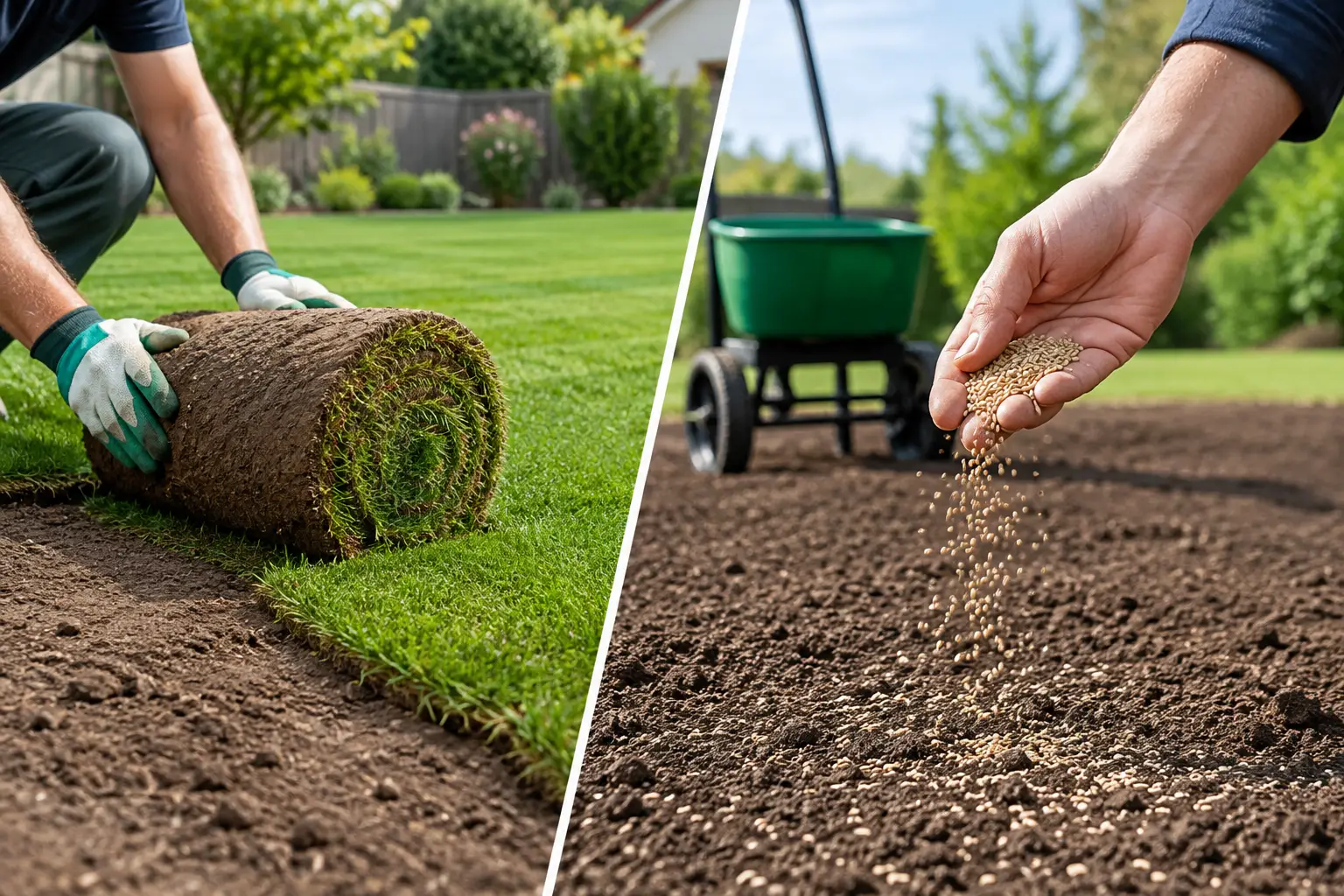
A bare garden can look like a straightforward job until the question of roll-on turf versus seeding arises. Turf gives an immediate green finish, while seed offers far more control over the grass species that will occupy the ground for years. The right answer is not simply the quickest or cheapest option. It depends on site conditions, budget, access, timing and how soon the lawn needs to withstand feet, pets or machinery.
For a front lawn where appearance matters immediately, quality turf is often the practical choice. For a large rear garden, a new build plot or an area with shade, drought or heavy use to account for, a properly selected seed blend can be the better long-term specification. In either case, preparation decides the result. Good grass cannot compensate for compacted subsoil, poor drainage or an uneven finish.
Roll-On Turf Versus Seeding: The Main Difference
Roll-on turf is mature grass grown on a turf farm, cut with a thin layer of rootzone soil and delivered in rolls. Once laid, it provides instant coverage, reduces exposed soil and gives the impression of a finished lawn on day one. That does not mean it is fully established. The turf still has to root into the prepared ground before it can cope with regular use.
Seeding establishes the lawn from scratch. Germination can begin in 7-14 days with a fast, professionally formulated ryegrass blend in suitable conditions, but the full process takes longer. The first shoots may look encouraging, yet the young grass needs careful watering, its first cuts at the correct height and time to tiller - the process by which each plant produces additional shoots and thickens the sward.
Turf buys time at the start. Seed provides greater choice from the start. Both can produce a dense, durable lawn when the ground is prepared properly and aftercare is not neglected.
When Roll-On Turf Is the Better Choice
Turf is well suited to projects with a fixed deadline. A landscaper completing a garden for handover, or a homeowner wanting a usable-looking lawn before an event, gains a clean visual result immediately. It is also useful on slight slopes and exposed soil where heavy rain could wash fine soil away before seed has germinated.
There is less opportunity for weeds to colonise the surface during establishment because the turf covers the ground at once. This is an advantage on sites where the soil has been freshly cultivated and contains a substantial weed seed bank. However, turf is not a licence to skip preparation. It will follow every hollow and hump beneath it, and poor contact with the soil causes edges and raised areas to dry out.
Freshness matters. Turf should be laid as soon as possible after delivery, especially in warm or windy weather. Rolls left stacked for too long heat up, yellow and lose vigour. Lay them in a brickwork pattern, butt the edges together without stretching them, and avoid walking on newly laid turf except from boards where needed. Water it thoroughly enough to moisten the soil beneath, not merely the leaf.
The principal drawbacks are cost and limited choice. Turf generally costs more per square metre than seed, and delivery, access and labour can add substantially to the project. You are also buying the grass mixture supplied in that turf crop. That may be perfectly suitable for a general-purpose lawn, but it is less precise than selecting a seed blend engineered for dense shade, drought tolerance, fine ornamental texture or hard-wearing family use.
When Seeding Makes Better Sense
Seeding is usually the economical route for larger areas. The materials cost is lower, and seed can be distributed across irregular plots, narrow side gardens and difficult corners without the cutting and handling associated with rolls of turf. It is also the better option when the lawn has a specific performance requirement.
A hard-wearing family lawn benefits from perennial ryegrass for rapid establishment and wear tolerance, balanced with fescues for density and finer texture. In a dry, sunny garden, deeper-rooting varieties are useful. Under trees or beside high fences, shade-tolerant mixtures give young grass a more realistic chance. No grass seed will flourish in permanent darkness, but matching the blend to the site removes a common cause of thin, disappointing lawns.
For new lawns and repairs alike, tetraploid ryegrass can be particularly useful. Its larger seed and vigorous early growth support rapid establishment, often within 7-14 days in favourable conditions, while its root system is suited to demanding conditions. It is not a substitute for watering or sound soil preparation, but it gives the new lawn a stronger start than a poor-quality, unspecified mixture.
The trade-off is patience. Seeded ground must be protected from birds, heavy rain, drying winds and traffic while the seedlings establish. Germination is also governed by soil temperature and moisture, not by the date on the calendar. A cold April can delay results, while a mild September often produces faster, more even germination than an early spring sowing.
Soil Preparation Is Not Optional
Whether laying turf or sowing seed, start with the ground, not the grass. Remove rubble, old turf, perennial weeds and large stones. If persistent weeds are present, control them before cultivation rather than trying to deal with them once the lawn is established.
Cultivate the upper 100-150 mm of soil, then level and firm it. The finished surface should be firm enough that a heel leaves only a shallow impression, but not compacted into a hard pan. Rake several times in different directions to remove stones and create a fine, level tilth. Check the site from different angles. Low points become puddles, and high spots scalp when mowing.
Poor drainage should be dealt with before grass goes down. Turf placed over wet, compacted soil may look satisfactory initially but can deteriorate as roots struggle for oxygen. On heavy clay, incorporate suitable organic matter where needed and avoid working the soil when it is saturated. If the problem is a perched water table or runoff from surrounding ground, surface shaping or drainage may be required rather than more cultivation.
A pre-seeder fertiliser with a balanced 6-9-6 analysis is a practical foundation for either method. The phosphorus supports root development, while moderate nitrogen encourages early growth without forcing weak, lush top growth. Apply it evenly and work it lightly into the surface before sowing or laying. Do not assume more fertiliser means faster establishment. Over-application can scorch young roots and create uneven growth.
Timing for UK Conditions
Early autumn is generally the strongest window for seeding. Soil remains warm after summer, rainfall is often more dependable and annual weeds are less competitive than in spring. Spring seeding can work well, but it may need more watering if dry weather arrives early, and young grass has less time to mature before summer stress.
Turf can be laid through much of the year provided the ground is neither frozen nor waterlogged. Autumn and spring remain the most forgiving periods. In summer, the workload is watering. In winter, the issue is soil condition and slow rooting. Turf laid on cold, wet ground can sit without properly knitting in, then suffer when the weather changes.
For both methods, avoid working fine soil in heavy rain. A rushed job on smeared, compacted ground is difficult to correct after the grass has established.
Aftercare Determines the Finish
New turf needs consistent moisture for the first few weeks. Lift a corner occasionally to check whether roots are beginning to bind into the soil. Once rooting is evident, gradually reduce watering frequency while applying enough water to encourage roots to travel downwards. Frequent light sprinkling keeps roots shallow.
A seeded lawn needs the surface kept consistently damp until germination is complete. Use a fine rose or gentle sprinkler pattern so seed is not washed into corners. Once seedlings are up, water less often but more deeply as they develop. The first mow should wait until plants are firmly anchored and around 50-75 mm tall. Remove only the top third of the leaf, using a sharp mower blade.
Do not apply selective weedkiller to very young grass. Allow the lawn to establish and be mown several times first. Isolated weeds can be removed by hand, while thin areas are best overseeded once the original plants are strong enough to compete.
Cost, Speed and Long-Term Value
If the priority is immediate presentation, turf is worth the additional outlay. If the priority is covering a large area economically or building a lawn around known site constraints, seed offers better value and better control. The cost comparison should include more than the price of turf rolls or a bag of seed. Factor in delivery, labour, soil improvement, fertiliser, watering and the likelihood of remedial work if preparation is poor.
A well-laid turf lawn and a well-sown lawn should both be treated as long-term living surfaces, not instant decoration. Ransley Pro Grow’s approach is straightforward: specify grass for the conditions, prepare the rootzone properly and feed according to the season rather than guesswork.
Choose turf when time and instant coverage are the priority. Choose seed when the site needs a tailored grass mixture and the establishment period can be managed. Give either one level, fertile ground and disciplined aftercare, and the lawn will repay the work long after the first green flush has appeared.