














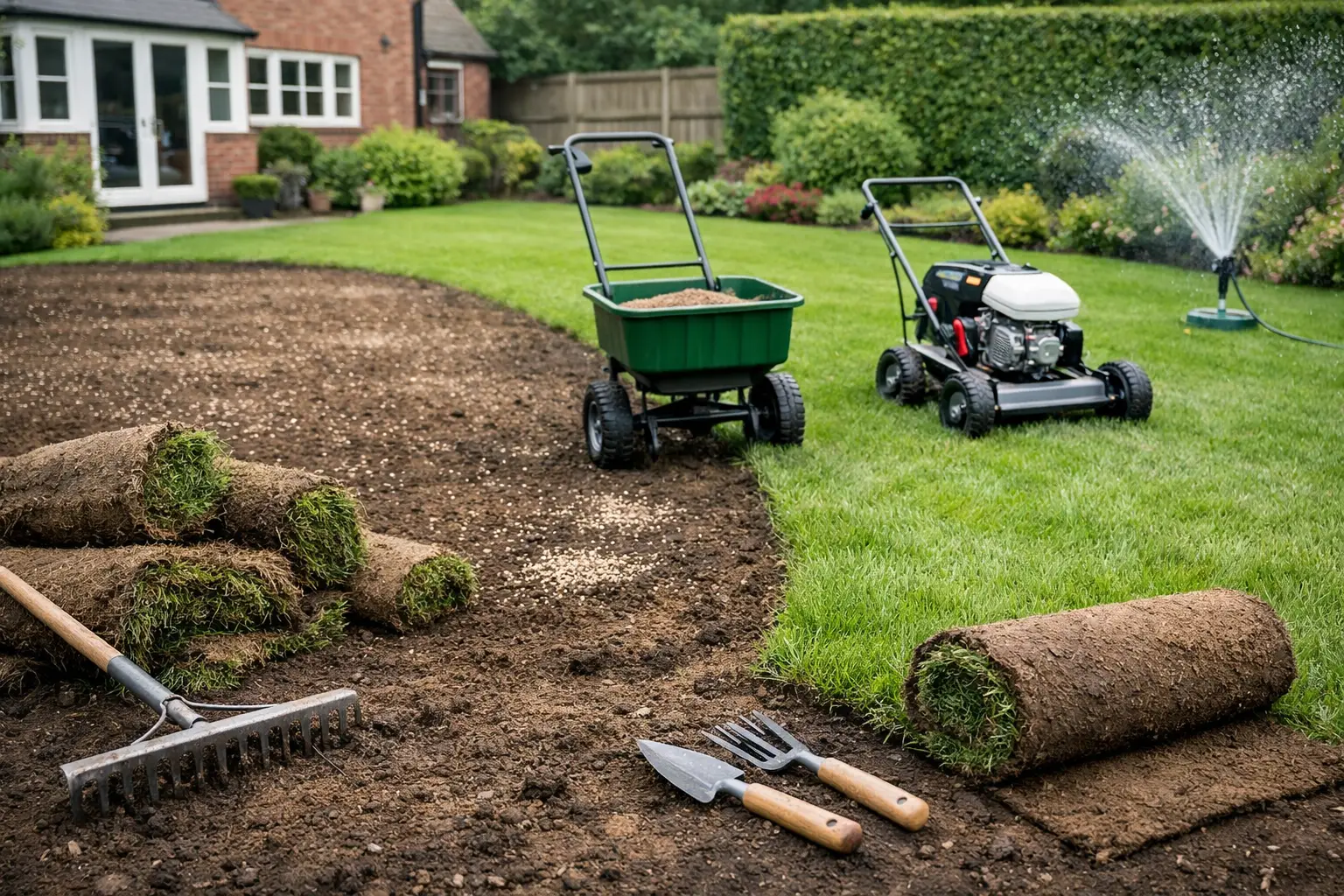
A lawn rarely fails for just one reason. Thin grass, moss and bare patches are usually the visible result of compacted ground, poor drainage, unsuitable seed, low fertility or mowing that has weakened the sward over time. This professional lawn renovation guide sets out the same practical order of work used to turn tired UK lawns into dense, resilient turf: diagnose first, then prepare the ground, seed correctly and manage the establishment period properly.
Renovation is not the same as throwing seed over an existing lawn. Overseeding can thicken a lawn that is fundamentally sound. A full renovation is required where more than around half the surface is moss, weed, bare soil or coarse, weak grass. The distinction matters because new seed cannot compensate for a compacted rootzone or a drainage problem beneath it.
Start with a proper lawn diagnosis
Walk the lawn after rain and inspect it at ground level. Water sitting on the surface, a spongy feel underfoot and heavy moss growth point towards poor drainage or compaction. Hard, dry ground that resists a garden fork is also compacted, even if it does not puddle. Grass roots need air as well as moisture. When the soil pores are squeezed shut, roots remain shallow and the lawn dries out quickly in warm weather.
Check the light levels as well. Grass beneath dense tree cover or beside north-facing boundaries receives less light and faces competition from tree roots. A standard hard-wearing ryegrass blend may establish, but it may not remain dense through winter. A shade-tolerant mixture with suitable fescues is the better long-term choice.
Weeds tell their own story. Daisy and clover often thrive in thin turf, while plantain can indicate compacted soil. Moss is not the original cause of lawn decline. It is an opportunist that takes space when grass growth is restricted by shade, wetness, acidity, low nutrition or close mowing.
Before committing to renovation, take a simple soil test. Soil pH affects nutrient availability, with most lawn grasses performing well in a mildly acidic to neutral range. Do not apply lime simply because moss is present. Raising pH without a test can create a different problem and will not cure compaction or shade.
Choose the right renovation window
Early autumn is normally the most dependable time for lawn renovation in the UK. Soil remains warm after summer, moisture levels usually improve and annual weeds are less aggressive. Seed can establish before winter, provided it is sown early enough for meaningful growth.
Spring is a sound second option, particularly where winter damage has exposed large areas of soil. The trade-off is that germination can be interrupted by late cold snaps, dry spells and rapidly emerging weeds. Spring-sown lawns also need closer watering through their first summer.
Avoid sowing into cold, saturated soil or during prolonged dry weather. Seed needs consistent moisture and soil contact, not a daily soaking. If the lawn is waterlogged, solve the drainage issue before spending money on seed and fertiliser.
Clear competition before you seed
A renovation succeeds when the new grass is given a clean, workable seedbed. Start by mowing the existing lawn down gradually over two or three cuts. Do not scalp healthy turf in one pass, particularly during dry weather, as this can expose soil and stress any grass worth retaining.
For a partial renovation, scarify to remove moss, thatch and dead material. Work in two directions where the build-up is heavy, then collect every loose piece of debris. This is often the point at which a lawn appears worse than before. That is normal. You are exposing the surface so seed can reach soil rather than sit on a mat of thatch.
For a lawn dominated by weeds or poor grass, a complete kill-and-renovate approach may be more economical than repeated patch repairs. A total herbicide can clear unwanted vegetation, but it must only be used exactly as the product label directs and with the stated interval before cultivation or sowing. Keep spray away from wanted plants, ponds and drains. Selective lawn weedkillers are useful where good grass remains, but newly sown grass is sensitive, so treatment timing must be planned rather than improvised.
High-iron moss treatments can blacken moss quickly, allowing it to be raked out. They do not replace scarification, aeration or improved feeding. Remove the dead moss or it will continue to block light and seed-to-soil contact.
Relieve compaction and correct the levels
Aeration is the part of renovation most often skipped and most often needed. On a compacted lawn, hollow-tine aeration removes small cores of soil and creates channels for air, water and roots. Solid tining can help lighter compaction, but it does not remove soil and is less effective where the ground is heavily sealed.
Aerate when the soil is moist enough to accept the tines without smearing. If it is sticky and saturated, wait. Smearing the sides of aeration holes can reduce the benefit.
Once the surface is open, address hollows and uneven areas with a suitable sandy lawn dressing or quality, screened topsoil appropriate to the existing ground. Apply it in thin layers, working material into the turf with a lute or the back of a rake. Deep hollows may need several applications. Burying established grass under a thick layer of soil will weaken it, not level it.
Where drainage is persistently poor, topdressing alone may not be enough. Consider the source: compacted subsoil from construction work, runoff from a patio, a low point in the garden or shade preventing evaporation. Larger sites may require drainage work before turf can perform consistently.
This professional lawn renovation guide starts at seed level
Seed selection should reflect how the lawn is used, not simply the appearance of the packet. Dwarf perennial ryegrass provides rapid establishment and wear tolerance, making it suitable for family gardens, access routes and many contractor projects. Fine fescues contribute a finer texture and better shade tolerance, but they are less suited to repeated hard wear.
For exposed, dry gardens, choose a blend with drought-tolerant characteristics and support it with deeper rooting through aeration and sensible mowing. No seed blend is immune to drought when growing in shallow, compacted soil.
Tetraploid ryegrass is a useful option where rapid establishment and resilience are priorities. Its larger seed and vigorous early growth can produce germination in around 7-14 days in suitable conditions, while its deeper root potential supports better drought tolerance than weak, shallow-rooted turf. It is particularly useful when a renovated lawn needs to become serviceable promptly, although weather and seedbed preparation still determine the final result.
Apply seed evenly in two passes at right angles, using the rate specified for the mixture and whether the job is overseeding or a new establishment. Spread half the seed lengthways and half crossways. Rake lightly so most seed is covered by only a few millimetres of soil, then firm the surface with a roller or by treading carefully with boards. Firm contact is essential. Seed left loose on the surface dries out, moves in rain and becomes easy pickings for birds.
Feed for roots, not a quick flush of leaf
Young grass needs phosphorus for root development and balanced nutrition to establish without scorching. A pre-seeder fertiliser with an NPK analysis such as 6-9-6 is designed for this stage: moderate nitrogen supports early green growth, while the higher phosphorus content encourages root development.
Apply fertiliser at the recommended rate to a prepared seedbed, either immediately before or after sowing according to the product instructions. Do not assume more feed means faster establishment. Excess fertiliser can damage young roots, especially in dry conditions, and create soft growth that is more vulnerable to disease.
Once the lawn is established, seasonal feeding should match the time of year. Spring and summer feeds generally carry more nitrogen to support growth and colour. Autumn and winter formulations use lower nitrogen and higher potassium to encourage stronger roots and improved tolerance of frost and disease pressure. Ransley Pro Grow supplies these targeted formulations for the different stages of establishment and seasonal maintenance.
Water, mow and protect the new sward
For the first few weeks, keep the top layer of soil consistently moist. In dry weather, this may mean light watering once or twice daily until germination is well under way. The aim is damp soil, not puddles. Once seedlings are rooted, water less often but more deeply to encourage roots to follow moisture down into the profile.
Mow when the new grass reaches roughly 5-7 cm and has rooted firmly enough that it does not pull out when lightly tested. Use a sharp mower and remove no more than one-third of the leaf blade. Start high, then reduce gradually towards the intended cutting height. For most domestic utility lawns, 35-50 mm is a sensible range; shaded lawns benefit from being kept slightly longer.
Keep foot traffic, pets and heavy equipment off new grass wherever practical. A newly germinated lawn may look green within two weeks, but it is not fully mature. Wear tolerance develops as roots thicken, tillers form and the first several mowing cycles encourage density.
Common renovation mistakes
The most expensive mistake is treating symptoms without correcting the cause. Killing moss without aerating a wet, shaded lawn simply creates bare soil for moss to return to. Sowing a fine ornamental mixture onto a football-playing family lawn creates a mismatch between seed and use.
The other common error is impatience. Applying weedkiller too soon after sowing, mowing too low, flooding seedlings or feeding heavily can set establishment back by weeks. Follow product labels, work with the weather and give the grass time to build a root system equal to the work you expect from it.
A well-renovated lawn should not need constant rescue treatments. When the seed suits the site, the soil can breathe and nutrition follows the season, the grass becomes the strongest competitor on the ground. That is the point at which routine mowing and measured maintenance replace repeated repair work.