














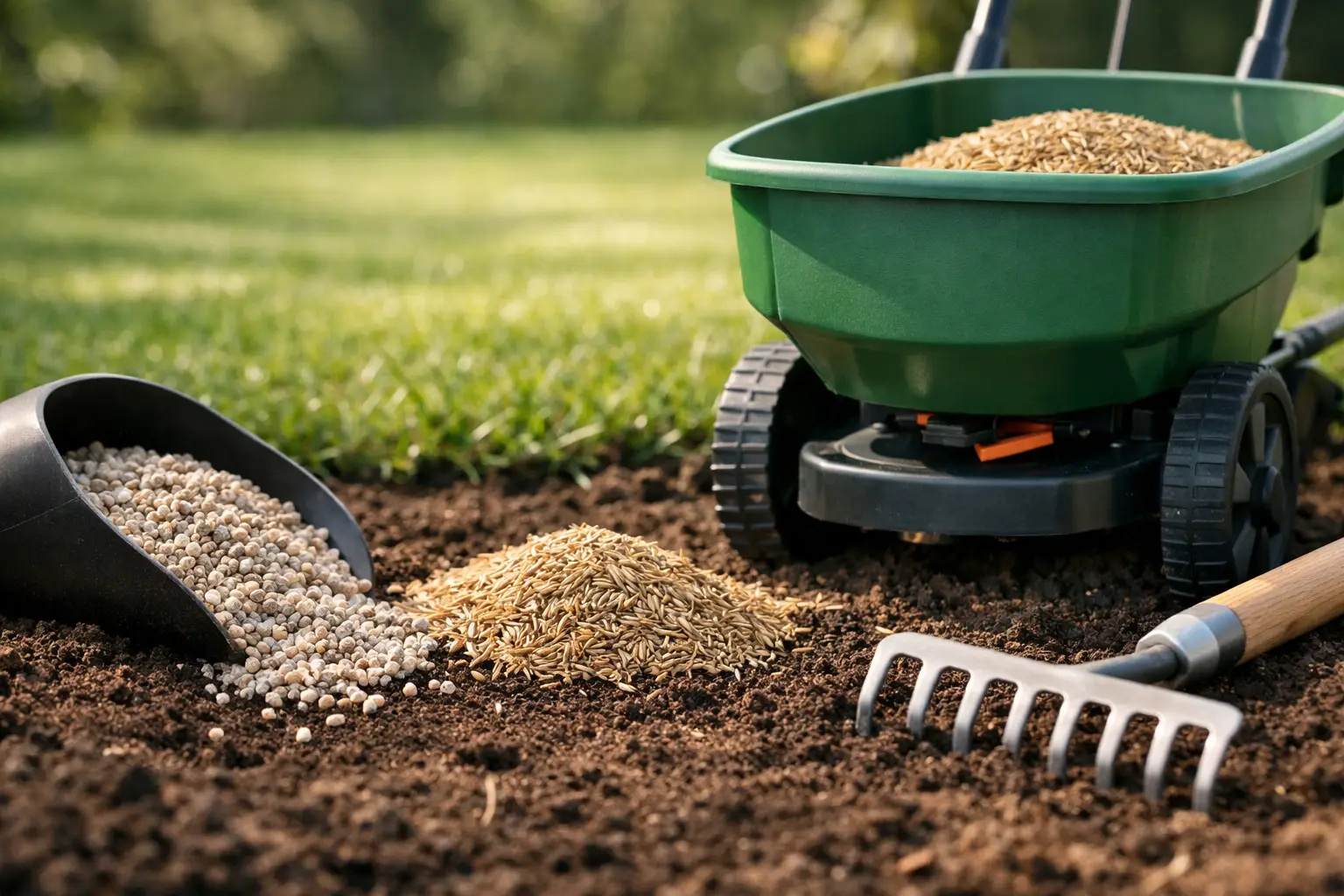
If a new lawn struggles, the problem often starts before the seed goes down. People tend to focus on seed quality, and rightly so, but pre-seeding fertiliser for lawns is what gives young grass the conditions to establish properly. Get the nutrient balance right at sowing and you support root formation, steady germination and better early colour. Get it wrong and you can end up with weak seedlings, patchy take-up or soft top growth that does not last.
What pre-seeding fertiliser for lawns actually does
A pre-seeder is not just a general feed used slightly earlier. It is specially formulated for the establishment phase, when grass needs phosphorus for root development, enough nitrogen to support early shoot growth, and potassium to improve resilience. That is why a balanced 6-9-6 analysis is so effective for newly sown areas.
At this stage, the grass plant is doing two jobs at once. It must emerge quickly enough to compete with drying winds, foot traffic and temperature swings, while also building a root system deep enough to anchor itself and access moisture. A feed with too much nitrogen can push lush leaf growth before the roots are ready. A proper pre-seeder avoids that imbalance.
This is the part many homeowners miss. A lawn can look as though it is "coming on" because there is plenty of green top growth, but if rooting is shallow the first dry spell exposes the weakness. Contractors will know the same issue on larger jobs - surface success is not the same as establishment.
Why phosphorus matters at sowing
Phosphorus is the key nutrient in most pre-seeding fertilisers because it drives root initiation and energy transfer within the plant. Young seedlings rely on it to produce the sort of early root mass that leads to stronger, denser turf later on.
In practical terms, that means better uptake of water and trace nutrients, less stress after germination, and a more even finish across the seeded area. On poor soils, newly built gardens, or sites where topsoil quality is variable, the value of phosphorus becomes even clearer. Those are the lawns that often germinate unevenly unless nutrition is addressed from the outset.
Nitrogen still has a role, of course, but it should be controlled. Potassium matters too, particularly in helping the seedling cope with wear, cooling nights and inconsistent moisture. The point is balance. A 6-9-6 formulation is engineered for that exact stage.
When to apply pre-seeding fertiliser for lawns
The best time is either immediately before sowing or straight after sowing, depending on how you prepare the seedbed. Both methods work, provided the fertiliser is distributed evenly and lightly incorporated or watered in.
If you are preparing a new lawn from bare soil, apply the fertiliser after final levelling and before raking the seed into the surface. This helps place nutrients within reach of the developing root zone. If the seed is already down, an application afterwards is still useful, especially if followed by gentle watering.
In the UK, the main sowing windows are spring and early autumn. Spring gives you rising soil temperatures and good day length, but weed competition can be stronger. Early autumn often provides better moisture and less stress from heat, though the window is narrower and day temperatures begin to fall. In both cases, a pre-seeder helps remove some of the risk by supporting quicker establishment.
Avoid applying to frozen ground, baked dry soil or waterlogged surfaces. In those conditions, nutrient use is poor and seed performance is compromised anyway.
How to apply it properly
Even application matters as much as product choice. Fertiliser spread unevenly will usually show itself in stripes, variable colour and inconsistent growth. On fine domestic lawns, that can be frustrating. On larger landscaped sites, it becomes an expensive callback.
For most jobs, spread the fertiliser at the recommended rate across the prepared area, then sow the seed in two passes at right angles for even coverage. Lightly rake so both seed and granules sit in the top layer of soil. Finish with a roller or the back of a rake to ensure good seed-to-soil contact.
Watering should be gentle and regular, not heavy enough to wash seed into low spots. The aim is a consistently moist surface during germination, not saturation. A pre-seeder cannot compensate for poor irrigation practice.
If you are overseeding into an existing lawn, the same principle applies but preparation becomes more important. Scarify first, remove debris, and open the surface enough for seed and fertiliser to reach the soil rather than sitting in the thatch layer.
Common mistakes that hold new lawns back
The most common error is using the wrong fertiliser at the wrong time. A high-nitrogen spring and summer feed may green up established turf brilliantly, but it is not designed for seedling development. Young grass needs measured support, not a rush of leaf growth.
Another issue is over-application. More feed does not mean faster success. Excess fertiliser can create salt stress around the germinating seed, and that can reduce emergence or damage tender roots. Trade-standard products are designed to perform at stated rates. Stick to them.
There is also the temptation to skip fertiliser altogether if the soil looks decent. Sometimes you get away with that on fertile, well-structured loam. More often, especially on modern building plots with compacted or thin topsoil, establishment is noticeably slower and less uniform without it.
Finally, timing matters. If the seedbed is poorly prepared, full of stones, badly levelled or allowed to dry out, even the right fertiliser will only do part of the job. Nutrition is one piece of a system, not a cure-all.
Choosing the right product for a new lawn
For a new lawn or overseeding project, you want a fertiliser specifically labelled for pre-seeding use, with a balanced nutrient profile suited to establishment. A 6-9-6 NPK formula is a proven choice because it supports root development without pushing soft, excessive top growth.
This is where specialist products earn their place. A trade-standard pre-seeder is formulated to feed the seedling at its most vulnerable stage and reduce the risk of scorching. That is particularly useful for homeowners aiming for professional results and for contractors who need dependable take-up across varied ground conditions.
At Ransley Pro Grow, the 6-9-6 Pre-Seeder Fertiliser is designed for application before or after sowing, which gives a bit more flexibility on site. That matters if the weather changes midway through a job or if the seedbed needs a final adjustment before seeding.
Seed and fertiliser need to work together
Fertiliser cannot rescue poor seed. Equally, excellent seed will never show its full potential in an undernourished seedbed. The best results come when the grass species and the feeding plan match the site.
For example, a hard-wearing family lawn may need a ryegrass-led mixture for durability and rapid establishment. A shaded area may need more fescue content to cope with reduced light. In either case, the pre-seeder gives the young plants a stronger start, but the seed choice still governs texture, wear tolerance and long-term appearance.
This is why professionals plan the job as a package. Soil preparation, seed selection, fertiliser timing, moisture control and aftercare all affect the outcome. Home gardeners benefit from taking the same approach.
What happens after germination
Once the lawn is up and rooted, the feeding programme should change. Pre-seeding fertiliser is not intended to carry the lawn indefinitely. After establishment, the plant's needs shift towards controlled top growth, colour development and seasonal resilience.
That usually means moving to an appropriate spring or summer fertiliser once the grass is strong enough and mowing has started regularly. Later in the year, an autumn and winter feed with lower nitrogen and higher potassium helps harden the turf for colder conditions.
The key point is not to rush the next application. Let the seedlings establish. Mow carefully, keep traffic light, and monitor colour and growth rate rather than feeding by habit.
A good lawn is rarely the result of one product alone. But if you want quicker establishment, stronger roots and fewer weak patches, starting with the right pre-seeder is one of the soundest decisions you can make before the first seed ever germinates.