














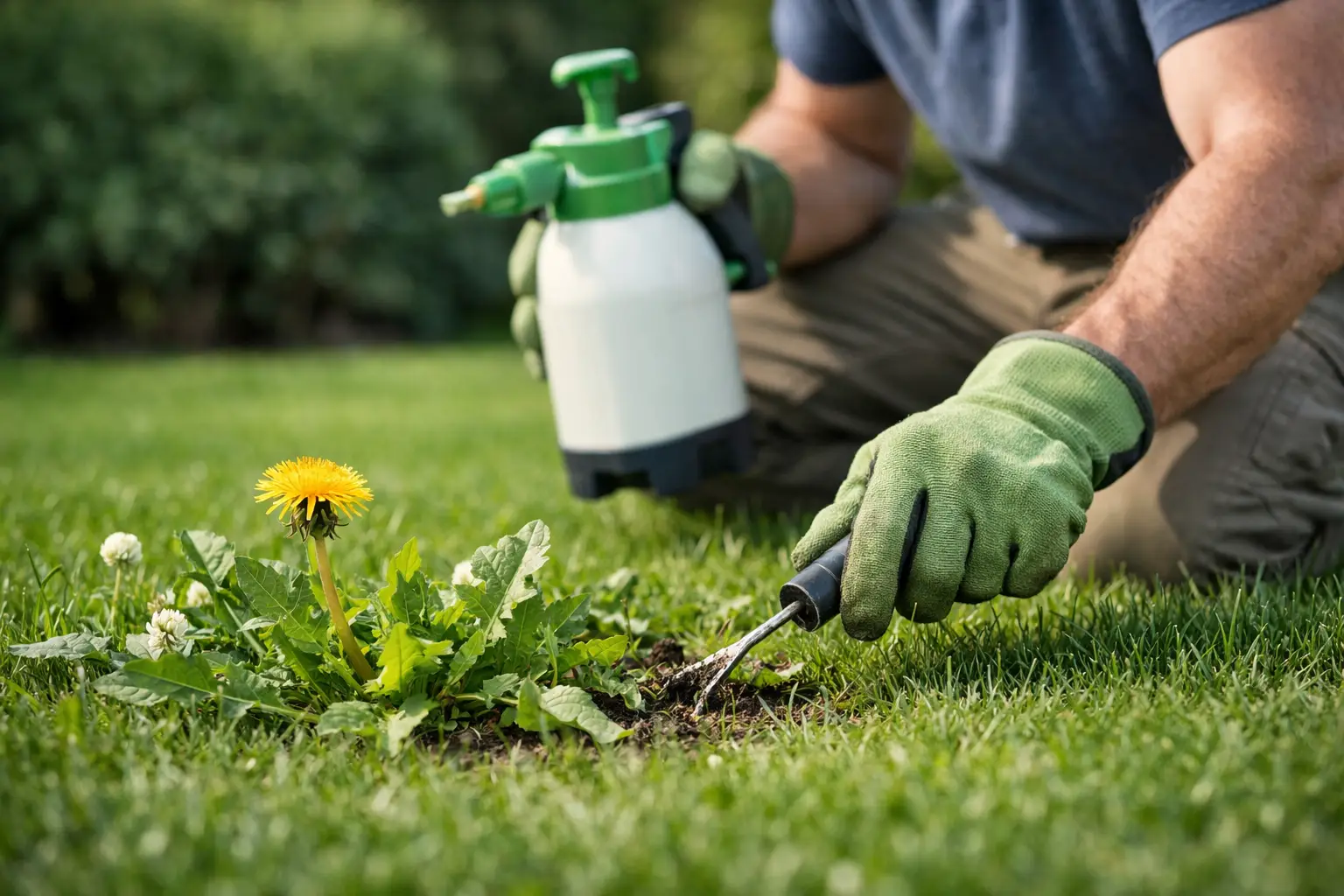
A lawn rarely turns weedy overnight. More often, the grass has been thinned by shade, poor feeding, compaction or close mowing, and the weeds simply take the invitation. That is why any useful lawn weed control guide has to start with the condition of the turf, not just the weed itself.
If you only kill what is visible, the gaps remain and the next flush soon follows. If you correct the cause as well, the grass begins to compete properly again. That is the difference between a short-lived tidy-up and a lasting result.
Lawn weed control guide - start with diagnosis
Before choosing a treatment, look at what is actually growing in the sward and why it has established. Broadleaf weeds such as dandelion, daisy, clover, plantain and buttercup usually point to weak turf density. Moss often appears where drainage is poor, light levels are low, or the surface stays damp for long periods. Coarse grassy weeds are a separate problem and are not controlled by standard selective lawn weed killers.
A quick inspection tells you a great deal. If the lawn feels hard underfoot, compaction may be reducing root development and water movement. If the grass is pale and slow, nutrient levels may be lacking. If the mower is set too low, the turf canopy will be too open to shade the soil surface. Each of those conditions favours weed ingress.
This matters because selective products are designed to target certain weed groups, not every unwanted plant in the lawn. Broadleaf herbicides will leave desirable grass species unharmed when applied correctly, but they will not solve poor establishment, chronic shade or thin coverage.
Identify the weed before you treat it
The most common mistake is treating first and identifying later. In professional turf care, that is backwards. You need to know whether you are dealing with annual broadleaf weeds, perennial broadleaf weeds, moss, or unwanted grass species.
Dandelions and plantains are deep-rooted perennials, so they often need an actively growing plant and a properly timed application for the chemistry to move through the system. Clover thrives in underfed lawns, especially where nitrogen is low. Daisy and selfheal often spread in short, weak turf. Moss is not a weed in the herbicide sense, so it requires a moss control treatment rather than a standard selective weed killer.
If the lawn contains couch, annual meadow-grass or other grassy invaders, the decision becomes more nuanced. There is no simple selective spray that removes these from a domestic lawn without risking the surrounding turf. In those cases, localised removal, renovation or full resurfacing may be more realistic than repeated spot treatments.
Choose the right control method
For most UK lawns, weed control falls into three categories: selective weed killer for broadleaf weeds, iron-based treatment for moss, and total herbicide for areas where you intend to clear all vegetation. The last of those is for hard surfaces, fence lines or full renovation work, not for routine use across a lawn.
A selective lawn weed killer is the standard tool where grass is present and worth keeping. It is specially formulated to control broadleaf weeds while leaving the turfgrass intact, provided application rates and conditions are correct. This is usually the most efficient route when weeds are widespread rather than isolated.
Granular multi-action products can be useful when a lawn has several issues at once. Where moss, weeds and low vigour are all present, a combined treatment can save time and improve presentation quickly. The trade-off is precision. A combined product is convenient, but it may not give you the same level of control as addressing each problem individually, especially on lawns with mixed conditions.
Timing matters more than people think
The best treatment can still disappoint if used at the wrong time. Weeds need to be actively growing for selective herbicides to work well. In practical terms, that usually means spring into early autumn, with steady soil warmth, adequate moisture and no imminent frost.
Avoid spraying during drought stress, very cold spells or immediately after mowing. A little leaf area helps the product absorb properly. It is generally better to mow a few days before treatment, allow the weed to recover some surface growth, then leave the lawn uncut for several days afterwards if the label advises it.
Rainfall timing matters too. Some products need a dry window after application. Others are more forgiving. Always work to the product instructions rather than assumptions, because active ingredients differ.
For moss, autumn and spring are common treatment windows, but the real question is why the moss arrived. If shade, poor drainage and low air movement remain uncorrected, it will return however effective the initial kill appears.
Application standards make the difference
Even coverage is the difference between a professional-looking result and a patchy one. Whether you are using a liquid concentrate or a granular treatment, calibration matters. Too little and the weeds are checked rather than controlled. Too much and you risk stressing the grass or breaching the label rate.
Liquid applications suit spot treatment and accurate coverage across awkward shapes. Granules are often quicker on larger domestic lawns and can be applied very evenly with a properly set spreader. The important point is consistency. Missed strips are common when people judge spacing by eye.
Apply to a dry leaf where the product requires adhesion, and avoid drift into borders, vegetable plots and ornamental planting. Broadleaf herbicides do not distinguish between a lawn weed and a valued perennial in the next bed.
Support the grass so weeds do not come back
This is the section many guides underplay, yet it is where long-term improvement happens. Weed control works best when the lawn is growing densely enough to occupy space. That depends on feeding, mowing, aeration and, where necessary, overseeding.
A hungry lawn is a slow lawn. In spring and summer, a higher-nitrogen feed supports chlorophyll production, stronger growth and better recovery. In autumn, the balance shifts towards root strength and hardiness. If you are seeding or repairing worn areas, a pre-seeder fertiliser with a balanced ratio such as 6-9-6 helps root development without scorching young plants.
Mowing height is equally important. Scalped turf invites weed seed to germinate because more light reaches the soil surface. Raising the height slightly in summer stress, shade or worn areas often improves density far more quickly than people expect.
If the lawn is thin after treatment, overseeding is often the missing step. Professional-grade seed blends establish faster, cover more evenly and are better matched to use conditions. On hard-wearing family lawns, ryegrass-rich mixtures provide strength and recovery. In shaded gardens, a shade-tolerant blend is the better choice. Good weed control without filling the gaps is only half a job.
When to renovate instead of repeatedly treating
There comes a point where constant weed killing is false economy. If more of the surface is weed, moss or bare ground than healthy grass, renovation may be the cleaner route. That can mean scarifying, aerating, targeted moss removal, overseeding and feeding, or in severe cases a complete restart.
This is especially true where the original lawn was poorly built, heavily compacted or laid with an unsuitable seed mix. Trying to maintain a fine ornamental finish in deep shade with a generic sunny-lawn seed rarely ends well. Matching the grass species to the site is part of weed prevention.
For homeowners, that may mean one planned renovation instead of three or four reactive treatments across the year. For contractors, it often means fewer call-backs and a more stable result for the client.
Common mistakes in lawn weed control
The first is using the wrong product for the problem. Moss killer will not control dandelions, and a selective broadleaf weed killer will not remove coarse grassy weeds. The second is poor timing, especially treating in stress conditions or when growth is too slow for uptake.
The third is neglecting the underlying cause. Thin, starved, compacted turf will keep inviting the same trouble back. The fourth is impatience. Some weeds twist and discolour quickly after treatment, while others take longer to collapse fully. Reapplying too soon can do more harm than good.
One final point is worth making. Not every lawn needs absolute eradication of every daisy and clover leaf. On some family lawns, a sensible threshold is more practical than perfection. On formal front lawns or prestige sites, the standard is naturally higher. It depends on use, budget and the finish you are trying to achieve.
A proper lawn weed control guide is really a turf health guide in disguise. Kill the weed, certainly, but give the grass every competitive advantage as well. When the sward is dense, well-fed and suited to the site, weeds stop being a constant battle and become an occasional correction - which is where a lawn ought to be.