














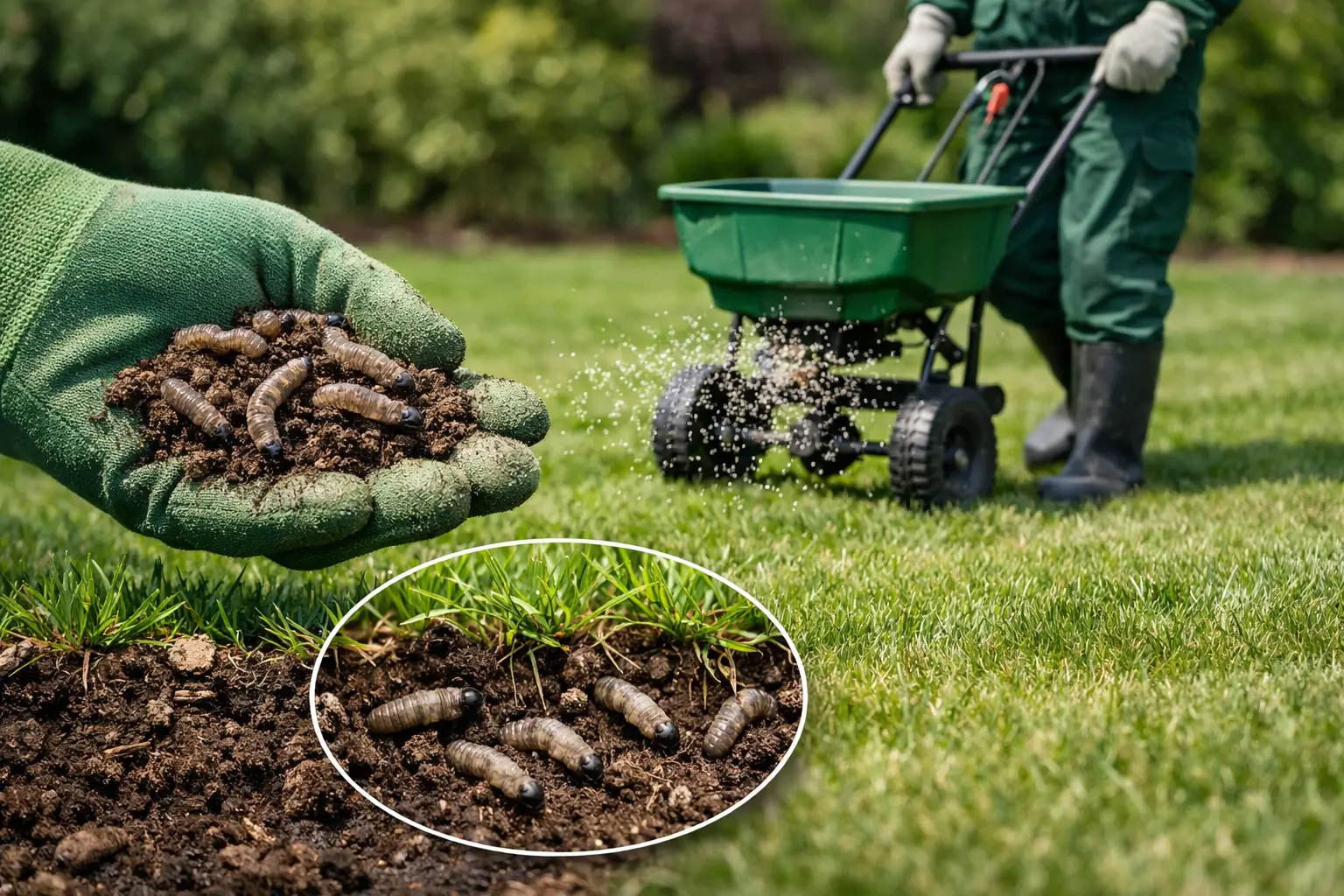
A lawn can look sound on Friday and be lifting in loose, brown sections by the following week. When birds are repeatedly pecking at the surface, or turf rolls back with very little resistance, leatherjackets are often the cause. Effective lawn treatment for leatherjackets is not about applying a quick feed or insecticide at the first sign of damage. It depends on identifying the larvae correctly, treating the young stage at the right point in the season, then rebuilding the grass plants that have lost their roots.
What leatherjackets do to a lawn
Leatherjackets are the grey-brown, legless larvae of crane flies, commonly called daddy longlegs. They live in the top few centimetres of soil and feed mainly on grass roots, crowns and emerging shoots. A small population may go unnoticed. A larger one can thin a lawn quickly, particularly where grass is already weakened by shade, compaction, drought or poor drainage.
The damage is usually most obvious from late autumn into spring. Grass may yellow, stop responding to normal feeding and pull away in patches because there is no root system holding it in place. Crows, starlings, foxes and badgers can make the situation look worse as they search for the grubs. Their digging is a symptom of an underlying population, not the original cause.
Do not confuse leatherjackets with chafer grubs. Chafer larvae are creamy white, C-shaped grubs with a brown head and distinct legs. Leatherjackets are longer, tougher-skinned and greyish, with no visible legs. Lift a small piece of affected turf or work through a shallow soil sample with a hand fork. Finding several leatherjackets in a small area, alongside weak or detached turf, is a reasonable basis for treatment.
Lawn treatment for leatherjackets starts with timing
The most reliable biological control for domestic lawns is beneficial nematodes, generally Steinernema feltiae. These microscopic organisms enter young leatherjackets in the soil and stop them feeding. They are highly targeted, but they are not a residual pesticide. They need the right soil temperature, moisture and pest stage to work well.
Adult crane flies commonly lay eggs in lawns from late summer into early autumn. The eggs hatch into small larvae, and this young stage is when nematodes have the best opportunity to control them. In much of the UK, the usual treatment window is August to October, although local weather matters more than the calendar alone.
Check the supplier's directions, but nematodes normally require soil temperatures of at least 12°C. A warm September after rain can be ideal. A cold, dry spell in October is less favourable, even if the date suggests treatment should still work. By late winter and spring, leatherjackets are larger, deeper in the profile and considerably harder to control with biological methods.
This is the main trade-off: waiting until visible damage is severe can mean missing the most effective treatment period. If the lawn is being attacked in March, protect and repair the turf, but plan the main population control for the following late summer.
Applying nematodes properly
Nematodes are living organisms, so handling and application matter. Buy them close to the intended application date, store them exactly as directed and use them before the stated expiry date. Do not leave a pack in a warm shed, on a sunny patio or in a vehicle.
Mow the lawn first if it is due, then water the ground thoroughly before application. The aim is damp soil around the grass roots, not a puddled surface. Mix the nematodes with clean water according to the pack rate and apply evenly using a watering can fitted with a coarse rose, or suitable spraying equipment that will not filter or damage the organisms.
Apply in dull conditions, early morning or evening. Strong sunlight and dry soil work against them. Water again immediately afterwards to wash the nematodes from the leaf blades into the soil, then keep the treated area consistently moist for around two weeks. In dry weather, that may mean light irrigation every day or two. This moisture period is not optional - nematodes move through a film of water in the soil.
Avoid applying when the ground is frozen, waterlogged or compacted so tightly that water sits on the surface. Aeration can help where compaction is the real limiting factor, but do not carry out aggressive hollow-tining on a lawn already lifting from root loss. Stabilise the surface first, then schedule renovation when conditions suit grass recovery.
Chemical insecticides previously used against soil-dwelling lawn pests are not a straightforward answer for UK domestic turf. Product approvals and permitted uses change, and many older treatments are no longer available for this purpose. Never use an agricultural or professional product unless its current label specifically permits your site, crop or turf situation and you are qualified to use it. A biological programme, correctly timed, is the practical approach for most home lawns.
Repair root damage once the larvae are controlled
Killing or reducing leatherjackets does not replace the grass that has already been lost. Inspect the lawn after treatment and again in spring. If the turf remains reasonably dense and anchored, gentle recovery work is enough: rake out dead material, brush soil back into minor depressions and feed only when the grass is actively growing.
Where there are bare areas, scarify lightly to expose soil and overseed with a durable lawn mixture. Perennial ryegrass is useful in hard-wearing family gardens because it establishes quickly and tolerates traffic, while fine fescues improve texture and suit lower-input areas. In exposed or heavily used lawns, a tetraploid ryegrass blend can establish in 7 to 14 days under suitable warmth and moisture, giving damaged ground faster cover.
Seed-to-soil contact is the difference between a repair that fills in and seed that becomes bird feed. Work seed into the surface with a rake, firm it with the back of the rake or a light roller, then water carefully and regularly. Keep foot traffic off new grass until it has rooted. Ransley Pro Grow's professional lawn seed blends are formulated for both overseeding and new establishment, so the mix can be matched to whether the lawn needs durability, shade tolerance or rapid recovery.
A pre-seeder fertiliser with a balanced analysis such as 6-9-6 can support root formation when establishing grass, provided it is applied at the stated rate. Do not compensate for leatherjacket damage by applying excessive nitrogen. High nitrogen may produce a short-lived flush of leaf growth, but it cannot replace missing roots and can leave soft growth more vulnerable to stress.
Preventing repeat outbreaks
You cannot entirely prevent crane flies from visiting a lawn. Adults are widespread, and a healthy lawn is not immune. The sensible objective is to make the grass more resilient and to act before a high population becomes a spring repair job.
Keep mowing height appropriate for the season. In dry weather or shade, raise it rather than scalping the lawn. Maintain drainage, relieve compaction where needed and avoid leaving newly seeded ground dry during late summer. A dense, well-rooted sward can tolerate a few larvae far better than thin turf sitting on compacted soil.
Watch for adult crane flies around the lawn in August and September, then assess the soil a few weeks later if there has been a history of damage. This is not a cue to treat automatically. Check for larvae and use nematodes only when soil temperature and moisture are suitable. Targeted treatment is more cost-effective and avoids applying products simply because a pest might be present.
The best leatherjacket control is usually quiet and timely: treat young larvae in moist, warm soil, then give the lawn enough seed, root support and sensible mowing to recover its footing. A lawn that is firmly rooted before winter has far more chance of coming through spring looking like turf, rather than a feeding ground for birds.