














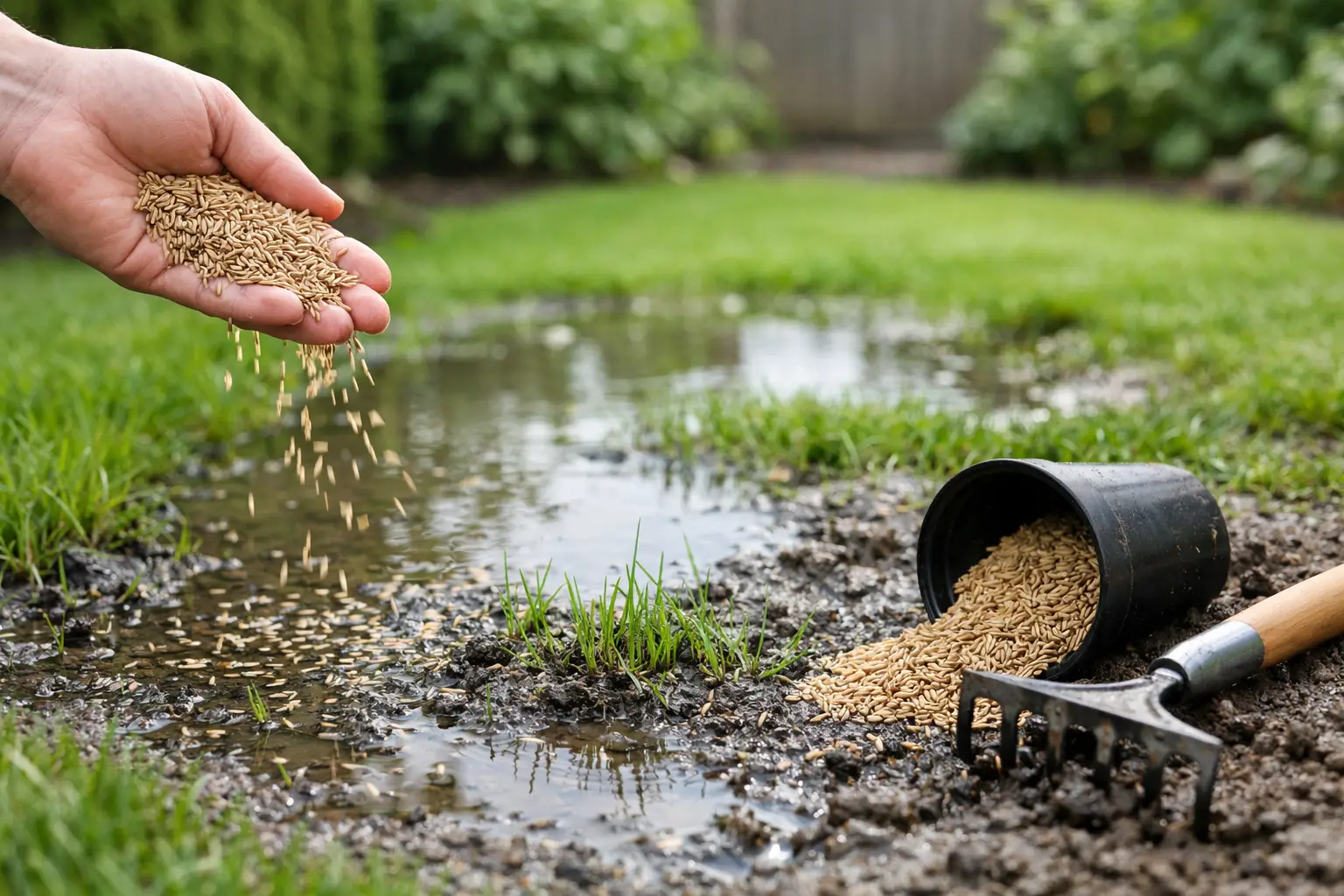
A lawn that squelches underfoot in February, carries puddles after ordinary rain or turns thin beneath moss has a drainage problem before it has a seed problem. The right lawn seed for poor drainage can help grass recover and hold the surface together, but no seed mixture will thrive with its roots sitting in standing water for weeks at a time. First correct the cause where practical, then select grass species suited to the level of dampness and use.
Why poor drainage leaves lawns thin
Grass roots need oxygen as well as water. In saturated soil, the air spaces between soil particles fill with water and root respiration slows. Growth becomes weak, nutrients are less readily taken up, and seedlings are vulnerable to disease. Moss, which is far less demanding than healthy turf, takes the opportunity to spread.
In many UK gardens, the issue is not simply heavy rain. Compacted clay, a buried builders' layer, low spots left after landscaping, excessive thatch and poorly directed surface water can all keep the rootzone wet for too long. A north-facing lawn beneath trees may have the additional challenge of shade, which slows evaporation and reduces grass vigour.
This is why a fast-germinating seed alone is not a cure. It may give a quick green result, then fade when the same wet conditions restrict root development. The aim is a grass cover with suitable tolerance, established in a surface that can exchange air and shed excess water.
Which lawn seed for poor drainage is suitable?
The best mixture depends on whether the lawn is occasionally wet after heavy weather or genuinely waterlogged. It also depends on how it will be used. A family lawn, a shaded ornamental area and a regularly trafficked access route need different priorities.
Perennial ryegrass for repair and wear
Dwarf perennial ryegrass is often the practical backbone of a hard-wearing lawn mixture. It establishes rapidly, copes well with traffic and provides useful early cover while slower species develop. Tetraploid ryegrass varieties have larger seed, vigorous early growth and a substantial root system once established.
Ryegrass is a sensible choice where drainage is imperfect but the soil dries between rain events. It is not, however, a true waterlogging grass. On persistently saturated ground, ryegrass can thin out, particularly through winter. Use it for recovery speed and durability, not as a substitute for drainage work.
Fine fescues for a balanced lawn
Strong creeping red fescue and Chewings fescue bring finer texture and density to many quality lawn blends. Strong creeping red fescue can knit damaged areas together with short rhizomes, while Chewings fescue contributes a neat, dense sward where fertility and wear are moderate.
Fescues are useful in a balanced mixture for a lawn that is damp rather than flooded. They do not appreciate prolonged stagnant water, so they should not dominate a blend intended for a low-lying area that remains wet for days. Their value is in creating lasting lawn character once the surface conditions are improved.
Bentgrass and rough-stalked meadow grass for damp sites
For consistently damp, shaded or low-lying ground, bentgrass and rough-stalked meadow grass can be more tolerant options. Bentgrasses form a close, fine turf and cope well with moist conditions, although they need more careful mowing to look their best and can encourage thatch if management is neglected.
Rough-stalked meadow grass is naturally at home in damper soils and shade. It can provide cover where ryegrass and fescue struggle, but it is softer under wear and generally less desirable for a formal, hard-used lawn. This is the trade-off: the species most willing to live with wet ground may not produce the crisp, ryegrass-led finish wanted for a busy garden or commercial entrance.
For most domestic lawns with moderate drainage issues, a professional-quality mixture containing perennial ryegrass with appropriate fescues is the most dependable starting point, provided the underlying soil is aerated and surface water is addressed. For persistently wet ground, specify a damp-site mixture rather than choosing a standard utility seed on price alone.
Diagnose the water before sowing
Walk the lawn after rainfall. If water sits only in a few shallow hollows, correcting the levels may be enough. If the entire lawn feels soft and water remains for more than 24 to 48 hours in mild weather, investigate soil structure and where the water is coming from.
Dig a small inspection hole around 150 to 200 mm deep. A dense, smeared layer can indicate compacted clay. Rubble, subsoil or a sharp change from topsoil to dense material may point to poor construction during a previous build. A black, sour-smelling layer suggests the soil has stayed without oxygen for too long.
Do not overlook roof run-off, overflowing gutters and neighbouring levels. Sending a downpipe across a lawn edge will repeatedly overload the same area, whatever seed is used. In these cases, drainage channels, soakaways or properly planned collection of surface water are more effective than repeated overseeding.
Prepare the ground so seed can root
Seed needs contact with fine, moist soil, but it also needs a route for roots to move downwards. Preparation is therefore the part of the job that determines whether the new lawn lasts beyond its first season.
For an established lawn, remove moss and accumulated debris first, then scarify lightly where thatch is present. Core aeration is usually more useful than solid tining on compacted ground because it physically removes plugs of soil and creates channels for air and water. On heavy clay, apply a suitable free-draining topdressing after aeration and brush it into the holes. Repeat work is often needed over several seasons.
Where levels need correcting, strip or cultivate the affected area and use a clean, sandy loam topsoil rather than burying the problem beneath a thin layer of sand. Pure sand over clay can form an unstable interface and does not solve a compacted subsoil. For major wet patches, land drains or a redesigned fall may be necessary before any reseeding begins.
Avoid working wet clay. It smears under machinery and foot traffic, closing the very pores you are trying to restore. Wait until it is moist enough to cultivate cleanly and crumbles rather than sticks to boots.
Sowing method for reliable establishment
Early autumn is usually the strongest sowing window in the UK. The soil remains warm after summer, moisture is more reliable and annual weeds are less competitive. Spring sowing also works, but seedlings may need more watering and can face pressure from dry spells or rapid weed growth.
Create a level, firm seedbed with a fine surface. A useful rule is that a footprint should be visible but not sink deeply. Sow at the rate stated for the chosen professional mixture, splitting the seed into two equal portions and applying one pass lengthways and one across the area. This gives a more even plant population than casting all seed in one direction.
Rake very lightly so most seed sits just below the surface, then firm with a roller or by treading boards across small areas. Seed buried too deeply struggles to emerge; seed left loose on top dries out or becomes bird feed. Keep the surface consistently damp with gentle irrigation until seedlings are established, but do not create puddles by applying water faster than the ground can absorb it.
A balanced pre-seeder fertiliser such as a 6-9-6 analysis can support early rooting, particularly where soil has been disturbed or stripped. Use the recommended application rate. More fertiliser does not compensate for wet ground and can stress tender seedlings if over-applied.
Manage the new lawn without compacting it
Make the first cut when the young grass reaches roughly 50 to 75 mm, taking only the top third with a sharp mower. Keep mowing height slightly higher in damp, shaded areas. A taller leaf helps the plant maintain energy reserves and reduces stress when roots are working in slower, wetter soil.
Keep unnecessary traffic off the lawn through winter, especially when the surface is soft. Repeated wheelbarrow runs, football use or machinery on saturated turf compresses the soil and recreates the original problem. If access is unavoidable, use boards to spread the load and repair worn routes in early autumn.
Moss is a symptom worth treating, but not the primary diagnosis. Once it has been controlled and raked out, overseed the exposed areas promptly. Leaving bare, damp soil simply gives moss and weeds another opening.
A better lawn on wet ground is built from the roots upward: choose species that match the site, create air in the soil, and keep surface water moving. Do that work once with care, and every future overseed will have a far better chance of earning its place.