














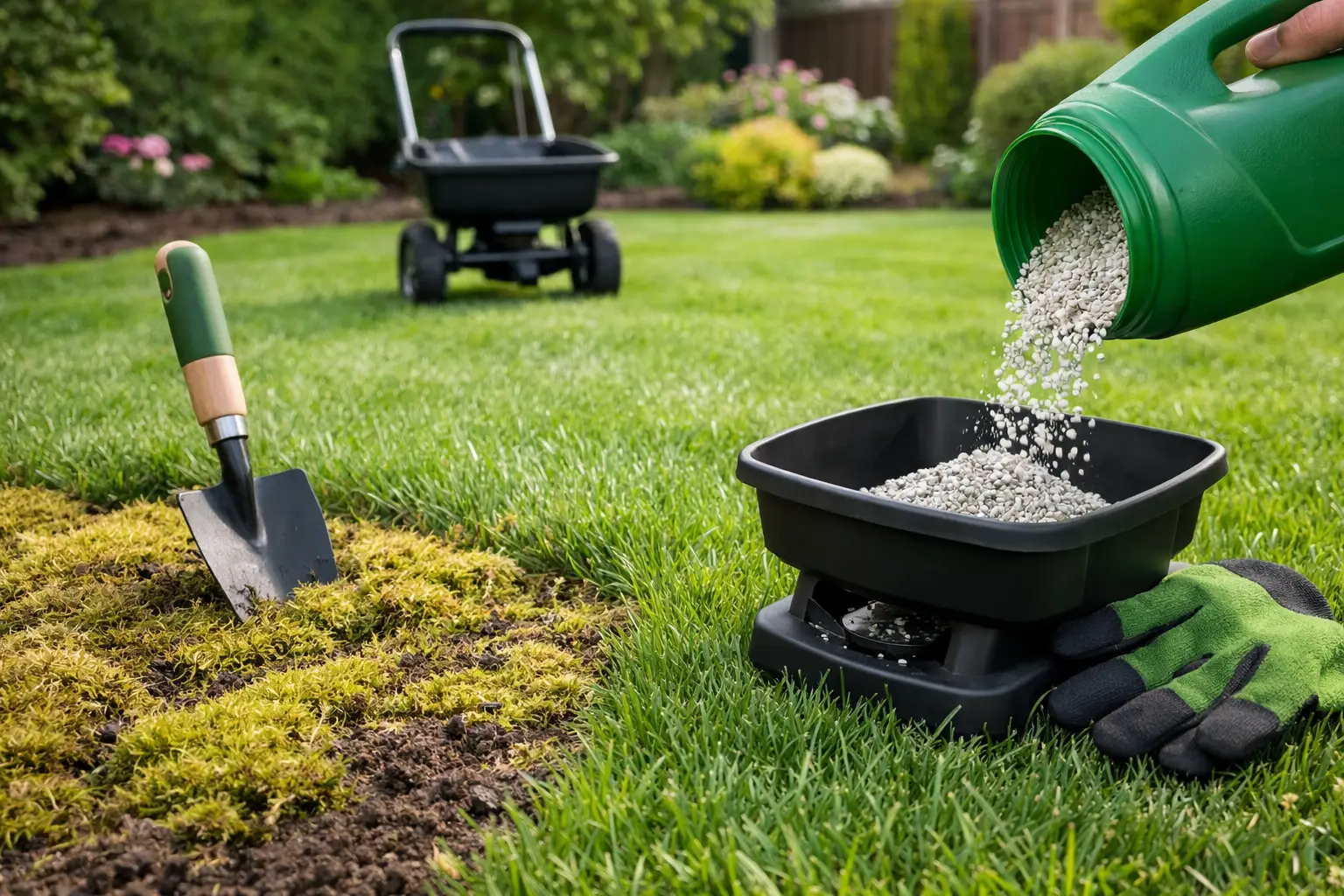
A mossy lawn rarely needs a stronger product first. It usually needs a better diagnosis. This lawn moss killer review separates the treatments that genuinely clear moss from those that merely make it look black for a few days, and explains how to stop the bare spaces returning as another green carpet.
Moss thrives where grass is under pressure: shade, compacted ground, persistent moisture, close mowing, poor drainage or weak fertility. A moss killer can remove the immediate problem efficiently, but it cannot create the light, air and grass density that keep moss out long term. The best treatment is therefore the one that suits both the severity of the moss and the recovery work you are prepared to do afterwards.
Lawn Moss Killer Review: The Treatments Compared
Most lawn moss treatments fall into two practical groups: iron-based products, usually containing ferrous sulphate, and combined granular lawn treatments containing moss control alongside fertiliser and, in some cases, selective weed killer. Both have their place, but they do different jobs.
Iron sulphate moss killers
Iron sulphate is the traditional trade-standard answer to established lawn moss. Once applied in suitable conditions, it causes moss to darken from green to brown or black as it dies back. That visible response is useful because it shows where treatment has reached, although blackened moss still needs physical removal.
A liquid iron sulphate treatment is generally the most precise option. It is well suited to patchy moss, awkward lawn shapes and lawns where the operator wants control over the application rate. Contractors will also value the ability to treat only affected areas rather than applying material across sound turf.
The trade-off is preparation. Liquid products must be measured accurately, mixed thoroughly and applied evenly. Over-application can blacken grass tips, stain paving, decking or clothing, and temporarily mark the lawn. Those marks normally grow out where the turf is healthy, but a stressed lawn may take longer to recover.
Granular iron treatments are more convenient for larger domestic lawns. They are spread dry and activated by moisture according to the product instructions. Even coverage matters. Stripes caused by uneven spreading are common, particularly where a hand-held spreader is used too quickly or without a consistent walking pace.
For heavy moss infestation, iron sulphate remains the strongest choice in this review. It is direct, economical by area and effective when followed by scarification or firm raking.
Granular feed, weed and moss treatments
Combined products are engineered for lawns with more than one issue. A typical formulation may feed the grass, suppress moss and control broadleaf weeds such as daisies, clover and dandelions. This is a sensible route when a lawn is thin, weedy and mossy rather than suffering from moss alone.
The advantage is efficiency. One accurately timed application can improve grass colour, reduce competition from weeds and weaken moss, allowing the lawn to start filling in. Ransley Pro Grow's Renovator Pro is an example of this triple-action approach, intended for lawns that need correction rather than a simple moss-only treatment.
The limitation is that a combined product is not always the right answer. If your lawn is largely weed-free, you may not need a selective herbicide. If you intend to overseed shortly afterwards, check the label carefully: weed-control ingredients often require a waiting period before sowing. Applying grass seed too soon can reduce establishment and leave you with the very bare ground moss exploits.
These treatments should also be kept away from borders and desirable broadleaf plants. They are selective for grass, not selective for every plant in the garden.
Moss control without a killer
Some lawns need remedial work more urgently than chemical control. Moss can be lifted with scarification or vigorous raking, particularly where it is shallow and loose. This removes the material but does not kill it, so spores and surviving fragments may return if the underlying conditions remain unchanged.
Mechanical removal is useful after an iron treatment, not usually instead of one on a heavily affected lawn. It is also demanding on weak turf. Scarifying a lawn that is waterlogged, drought-stressed or sparse can turn a manageable problem into extensive bare patches. Time the work for active grass growth, commonly spring or early autumn, when grass can recover and seed can establish.
What Makes a Moss Killer Worth Buying?
The best product is not necessarily the fastest-looking one. A worthwhile moss treatment should match the lawn’s condition, application method and recovery plan.
First, consider coverage and dose accuracy. A product that appears cheaper can become poor value if its application rate is high or its coverage figure is based on an unrealistic light dose. Measure the lawn rather than guessing. For irregular shapes, split the area into simple rectangles, calculate each section and add them together. This avoids both under-treatment and unnecessary chemical use.
Second, decide whether you need a spot treatment or a whole-lawn application. A few mossy patches beneath a hedge may only need liquid iron sulphate applied locally. Moss spread across a shaded, compacted lawn calls for broader treatment and follow-up renovation.
Third, read the weather requirements. Do not apply to frozen ground, drought-stressed grass, waterlogged soil or when heavy rain is expected immediately afterwards unless the label specifically permits it. Wind matters with liquid products, while damp foliage can affect how some granules adhere and distribute. Product labels are the working specification, not an optional extra.
Finally, account for staining. Iron-based treatments can leave dark marks on concrete, porcelain paving, timber and clothing. Sweep any stray granules from hard surfaces before watering, and rinse equipment after use. This is a small detail, but one that separates a tidy job from an avoidable call-back.
Timing Matters More Than Most People Expect
For UK lawns, early spring and early autumn are usually the most productive periods for moss treatment and repair. Soil moisture is more dependable, grass is actively growing and daytime temperatures are generally moderate. Autumn is particularly useful because summer drought has passed while the soil retains warmth for germination.
Treating moss in midwinter may blacken it, but grass recovery will be slow. Treating during a dry summer can add stress to already struggling turf. If the lawn is in deep shade and remains wet through winter, it may be better to wait until spring before carrying out the full programme of treatment, raking, aeration and overseeding.
Mow the lawn a few days before application, but do not scalp it. A moderate cut gives treatment access to the moss while retaining enough leaf for grass to recover. Keep children and pets off the area until the product label confirms it is safe to return.
The Step That Prevents Moss Coming Back
Once the moss has darkened and dried, rake or scarify it out. This is where many lawns are lost: dead moss is left in place, blocking light at soil level and preventing seed-to-soil contact. Collect the debris thoroughly, then assess what is underneath.
If the soil feels hard, use a garden fork or hollow-tine aerator to relieve compaction. Solid tining is a practical option for most gardens, while hollow tining removes plugs of soil and is more effective on seriously compacted ground. On persistently wet lawns, investigate drainage and avoid repeatedly walking over the same route when the ground is soft.
Overseed bare areas with a grass mixture suited to the site. Fine fescue-containing blends cope better with moderate shade, while a durable ryegrass and fescue mix is often the sensible choice for family lawns and access routes. Seed needs contact with soil, consistent surface moisture and protection from heavy traffic while it establishes.
A suitable seasonal fertiliser can then help the remaining turf and new seedlings thicken. Avoid applying a high-nitrogen feed simply to force colour during unsuitable weather. Healthy density comes from balanced nutrition, correct mowing and roots that can access air and moisture below the surface.
Our Verdict on Lawn Moss Killers
For established moss on an otherwise sound lawn, choose an iron sulphate moss killer and plan to rake the dead material out. It is the most focused, dependable treatment and avoids applying weed killer where none is required.
For a lawn carrying moss, broadleaf weeds and thin grass, a combined granular treatment can save time and produce a more balanced result. Just respect any sowing interval on the label and do not mistake a greener lawn for a solved drainage or shade problem.
No moss killer can compensate for permanently saturated soil, dense shade or grass cut too low. Treat the moss decisively, then give the grass the conditions to win the space back. That is how a lawn stays cleaner through the next wet season, rather than needing the same rescue job every spring.