














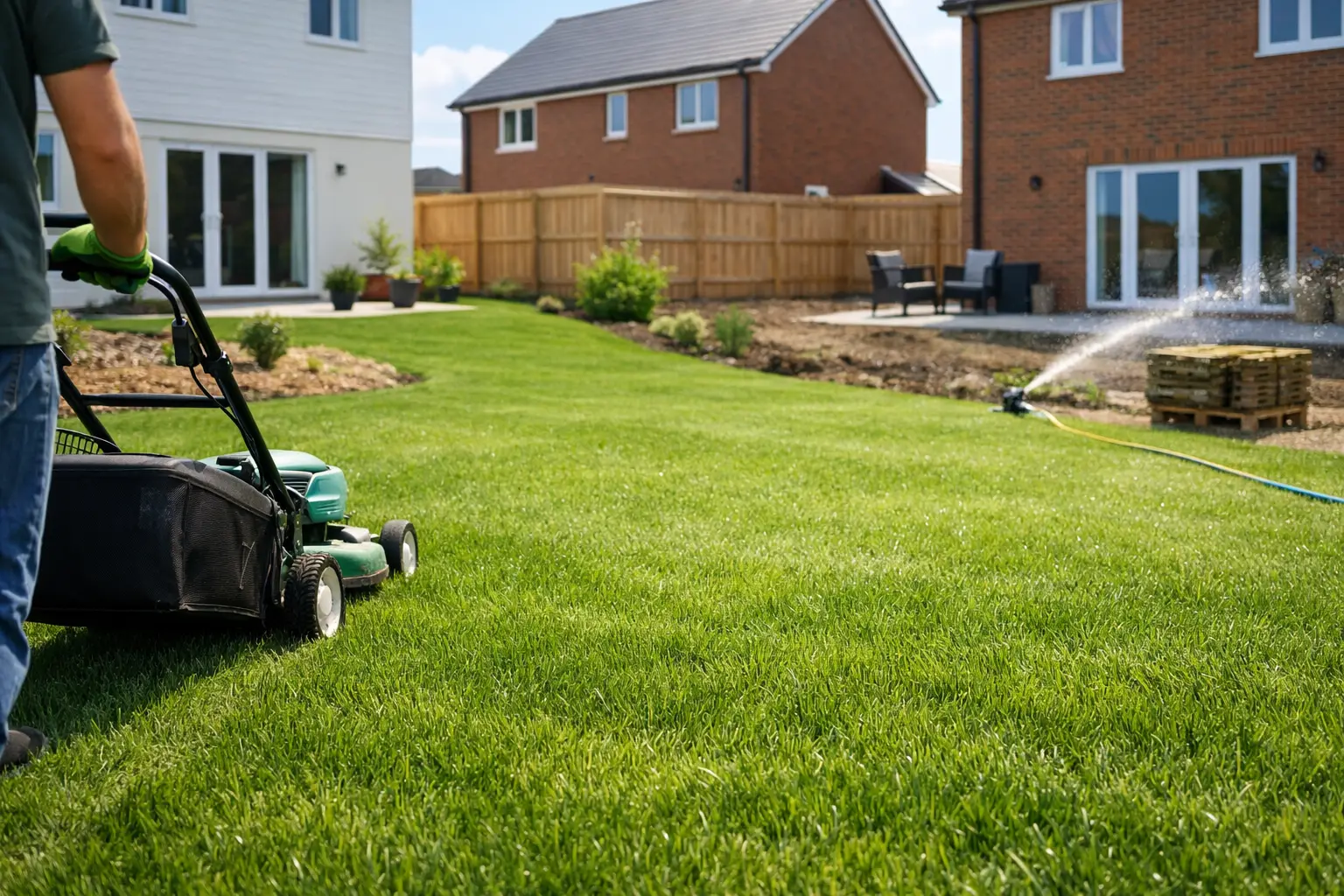
New build plots rarely fail because of the seed. They fail because the ground underneath has been treated like a building site for months, sometimes years. If you want proper lawn care for new build gardens, the job starts well before the first bag of seed is opened.
Most new lawns on housing developments are laid over compacted subsoil, thin topsoil and a fair amount of rubble. You might have an attractive level surface, but that does not mean you have a good rooting zone. Grass is only as strong as the profile below it, and in new build gardens that profile is often the weakest part of the whole project.
Why new build lawns struggle
The typical issues are predictable. Heavy machinery compresses the ground, drainage becomes patchy, and builders' debris interferes with root development. Even where turf has been laid by the developer, it often sits on poor ground and receives just enough water to keep it presentable until handover.
That is why many homeowners see the same symptoms in the first year - yellowing, thin growth, hard dry soil in summer and surface water in winter. Contractors will recognise it as a classic construction-soil problem rather than a grass problem.
Compaction is usually the main culprit. Grass roots need oxygen as much as they need water and nutrients. When the soil is tight, roots stay shallow, and shallow-rooted grass is always the first to suffer in dry spells. On top of that, fresh topsoil on new developments can be low in organic matter and inconsistent in pH, which makes nutrient uptake less efficient.
Lawn care for new build gardens starts with the soil
Before sowing or repairing anything, inspect the ground properly. Push a garden fork or spade into the soil. If it is difficult to get in more than a few inches, the ground is too tight. If you hit brick fragments, plaster, stones or compacted clay, clear them now rather than letting them cause patching later.
A decent lawn profile for domestic use should ideally give you 100-150mm of workable topsoil. Less than that, and grass can still grow, but it will need more careful feeding and watering because there is little reserve below the surface. If you are building the lawn from scratch, cultivate the area thoroughly and incorporate soil conditioner or quality organic matter where needed. The aim is not to make the ground fluffy, but to create a firm, open seedbed that drains and roots evenly.
Where the surface has already been levelled by the builder, do not assume it is ready. Rake off debris, break up capped areas, and consolidate lightly so footprints sit around 10-15mm deep. That is a good test of a seedbed that is neither too loose nor too hard.
Check drainage before you sow
Poor drainage is common in new build gardens, particularly where patios and driveways have changed the way water moves through the plot. After heavy rain, note where water sits for more than a day. If the lawn area puddles repeatedly, simply adding seed will not solve it.
In mild cases, improving structure and aeration may be enough. In more severe cases, you may need to regrade slight hollows or consider drainage channels before the lawn goes down. It is always cheaper to correct waterlogging before establishment than after the grass has failed twice.
Choosing the right grass seed for a new build plot
Seed choice should match the site, not the picture on the box. New build gardens often need a mixture that establishes quickly, tolerates wear and copes with inconsistent moisture in the first season. A trade-standard blend with perennial ryegrass and fine fescues is often a sound starting point because it gives both strength and presentable texture.
If speed matters, tetraploid ryegrass has a clear advantage. Larger seed, rapid establishment in around 7-14 days in suitable conditions, and stronger early vigour can make a real difference on exposed plots. It is particularly useful where homeowners want a usable lawn quickly or contractors need dependable germination.
That said, it depends on the garden. Shaded plots behind close fencing may benefit from a shade-tolerant mixture, while south-facing gardens with thin soil may need drought-resistant species with finer leaves and lower water demand. There is no single best seed for every new build lawn. There is only the best blend for that site.
Feeding young grass without scorching it
New lawns need nutrition early, but they do not need heavy-handed feeding. A pre-seeder fertiliser with a balanced analysis such as 6-9-6 is designed for this stage because it supports root development without forcing soft, weak top growth.
Phosphorus is especially useful at establishment because it encourages root initiation. That matters on new build gardens where the soil profile is often shallow and uncooperative. Apply at the recommended rate before sowing, or immediately after if conditions suit. More is not better. Over-application can check germination, waste product and create uneven growth.
Once the lawn is established and being mown regularly, move onto a seasonal feeding approach. Through spring and summer, a higher-nitrogen feed will improve colour and recovery. As autumn approaches, lower nitrogen and higher potassium are preferable for root strength and winter resilience.
Sowing and watering - where most new lawns are won or lost
Sow when soil temperature and moisture are on your side. In the UK, spring and early autumn are generally the best windows. Early autumn often gives the most reliable results because the soil is warm, weed pressure is lower and rainfall is more consistent.
Spread seed evenly in two directions to avoid striping and patchiness. Lightly rake it in so the seed has contact with the soil, then firm the surface. Good seed-to-soil contact is one of the simplest ways to improve germination.
Watering needs discipline. A new lawn does not want occasional flooding followed by several dry days. It wants consistent surface moisture until germination, then deeper and slightly less frequent watering as roots begin to move down. On many new build sites, the biggest mistake is letting the top 10mm bake hard between waterings. Once that surface crust forms, germination becomes uneven very quickly.
If turf has been laid instead of seed, the principle is similar. Lift a corner and inspect beneath. If the soil below is dry, surface watering is not enough. Turf must knit down into the soil, and that only happens when moisture reaches the rootzone.
Ongoing lawn care for new build gardens
The first mowing should take just the top off the grass, using a sharp blade on a dry day. Do not scalp it. Young grass still has a shallow root system, and cutting too low puts it under unnecessary stress. As a rule, remove no more than a third of the leaf blade at any one time.
During the first year, expect some unevenness. New build ground settles. Minor low spots can often be corrected with light topdressing over time, but substantial dips may need more direct levelling once the lawn is established.
Weeds will appear. That is normal on disturbed ground. The right response depends on timing. In a very young seeded lawn, patience is often the best first step because some weeds fade with regular mowing. Once the grass is strong enough, a selective weed killer can deal with broadleaf weeds without damaging the lawn. If moss develops, that is usually a sign of excess moisture, compaction or weak grass cover rather than an isolated problem.
For tired lawns that need a combined reset, a professional multi-action treatment can be useful, particularly where moss, weed pressure and poor colour are occurring together. But treatments work best when the underlying issue has also been corrected. Killing weeds in compacted, starved ground only creates bare spaces for the next problem to move into.
When to overseed a new build lawn
Even a newly established lawn may need overseeding after its first summer or winter. That is not failure. It is often part of bringing a construction-grade plot up to a proper domestic standard.
Overseed where thin areas persist, using a compatible seed mixture and a light feed to support recovery. Rake the surface first to expose soil, improve contact and remove dead material. On poor plots, this second phase is often where the lawn begins to look settled and durable.
Ransley Pro Grow works with both homeowners and contractors who want that sort of dependable establishment - not just quick green cover, but a lawn built on sound preparation and the right inputs.
A new build garden can produce an excellent lawn, but it responds badly to shortcuts. Fix the soil, match the seed to the site, feed for root development and stay disciplined with watering. Do that, and the lawn stops behaving like a building-site afterthought and starts performing like a proper part of the garden.