














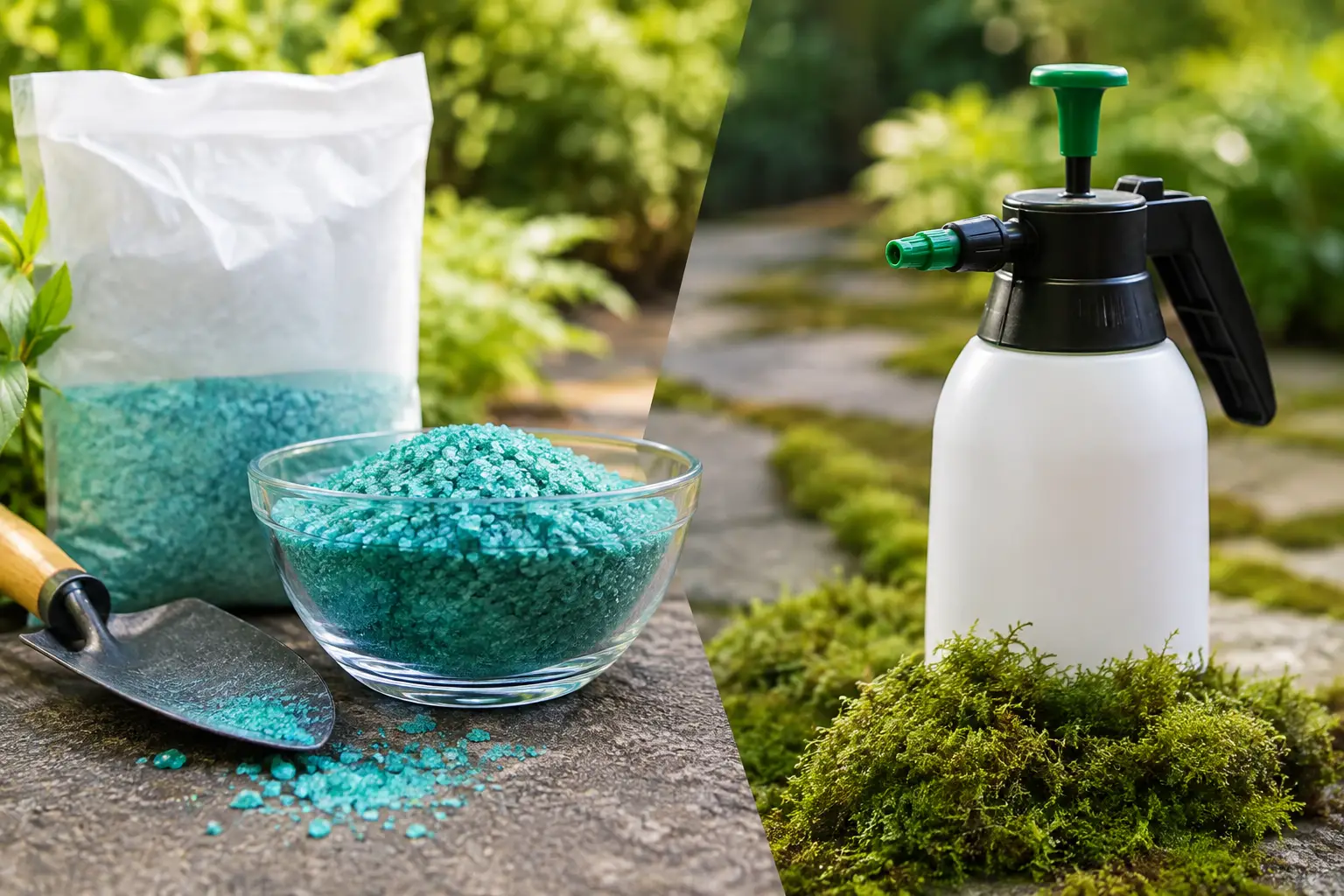
A lawn can look greener within days of treatment, yet still lose ground to moss by the next wet spell. That is why iron sulphate versus moss killer is not quite the either-or choice it first appears. Iron sulphate is often the active ingredient that does the killing; ‘moss killer’ is the broader product category, covering treatments with different ingredients, formats and added benefits.
For a sound result, choose the treatment for the condition of the lawn, then correct the reason moss arrived in the first place. Moss thrives where grass is under pressure: persistent shade, compacted ground, poor drainage, close mowing, thin turf or low fertility. Killing it is the first job. Giving grass the means to reclaim the space is the lasting one.
What is iron sulphate?
Iron sulphate, also known as ferrous sulphate, is an iron salt commonly used in professional lawn care. Applied at the label rate, it blackens moss quickly, making the dead material easy to identify and remove by scarifying or firm raking. It can also produce a noticeably deeper green in grass because iron supports chlorophyll production.
That rapid colour response is useful, but it should not be confused with feeding the lawn. Iron is a micronutrient, not a replacement for a balanced fertiliser programme. If the grass is pale because it lacks nitrogen, has weak roots or is sitting in wet, compacted soil, iron alone will only disguise part of the problem.
Iron sulphate treatments are available as soluble powders, liquids and granules. Soluble or liquid products can give fast, even coverage when accurately mixed and applied through a suitable sprayer or watering can. Granules are convenient for larger domestic lawns and are easier to spread consistently with a calibrated spreader. In every case, use the rate and conditions stated on the product label. More iron is not better.
Iron sulphate versus moss killer: the practical difference
A dedicated iron sulphate treatment is usually the best choice when moss is the principal issue and you want control over each stage of lawn renovation. You can kill the moss, rake it out, aerate compacted soil, overseed bare areas and apply the appropriate seasonal feed separately. This approach is particularly useful on lawns with extensive moss, where the ground needs physical improvement as much as chemical treatment.
A product labelled as a moss killer may contain iron sulphate, but it may also include fertiliser or selective weed control. Multi-action granules are engineered for lawns carrying several common problems at once: moss, broadleaf weeds and a tired, hungry sward. They are efficient where the timing is right and the lawn needs all three actions.
The trade-off is flexibility. A combined product is not automatically the right answer for every lawn. If you only have moss, there is little value in applying herbicide unnecessarily. Equally, if you plan to overseed soon, check the product label carefully. Selective weed killers can restrict when seed may be sown, while a straight iron treatment is generally simpler to fit into a renovation programme.
When straight iron sulphate earns its place
Choose a dedicated iron sulphate treatment where moss is dense, where you are preparing for scarification, or where you want to avoid applying herbicide. It is also a sensible option on lawns that are otherwise weed-free and well fed.
It is particularly effective as part of an autumn recovery plan. Autumn brings moisture and mild temperatures that favour both moss and grass growth. Treating moss, removing the debris, aerating and overseeding with a suitable ryegrass and fescue blend gives new grass a chance to establish before winter. In spring, iron sulphate can still be useful, but avoid turning a soft, saturated lawn into a renovation site too early.
When a combined moss killer is more efficient
A multi-action moss killer is practical where the lawn has visible moss, broadleaf weeds such as daisies or clover, and poor colour caused by low nutrient availability. One accurately applied granular treatment can reduce competition and encourage the remaining grass to respond.
This is a maintenance tool, not a substitute for diagnosis. Do not use it simply because moss has appeared in a few shaded corners. A shaded lawn may need a more shade-tolerant seed mixture, a higher mowing height and less aggressive feeding. Throwing repeated treatments at an unsuitable grass species is expensive and rarely produces a durable finish.
Speed, colour and soil effects
Iron sulphate is valued for visible speed. Moss may darken to brown or black soon after application, depending on weather, product strength and the moss species. The lawn can also look darker green. Allow time for the treatment to work before raking, and do not expect the blackened moss to disappear by itself. It remains in the sward, blocking light and trapping moisture until it is removed.
Its effect on soil deserves more attention. Repeated iron sulphate use can contribute to lower soil pH, particularly on already acidic ground. Grass tolerates mildly acidic conditions, but moss often benefits when the balance moves too far that way. If moss repeatedly returns despite sensible mowing and feeding, a soil test is more useful than another routine application. Test pH, assess drainage and look below the surface for compaction.
Lime should not be applied as an automatic answer to moss. It is only appropriate where a soil test indicates that pH correction is needed. Applying lime and iron sulphate without a plan can work against itself and wastes material.
Apply at the right time, not just the first dry day
For most treatments, apply when the grass is actively growing, the moss is moist and rain is not expected to wash the product away immediately. Avoid drought-stressed turf, frosty conditions, waterlogged ground and very hot weather. A calm day matters too, particularly with liquid applications, as drift can mark or damage nearby plants.
Mow a few days before treatment if the lawn is long, but do not scalp it. Leave sufficient leaf for the grass to recover. Once the moss has blackened, rake or scarify it out. This can leave the lawn looking thinner for a short period, which is normal. The empty areas need light, seed-to-soil contact and appropriate nutrition before grass can replace the moss.
For patchy lawns, overseed after removal using a hard-wearing mixture suited to the site. A tetraploid ryegrass blend can establish in around 7-14 days in suitable conditions and brings useful drought tolerance through deeper rooting. On shaded lawns, include shade-tolerant species rather than relying on ryegrass alone.
Common mistakes that keep moss coming back
The most frequent mistake is treating moss but leaving the lawn permanently wet. Aeration with a garden fork or hollow-tine equipment improves air movement and infiltration, while clearing blocked drains, reducing shade where practical and avoiding winter traffic limits compaction.
The next is mowing too low. A close cut weakens grass and opens the canopy to light at soil level, exactly where moss establishes. Keep the mower higher in shade, during dry weather and into autumn. Remove no more than one-third of the leaf in a single cut.
Finally, do not confuse black moss with a finished job. Once it has died, remove it and repair the surface promptly. This is the point at which a suitable seasonal fertiliser, good seed and steady watering make the difference between a short-lived improvement and a thicker lawn.
Iron sulphate is a proven, trade-standard moss control tool; a combined moss killer can be the smarter option when weeds and feeding requirements genuinely coincide. Read the label, measure accurately and deal with drainage, shade and compaction with equal care. The best treatment is the one that leaves more space for grass to win next season.