














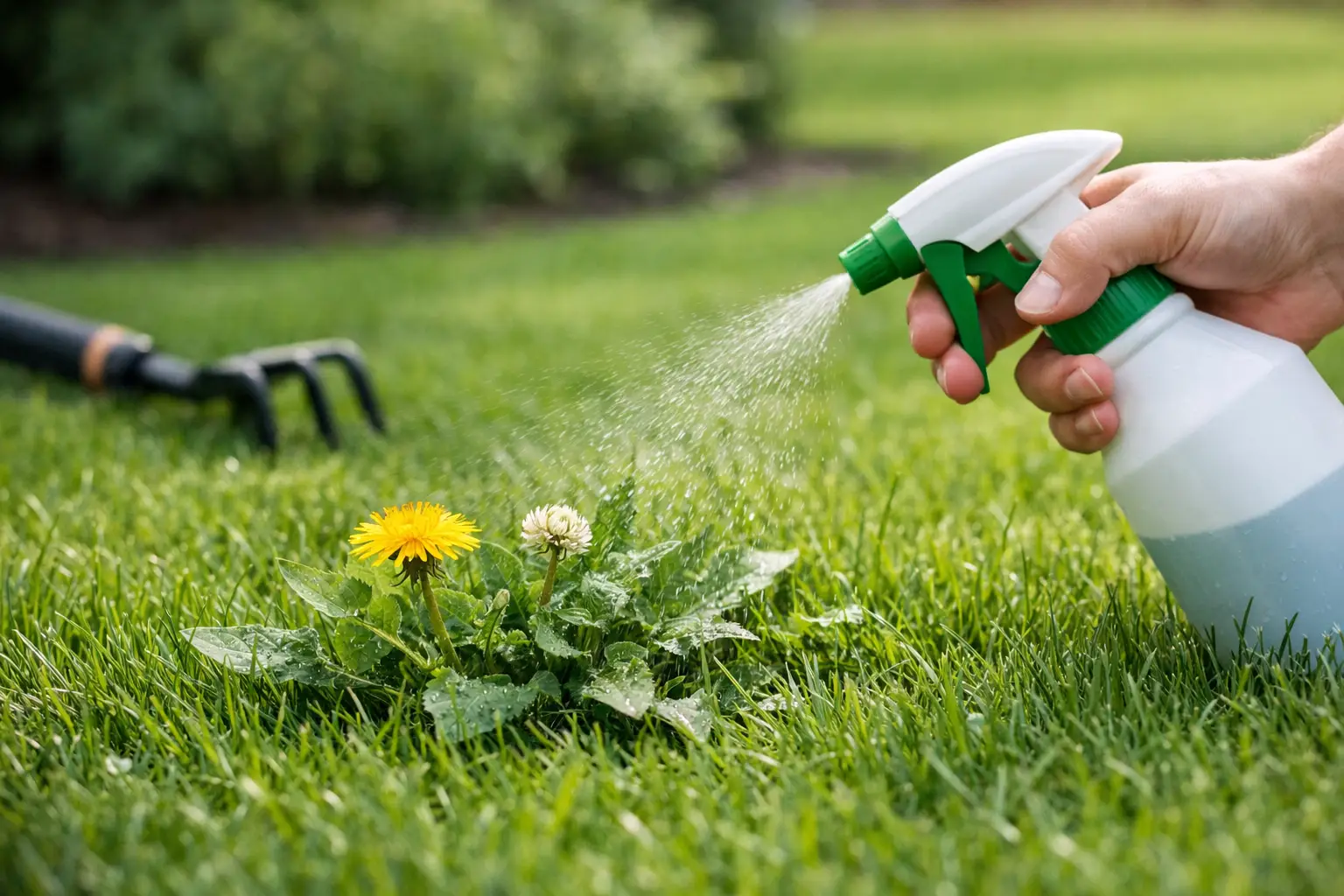
A lawn rarely fills with weeds by accident. Dandelions, clover, daisies, plantain and buttercups usually arrive because the grass is thin, underfed, compacted or cut poorly. If you want to know how to kill lawn weeds properly, the first rule is simple: treat the weed in front of you, but fix the lawn beneath it as well. Otherwise, the same problem returns a few weeks later.
That is why the best results come from a measured approach rather than a quick spray and hope. In most UK lawns, broadleaf weeds can be controlled effectively without harming established grass, but timing, weather, product choice and aftercare all matter.
How to kill lawn weeds the right way
There are two parts to weed control in turf. First, remove or suppress the unwanted plant. Second, improve grass density so there is less space, light and moisture available for weeds to return.
For most domestic and professional lawns, broadleaf weeds are the main issue. These include dandelion, white clover, common daisy, ribwort plantain, chickweed and creeping buttercup. A selective lawn weed killer is designed to target these species while leaving grass plants unharmed when used correctly. That makes it the standard choice for established lawns.
The important phrase there is established lawns. If you have just sown seed, laid fresh turf, or overseeded patchy areas, you cannot assume every weed treatment is safe straight away. Young grass is more sensitive, and applying the wrong product too early can check growth or thin the sward.
Start by identifying what is actually growing
Not every lawn problem is a weed problem. Moss, algae, coarse grasses and sedges are often mistaken for broadleaf weeds, yet they need different treatment.
Broadleaf weeds have wider leaves and a different growth habit from fine lawn grasses. Dandelions form deep taproots. Clover spreads low and dense, often where nitrogen levels are poor. Plantain sits flat and survives heavy wear and compaction. Buttercup favours damp, poorly drained ground. Those details matter because they tell you why the weed has gained a foothold.
If the lawn is mostly broadleaf weeds in scattered patches, selective control is usually straightforward. If the area is more weed than grass, complete renovation may be the better route. That is one of the key trade-offs. Spot treatment and feeding can rescue a lawn with decent grass cover. A lawn that is 60 to 70 per cent weeds often responds better to clearing and re-establishing from seed.
Choose the correct method for the lawn condition
When people ask how to kill lawn weeds, they are usually deciding between hand removal, selective weed killer or total herbicide. Each has a place.
Hand weeding suits isolated perennial weeds, especially large dandelions and docks. It is precise, avoids unnecessary chemical use, and works well if you remove the full root. The weakness is scale. On a larger lawn, it is slow, and any root left behind can regrow.
Selective lawn weed killer is the practical choice for most established lawns. It controls common broadleaf weeds across the whole area or as a spot treatment while preserving the grass. This is the method that gives the best balance of efficiency and turf safety in regular lawn care.
Total herbicide has a different job. It kills all green vegetation, including grass, so it is useful for clearing paths, drive edges or a lawn that needs complete renovation. It is not for routine weed control in a lawn you want to keep.
Timing matters more than most people realise
The best window to treat lawn weeds in the UK is during active growth, usually from mid-spring into early autumn. The grass and the weeds both need to be growing properly. In cold conditions, drought stress or very hot weather, uptake is poorer and results are less reliable.
Late spring is often ideal because broadleaf weeds have enough leaf area to absorb treatment and the lawn is growing strongly enough to recover. Early autumn can also be effective, especially when soil is still warm and moisture has returned.
Avoid mowing immediately before application. A weed killer needs leaf surface to work through. As a rule, leave a few days before treatment and a few days after, unless the product instructions state otherwise. Rainfall also matters. Many products need a dry period after application so they can bind and absorb properly.
Apply selective weed killer carefully
This is where good results are won or lost. Use the correct dose, apply in suitable weather, and treat only when the grass is healthy enough to withstand normal maintenance.
If weeds are scattered, spot treatment is often enough. If they are spread throughout the lawn, a full application may be more efficient. Either way, even coverage matters. Overdosing does not improve performance. It only increases the chance of stressing the turf.
For homeowners, liquid selective weed killers are often used with a knapsack or pressure sprayer. Granular multi-action treatments can also work well where feeding, weed control and moss suppression are needed together, but they are less precise in awkward shapes or tiny patches. For contractors, the choice often comes down to site size, calibration accuracy and the need to combine operations.
One practical point that gets overlooked: do not treat a lawn that is already struggling from drought, severe compaction or nutrient deficiency and expect a perfect finish. Weed control removes competition, but the grass still needs enough strength to fill the gaps afterwards.
What to do after the weeds die back
A weed-free lawn is not automatically a good lawn. Once the weeds begin to curl, blacken or disappear, you are left with the real question: will the grass close over, or will new weeds simply germinate into the open space?
This is where feeding and repair become important. If the lawn is in active growth, a suitable seasonal fertiliser helps the grass thicken and improve colour. In spring and summer, nitrogen supports leaf growth and chlorophyll production. In autumn, lower-nitrogen, higher-potassium formulations support root strength and winter resilience.
If the lawn is thin, overseeding is often the missing step. Strong modern seed mixtures establish faster and create a denser sward, which is one of the most effective long-term weed prevention tools available. On worn or patchy lawns, trade-standard seed blends with perennial ryegrass and fescues are especially useful because they balance durability with finer appearance. Ransley Pro Grow, for example, specialises in these professional-grade lawn inputs, which is exactly the sort of joined-up approach weed control needs.
How to stop lawn weeds coming back
If weeds are recurring, the lawn is usually telling you something. Clover often points to low fertility. Moss and buttercup suggest damp, shade or poor drainage. Plantain is common in compacted ground. Daisy and self-heal thrive in close-cut, hungry turf.
Prevention is less glamorous than spraying, but it is what keeps a lawn tidy for the long term. Mow at the right height for the season and grass type rather than scalping it short. Feed according to growth stage, not guesswork. Aerate compacted ground so air, water and roots can move properly. Overseed worn areas before they become open invitations to weeds.
It also helps to adjust expectations around perfection. A family lawn, a shaded garden lawn and a high-wear contractor-maintained surface all behave differently. The right standard is a dense, healthy sward suited to its use, not a forcing programme that weakens the grass for the sake of a temporary cosmetic finish.
Common mistakes when trying to kill lawn weeds
The most common error is using the wrong product. A total herbicide on a lawn is a costly mistake. The second is poor timing, especially applying in cold snaps or dry stress. The third is treating the weed but ignoring the reason it appeared.
Another mistake is mowing too short after treatment and exposing the soil. That reduces grass vigour just when recovery is needed. Finally, many people expect one pass to solve everything. Some perennial weeds need follow-up treatment, particularly if they are mature, deeply rooted or growing in compacted conditions.
When a full lawn renovation is the better option
There comes a point where selective treatment is no longer the most efficient route. If the lawn is heavily infested, uneven, compacted and sparse, full renovation may save both time and money. That usually involves clearing the area, correcting the soil profile, applying a suitable pre-seeder fertiliser, then sowing a quality seed blend chosen for the site conditions such as shade, wear or drought exposure.
This approach is more disruptive in the short term, but the end result is often cleaner and longer lasting than repeated rescue treatments on a failing lawn.
The best lawns are not built by reacting to every weed as it appears. They are built by creating conditions that favour grass first. Kill the weeds, certainly, but then give the lawn a reason to stay thick, competitive and healthy. That is the part that turns a temporary fix into a proper result.