














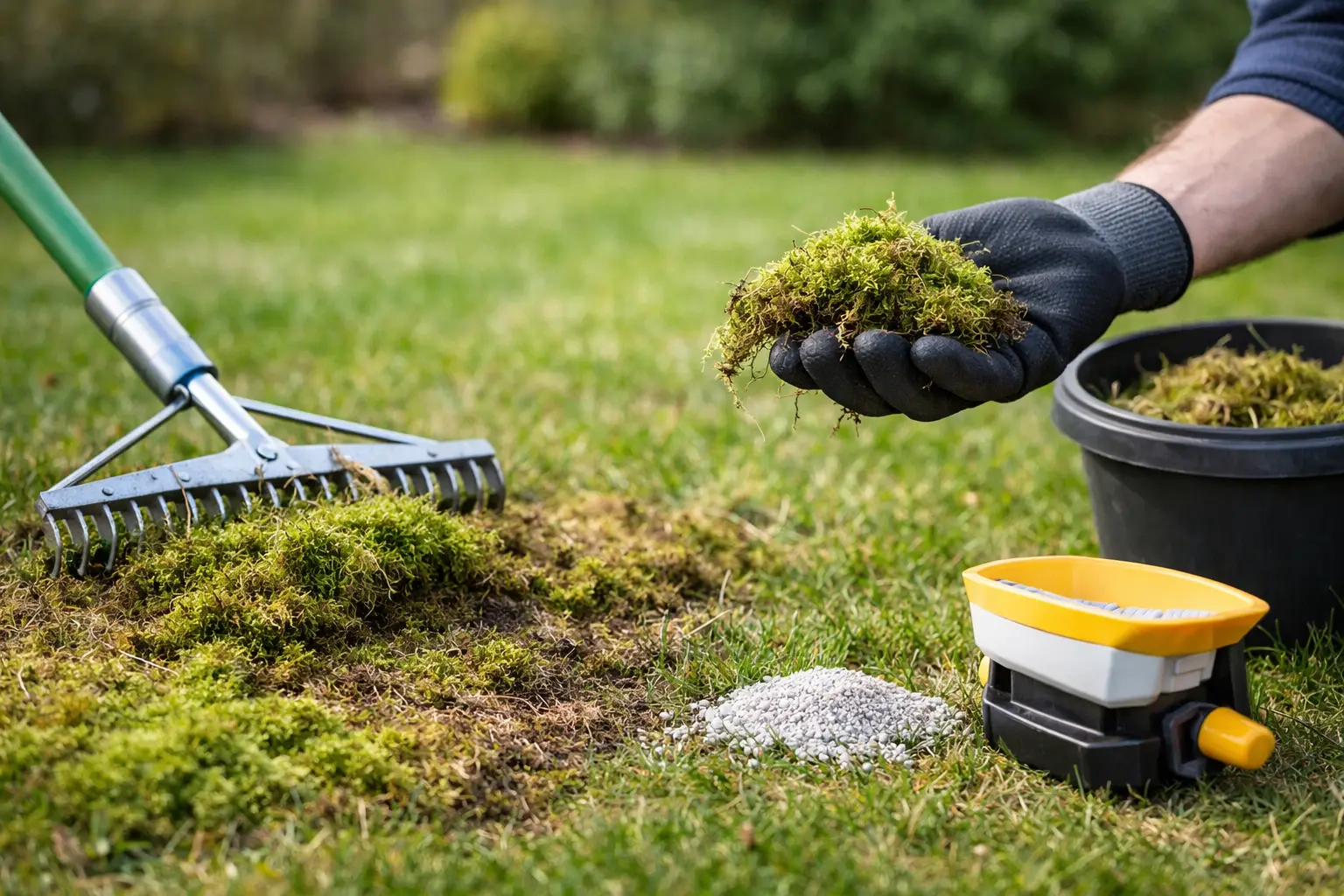
Moss rarely appears because it is “winning”. It appears because the grass has stopped competing. If you want to know how to fix lawn moss, start there. Killing the moss is the easy bit. The lasting fix is to correct the conditions that allowed it to spread in the first place - usually shade, compaction, poor drainage, low fertility, acidic soil, or a mowing regime that weakens the sward.
A lawn with moss can still be recovered to a very high standard, but the method depends on why the moss is there. A damp, shaded garden in Surrey needs a different approach from a compacted, waterlogged new-build lawn in Manchester. Treat the symptom first if you need a quick tidy-up, then deal with the cause if you want the result to hold.
How to fix lawn moss without guesswork
The most reliable approach is a three-stage job. First, kill or suppress the moss. Second, remove the dead material and correct the site conditions. Third, help grass re-establish quickly so the open space does not simply moss over again.
If you skip the middle stage, moss usually returns. That is why many lawns look better for a fortnight after treatment, then slide backwards.
Step 1: Kill the moss cleanly
For active moss growth, iron-based moss control remains the trade-standard option. High-iron treatments blacken moss quickly and give you a clear view of the affected areas. They are particularly useful in spring and early autumn, when moisture levels favour both moss growth and lawn renovation.
Apply only to a suitable lawn, follow the rate precisely, and avoid overlap. More product is not better. Excessive application can stress the grass and leave temporary blackening on paving or concrete if granules are tracked about.
Some homeowners prefer a combined product that feeds the lawn while tackling moss and broadleaf weeds at the same time. That can be efficient, but only if all three problems are present. If your lawn has moss and little else, a simpler treatment is often the cleaner choice.
Step 2: Scarify out the dead moss
Once the moss has blackened and died back, rake or scarify it out thoroughly. This is the stage many people underestimate. Dead moss left sitting in the surface layer continues to hold moisture, shades the crown of the grass plant, and restricts air movement at soil level.
On a lightly affected lawn, a spring-tine rake may be enough. On heavier infestations, a powered scarifier will do a far better job and expose the true condition of the turf. Expect the lawn to look worse before it looks better. That is normal. You are removing weak material so stronger grass can return.
Step 3: Repair the bare areas quickly
Any space left after scarifying must be reoccupied by grass. Overseed promptly using a mixture suited to the site. For shaded lawns, use a shade-tolerant blend rather than forcing a standard ryegrass mix into poor light. For family lawns and general wear, a hard-wearing blend with perennial ryegrass and fescues usually gives the right balance of recovery speed and finish.
Seed-to-soil contact matters more than optimism. Work seed into the surface, keep it moist during germination, and protect young grass from heavy traffic. If the lawn is thin across a large area, overseeding the whole surface often gives a more even result than patch repairs alone.
Why moss keeps coming back
Moss is a sign of weak turf conditions. Unless you change those conditions, you are only buying time.
Shade and low light
Grass needs light to produce dense, competitive growth. Moss is far more tolerant of low light, especially where air movement is poor and surfaces stay damp. If fences, walls, trees or neighbouring buildings keep the lawn in prolonged shade, choose a grass seed blend engineered for those conditions and raise your mowing height slightly. Longer leaf means more photosynthetic area, which helps the grass compete.
Not all shade can be fixed. Sometimes selective pruning improves light levels. Sometimes it does not. In very dark corners, it may be more sensible to reduce lawn area and use a different surface finish.
Compaction and poor drainage
If water sits on the lawn after rain, or if the ground feels hard underfoot in summer and sticky in winter, compaction is likely. Compacted soil restricts root growth and oxygen movement. Grass struggles. Moss does not mind nearly as much.
This is where aeration matters. Hollow-tine aeration is the stronger remedy on heavily compacted lawns because it physically removes cores and creates space for air and water movement. Solid-tine aeration helps too, particularly as routine maintenance, but it does less to relieve severe compaction.
On clay soils, one treatment will not perform miracles. Repeated autumn aeration, combined with sensible topdressing and improved surface management, usually brings the best long-term improvement.
Low fertility
Thin, pale grass gives moss room to spread. Lawns that receive little or no feeding often lack the density needed to resist invasion. A proper feeding programme should reflect the season. In spring and summer, nitrogen supports chlorophyll production and active growth. In autumn and winter, lower nitrogen with higher potassium is better for root strength and cold-weather resilience.
Feeding is not a substitute for drainage or light, but it is a key part of recovery. A hungry lawn is rarely a resilient one.
Acidic soil
Moss is often associated with acidic conditions, but soil pH should be checked rather than guessed. Not every mossy lawn is too acidic, and indiscriminate liming is poor practice. A simple soil test gives a clearer answer. If pH is genuinely low, corrective action may help the grass perform better. If pH is already acceptable, lime will not solve the problem and may interfere with other treatments.
Mowing too short
Scalping weakens grass and exposes the surface. That creates an ideal foothold for moss, especially in damp weather. If your mower is set low because you want a tight finish, but the lawn is shaded or under stress, you are making the grass work harder than the site allows.
As a rule, keep the cut higher in shaded areas and during dry spells. Remove no more than a third of the leaf blade in one mow. Short-term neatness is not the same as long-term turf health.
The best time of year to fix moss in a lawn
If you are deciding how to fix lawn moss in the UK, timing matters. Spring and early autumn are usually the best windows because the soil is moist, temperatures are moderate, and grass is active enough to recover.
Spring is useful when moss has built up over winter and you want the lawn back into shape before the main growing season. Early autumn is often even better for renovation work because soil temperatures remain good for germination, weed pressure tends to ease, and moisture conditions are generally more reliable than in late spring.
Mid-winter is poor timing for major repair. The lawn is slow, wet and vulnerable to damage. High summer can also be awkward, particularly if drought conditions make overseeding difficult to keep alive.
What to do after moss treatment
Once the moss is removed and the lawn is reseeded, aftercare decides the result. Keep foot traffic light while new seedlings establish. Water enough to keep the seedbed consistently damp, not saturated. Begin mowing only when the new grass is strong enough to take a light cut, and keep the blade sharp to avoid tearing young leaf tissue.
Continue with a measured feeding plan. Newly recovering turf benefits from nutrition that supports root development without excessive soft growth. A balanced pre-seeder or establishment feed is often the right choice after overseeding, while stronger seasonal fertilisers can follow once the grass is mature enough.
If moss was linked to heavy shade or wet ground, keep expectations realistic. Improvement is absolutely possible, but the lawn may need an ongoing management approach rather than a one-off rescue.
When moss needs a different answer
There are lawns where repeated moss problems are telling you something structural. Deep shade, persistent standing water, poor subsoil from building works, or constant wear in winter may mean turf is the wrong surface for that particular area. That is not failure. It is good groundsmanship. The right answer is the one that suits the site.
For most lawns, though, moss can be brought under control with a proper sequence: treatment, removal, correction, repair. That is the difference between a temporary cosmetic fix and a lawn that thickens up and stays cleaner through the season.
If you want a better lawn, stop treating moss as the main problem. Treat it as a warning sign. Once the grass has the right light, air, drainage, nutrition and seed mix, it usually does what it is meant to do - close the gaps and keep the moss out.