














A lawn that has turned pale, mossy and thin after a wet spell does not always need more nitrogen. It may need iron. Knowing how to apply lawn iron correctly gives grass a deeper green colour, checks moss and helps the lawn look sharper without forcing soft, excessive growth. Apply it carelessly, however, and iron can blacken moss, stain paving and scorch already stressed turf.
Iron is a useful trade-standard tool, but it is not a substitute for correcting shade, compaction, poor drainage or worn-out grass cover. Use it for the job it is formulated to do, at the rate printed on the pack.
What lawn iron does - and what it does not do
Most lawn iron treatments contain iron sulphate, also called ferrous sulphate. On grass, iron supports chlorophyll production, which is why a correctly treated lawn often develops a noticeably richer green colour. It is particularly useful when the lawn is growing but lacks depth of colour, or where moss is competing with the turf.
Its most familiar role is moss control. Iron sulphate acidifies the moss surface and causes it to turn dark brown or black. That is a sign the treatment is working, not that the lawn has failed. Once the moss has died back, it needs to be scarified or raked out. Leaving it in place creates a layer of debris that blocks light and prevents grass from thickening into the space.
Iron does not cure the conditions that allowed moss to establish. Moss is usually a symptom of one or more underlying issues: compacted ground, persistent shade, poor drainage, close mowing, weak grass cover or low soil fertility. Treat the moss, then address the cause. Otherwise, it will return.
Choose the right iron product first
There are two broad categories of lawn iron, and they should not be treated as interchangeable.
Iron sulphate products are generally used for moss control and rapid colour response. They may be supplied as soluble granules, powder, liquid concentrate or as part of a granular moss and feed treatment. These products can be highly effective, but concentration and application rates vary significantly between formulations.
Chelated iron products are generally milder lawn tonics, designed to improve colour where iron availability is limited. They are often used when the aim is cosmetic green-up rather than moss removal. Some are formulated for application through a sprayer and may be suitable for more regular use, provided the label permits it.
A combined feed and moss treatment is convenient where the lawn needs both nutrition and moss control. The trade-off is timing. A high-nitrogen feed can stimulate leaf growth, while a strong moss treatment may be better applied when the grass is actively growing but not under stress. If the lawn is drought-stressed, heavily shaded or compacted, solve those issues before pushing growth with fertiliser.
When to apply lawn iron in the UK
Spring and early autumn are normally the most reliable windows. The grass should be actively growing, the soil should have some moisture, and temperatures should be mild. In practical terms, that often means March to May and September to October, though weather matters more than the calendar.
Choose a calm, dry day when rain is not expected immediately after application, unless the product label specifically instructs you to water it in. Liquid iron needs time on the leaf for effective uptake. Granular products vary: some should be applied to dry grass and watered in, while others are designed to dissolve with light rainfall.
Do not apply iron to a frost-covered lawn, drought-stressed turf, newly laid turf or seedlings that have not established properly. Avoid very hot, bright conditions too. A stressed lawn is more likely to mark or scorch, especially with stronger iron sulphate formulations.
If you have recently scarified, aerated or overseeded, give the lawn time to recover before using a moss-killing iron treatment. Young seedlings and exposed crowns are less tolerant than mature turf. For a repair job, it is often better to remove moss first, prepare the surface, sow fresh seed and then feed with a suitable pre-seeder fertiliser rather than applying more iron.
How to apply lawn iron safely and evenly
The label rate is the controlling figure. Do not increase the dose because the lawn looks particularly mossy or pale. More iron does not mean a better result. It increases the chance of leaf scorch, blackened patches and staining.
Before treating the whole lawn, measure the area accurately. A lawn that looks like 100 square metres is often substantially smaller once beds, paths and patios are excluded. Calculate the dose for the actual grass area, then measure the product rather than estimating by eye.
Applying granular iron treatments
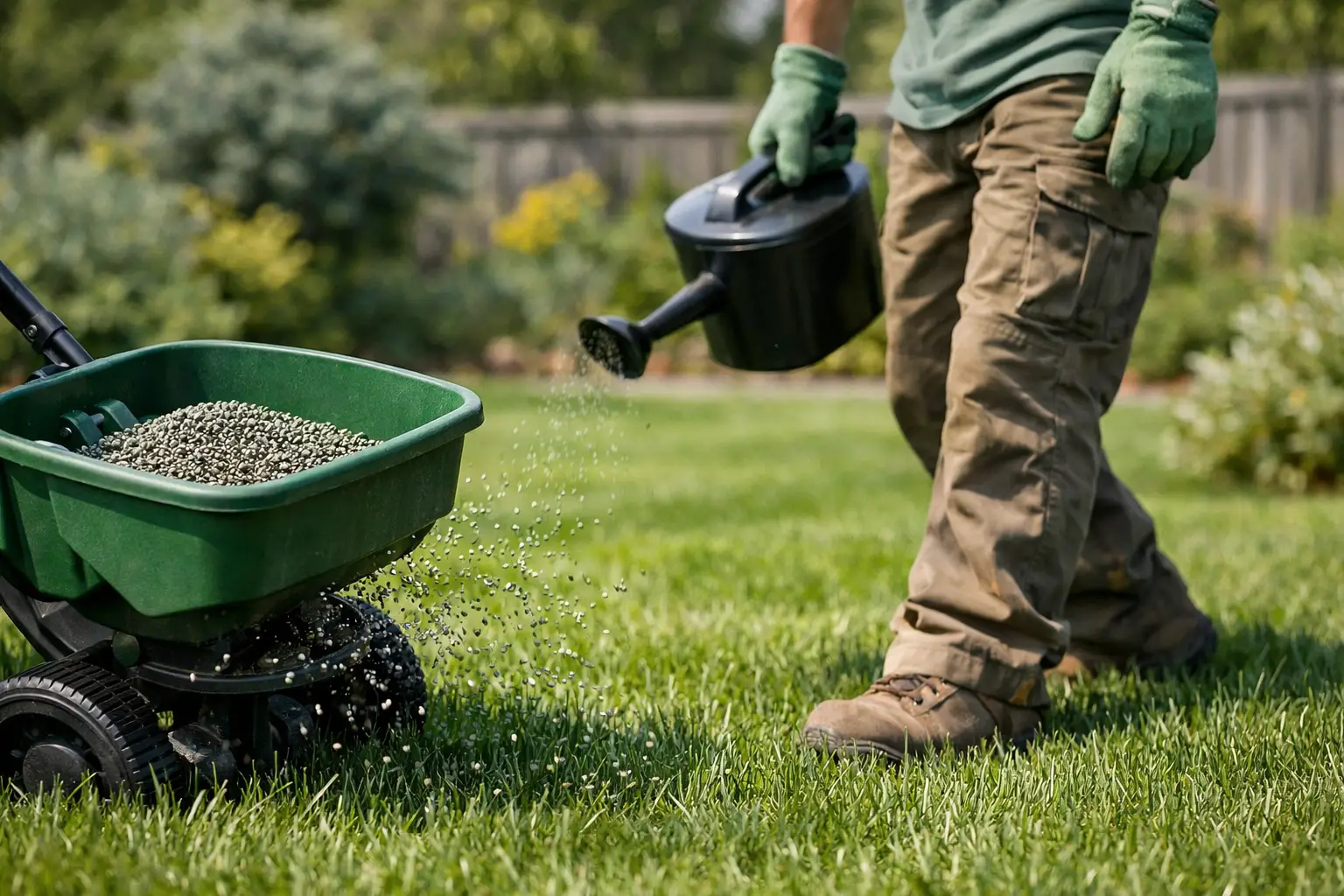
For granular products, use a calibrated rotary or drop spreader for the most even result. A drop spreader gives greater control along borders and near paving; a rotary spreader covers larger areas quickly but can throw granules into beds or onto hard surfaces.
Apply half the product while walking in one direction, then apply the remaining half at right angles. This cross-hatch method reduces striping and missed areas. Keep a steady walking pace and overlap only as instructed, particularly with a rotary spreader.
Sweep any granules off paths, decking, paving and driveways immediately. Iron can leave stubborn rust-coloured marks on porous surfaces. Do not wash product into surface drains or ponds.
Applying liquid lawn iron
Liquid products need accurate dilution and consistent spray coverage. Use a clean watering can fitted with a fine rose for small lawns, or a properly calibrated knapsack sprayer for larger areas. Add water to the tank first, then measure in the concentrate and mix according to the label directions.
Spray evenly over the leaf, avoiding run-off. The aim is a light, uniform coating, not puddles. Keep the nozzle at a consistent height and walk at a regular pace. It is sensible to test the spray pattern with plain water first, especially if using a new sprayer.
Wear gloves, long sleeves and suitable eye protection when mixing and applying concentrated products. Keep children and pets off the treated lawn until it has dried, or for the period stated on the label. Wash equipment thoroughly after use, but never dispose of washings into drains, watercourses or ponds.
What to expect after application
A colour response from iron can appear within a few days, depending on temperature, grass growth and product type. Moss commonly darkens quickly after an iron sulphate treatment. Allow it to die back fully, then rake or scarify it out when conditions allow.
Do not mow immediately before or after applying liquid iron. Leaving a reasonable leaf area helps the treatment contact the grass, while mowing too soon afterwards can remove treated foliage before the product has done its work. As a practical rule, mow two or three days before treatment if the lawn needs it, then wait until the lawn has dried and shown a response before mowing again. Always follow the product instructions where they differ.
After moss removal, bare areas will need attention. Lightly rake the surface, overseed with a suitable lawn seed mixture, maintain even moisture and avoid cutting too low while new grass establishes. A durable ryegrass and fescue blend is often a sensible choice for family lawns because it combines wear tolerance with a finer finish.
Common mistakes that cause poor results
The first mistake is using iron as a permanent fix for moss. If water sits on the lawn, trees block light or soil is compacted, treatment alone will only buy time. Aeration, drainage improvement, sensible mowing and overseeding are the long-term answer.
The second is applying it unevenly. Dark stripes and patchy colour usually point to inconsistent spreader settings, overlapping spray passes or inaccurate measurement. Calibrate equipment on a small measured area before treating the full lawn.
The third is combining too many treatments at once. Avoid applying iron alongside selective weedkiller, strong fertiliser, wetting agent and other lawn chemicals unless the individual labels specifically confirm compatibility. Give the lawn time between operations so you can judge the response and avoid unnecessary stress.
Finally, do not treat an iron application as a cue to cut the lawn short. Keep mowing height sensible - usually around 25-40 mm for a general domestic lawn, and higher in shade or dry weather. More leaf area means more energy for recovery and a denser turf that leaves less room for moss.
A well-timed iron treatment can make a tired lawn look markedly better, but the lasting result comes from what follows: remove the dead moss, improve the growing conditions and give the grass enough seed, nutrition and room to fill in properly.