














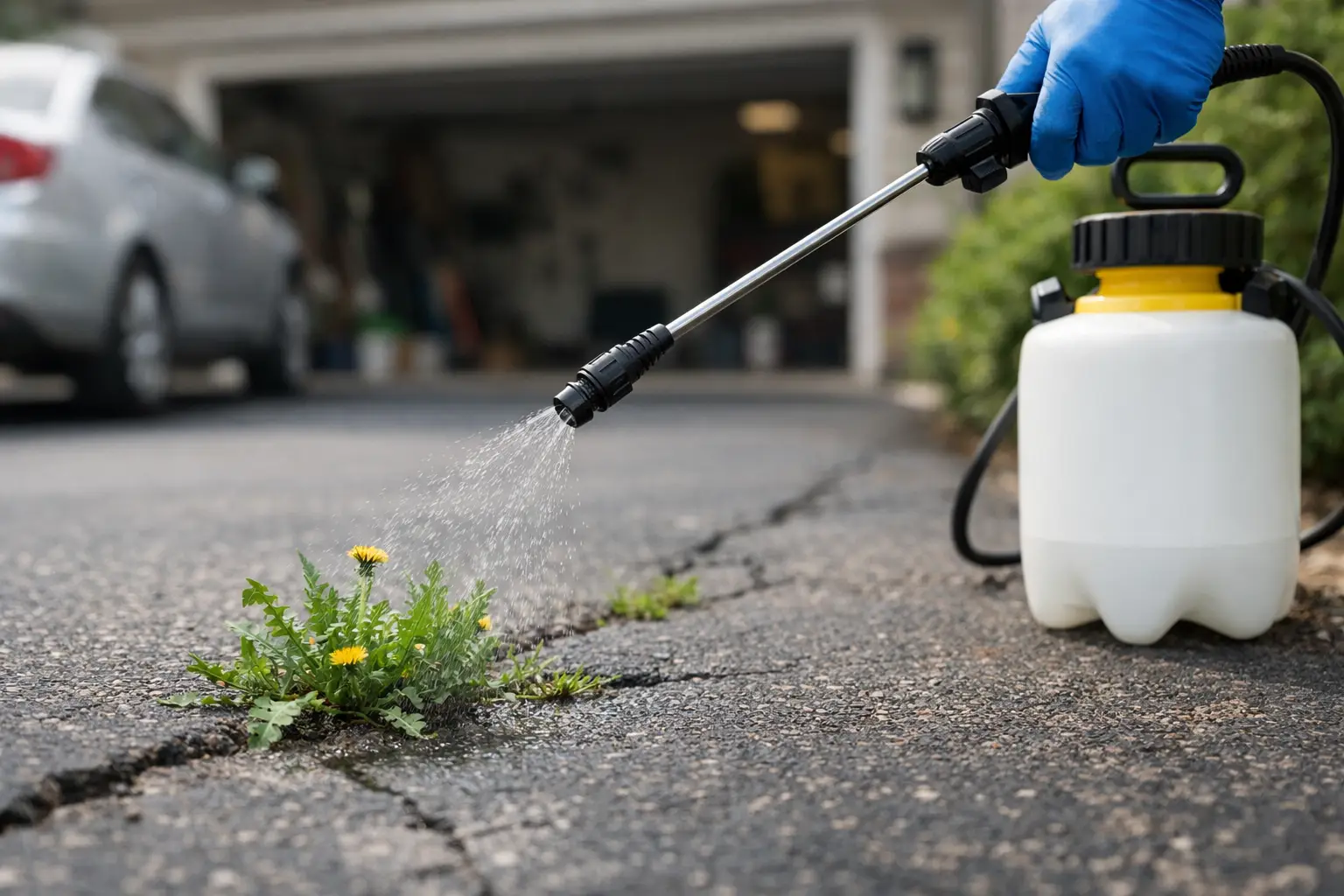
A clean driveway usually tells the truth about weed pressure in the rest of the garden. If annual meadow grass is seeding in the joints, dandelions are pushing through edge cracks and moss is holding moisture on the shaded side, you do not need a miracle cure. You need the right treatment, used at the right stage. For many hard-surface jobs, a glyphosate weed killer for driveways remains the most reliable way to clear active growth back to bare ground.
The key point is that glyphosate is a total herbicide, not a selective one. It does not distinguish between a weed in a block paving joint and a border plant you meant to keep. That makes it highly effective on driveways, paths and other hard surfaces, but only where precise application is possible and drift is controlled.
When glyphosate weed killer for driveways works best
Glyphosate is absorbed through green leaf tissue and moved through the plant into the root system. That matters because timing affects performance far more than most users realise. Spraying a plant that is actively growing in mild conditions will give a better result than treating stressed, dusty or drought-checked weeds in poor conditions.
In practical terms, late spring through early autumn is usually the main treatment window in the UK. You want enough leaf area to intercept the spray and enough active growth for the herbicide to translocate properly. Small seedlings can be controlled, but weeds with a little more top growth often take treatment more efficiently. Very mature, woody or weather-stressed weeds can need more patience, or in some cases a follow-up application.
Dry weather helps, but not baking heat. A calm day is better than a windy one, and avoid spraying if rain is due shortly afterwards. Check the product label for rainfast timing because formulations differ. If the spray is washed off before absorption, results will be weaker and patchier.
What it controls on hard surfaces
On driveways, glyphosate is typically used against a broad range of common UK weeds. That includes annual meadow grass, chickweed, groundsel, sow-thistle, plantain, nettles and dandelion, along with many other broadleaf and grass weeds that emerge in joints, gravel and perimeter edges.
It is also useful where weeds are growing from the base rather than simply sitting on the surface. Because glyphosate moves within the plant, it can control more than the visible leaf. That gives it an advantage over quick-burn contact products, which may scorch the top growth without fully suppressing the root system.
There are limits, though. Moss is not the main target for glyphosate, and heavy algae growth on shaded paving is a separate issue altogether. If your surface is slippery green rather than weedy, you are dealing with a cleaning and surface-management problem as much as a herbicide one. Likewise, large perennial weeds with deep or well-protected crowns may not disappear overnight.
How to apply glyphosate on a driveway properly
Good application is mostly about accuracy. Driveways sit close to lawns, borders, hedges and often drainage channels, so a casual approach creates the sort of collateral damage that people then blame on the product.
Start by removing heavy debris. There is no point spraying over fallen leaves, silt or thick dust if that material is shielding the weed foliage. Let the target weeds grow enough to produce fresh green leaf, then apply evenly to wet the foliage without driving the spray to run-off. More is not automatically better. Over-application wastes product and increases the chance of drift and surface contamination.
A handheld pressure sprayer or a controlled trigger sprayer is usually the right scale for domestic driveways. For contractors, nozzle selection and pressure setting matter because coarse droplets reduce drift. Fine misting may look thorough, but it is much easier to move off target.
Keep the spray low and close to the weed. Work methodically from one section to the next, especially on block paving where missed joints become obvious a fortnight later. If weeds are tight against lawn edges, a physical shield can be sensible. A piece of board used carefully as a spray guard is often enough.
Glyphosate weed killer for driveways and block paving joints
Block paving is where most driveway weed problems begin, not because the blocks are faulty, but because organic matter settles into the joints. Dust, decomposed leaves and blown soil create a thin rooting zone. Add moisture and light, and seeds do the rest.
Glyphosate will control the weed growth in those joints, but it will not remove the reason weeds return. If the paving is old and the jointing sand has thinned out, weeds will recolonise quickly after treatment. Once the weeds have fully died and been removed, it is worth re-sanding where appropriate and keeping the surface cleaner through the season. Herbicide deals with the symptom. Surface maintenance reduces the repeat pressure.
On gravel drives, the same principle applies. Glyphosate can clear established weeds effectively, but if windblown soil is collecting and the gravel layer is too shallow, fresh germination will remain a recurring job.
Common mistakes that reduce results
The most frequent error is impatience. Users spray, see little happening after two or three days, then decide the treatment has failed. Glyphosate is not a scorch herbicide. Visible yellowing can take several days, and full dieback often takes one to three weeks depending on weed type, weather and growth stage.
The second mistake is cutting or strimming too soon before treatment. Glyphosate needs green leaf area to be absorbed efficiently. If you remove most of the foliage, you reduce uptake. Let weeds recover enough leaf before spraying.
Another common problem is disturbing the treated area too quickly afterwards. Sweeping out joints, hoeing or pressure washing immediately after application can interrupt translocation into the roots. Give the herbicide time to work through the plant first.
Finally, people often use total herbicide where a selective product would make more sense. That is particularly risky if the target weeds are actually in lawn margins rather than on the hard surface itself. Keep the distinction clear. Selective lawn weed killers are designed to preserve grass. Glyphosate is not.
Safety, legality and sensible use in the UK
Any plant protection product must be used in line with its label. That is not a technicality. It covers where the product can be used, the application rate, protective measures and any restrictions around drains or water.
With driveways, special care is needed around surface water drains, channels and gullies. Avoid spraying where the product could move directly into water systems. Apply only to the target weeds and only in suitable weather. Children and pets should be kept off the treated area until the spray has dried, or longer if the label states otherwise.
Store products securely, upright and frost-free where possible, and mix only what you need for the job. For professionals, calibration and record-keeping are part of good practice. For homeowners, careful measuring and labelled equipment achieve the same practical end - consistent, safe application.
Is glyphosate always the right answer?
Not always. If you have one or two weeds in a new driveway, hand removal may be quicker and perfectly adequate. If weeds are growing because edging detail has failed or gravel membrane has been exposed, repair work will have more lasting value than repeated spraying alone.
There is also a timing question. If a driveway is due for lifting, re-laying or major cleaning, it may make sense to coordinate weed control with that work rather than treating in isolation. The best result often comes from combining chemical control with mechanical and structural maintenance.
Where total clearance is required on hard surfaces before further improvement works, glyphosate is often the practical trade-standard choice. It is especially useful where perennial weeds have rooted into cracks and where repeated hand pulling simply snaps the top off and leaves the crown intact.
For homeowners wanting a tidy frontage and contractors responsible for presentation on managed sites, the principle is straightforward. Match the product to the surface, treat weeds when they are actively growing, and do not expect any herbicide to compensate for poor maintenance. If you need trade-standard lawn and weed control products for the wider garden, Ransley Pro Grow stocks professional-grade options suited to both hard surfaces and turf management.
A driveway stays cleaner for longer when weed control is precise rather than frequent. Treat what is growing, correct the conditions that let it return, and the whole job becomes easier each season.