














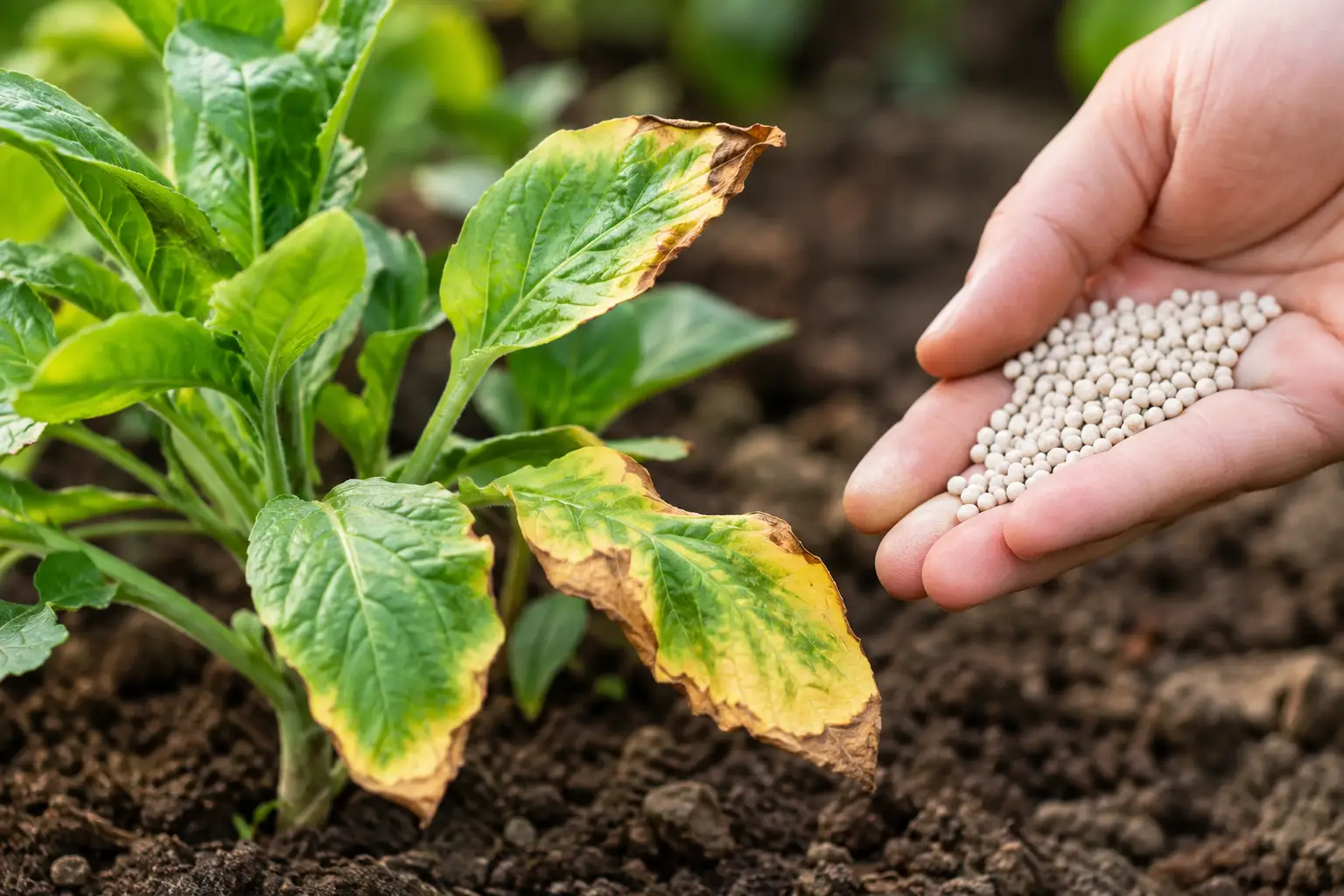
A lawn can look worse within 48 hours of feeding than it did before the bag was opened. Brown tips, scorched stripes and thinning grass are familiar fertiliser burn symptoms, particularly after a heavy application, dry weather or an uneven pass with a spreader. The good news is that established turf can often recover well once the cause is removed and moisture is managed correctly.
Fertiliser burn is not a disease, and it is not always permanent. It is a salt injury. Most lawn fertilisers contain mineral salts that supply nitrogen, phosphorus and potassium. Used at the stated rate, these nutrients support chlorophyll production, rooting and steady leaf growth. Applied too heavily, they draw water out of the grass plant and surrounding soil through osmosis. The result is dehydration at the root zone, even when the lawn appears to have been fed rather than starved.
What do fertiliser burn symptoms look like?
The first signs are usually visible in the leaf blade rather than across the entire lawn. Grass tips turn yellow, then straw-coloured or brown. The damage can progress down the leaf, leaving turf that looks dry, brittle and grey-green. Unlike a gradual nutrient shortage, which tends to produce an even pale colour, fertiliser scorch often appears suddenly and in defined areas.
Look closely at the pattern. Dark green growth beside yellow or brown grass is a strong clue that the fertiliser was distributed unevenly. Bands following the route of a spreader, circular patches where granules were spilled, and burnt edges along paths are all typical. A missed overlap can leave one stripe hungry while a doubled overlap receives enough salt to scorch it.
Severe cases affect the crown and roots as well as the leaves. Turf may thin out, pull away easily when lifted, or fail to respond after rain. Granules still visible among the grass several days after application are another warning sign, especially if conditions have remained dry.
Fertiliser scorch versus other lawn problems
Correct diagnosis matters. Brown grass has several possible causes, and adding more fertiliser to an already scorched lawn will only increase the damage.
Drought stress is often more widespread, especially on free-draining or compacted ground, and grass may temporarily recover colour after a thorough watering. Dog urine tends to create small, sharply defined patches, sometimes with a dark green ring where diluted nitrogen has stimulated surrounding turf. Leatherjacket or chafer grub damage usually allows turf to be lifted in loose sections because roots have been eaten.
Moss treatments containing iron can blacken moss rapidly. This is expected and should not be confused with fertiliser burn, although excessive application of any treatment can mark grass. If symptoms appear in wheel tracks, application lines or beneath a tipped bag, treat over-feeding as the leading cause.
Why fertiliser burn happens
Applying more than the label rate is the most common cause, but it is not the only one. Granular fertiliser needs even distribution and sufficient water to move nutrients into the root zone. When product is left on dry leaves or dry soil, salts become concentrated around the plant instead.
Weather changes the risk. A rate that performs well during damp, active growth can be too aggressive during a hot, dry spell when the lawn is already short of moisture. Newly sown lawns and freshly laid turf are also more vulnerable because their roots are limited. Young seedlings should never be treated like a mature, established sward.
Application errors are equally important. Overlapping spreader passes, stopping with the hopper open, filling a spreader on the lawn and using an uncalibrated machine can all create localised excess. Hand spreading can work on small areas, but it requires measured quantities and a disciplined, crossed application pattern. Guesswork is expensive when nitrogen is involved.
The fertiliser itself must suit the season. High-nitrogen spring and summer feeds are engineered to support active green growth. Autumn and winter formulations typically reduce nitrogen and increase potassium to support root resilience and hardiness. Applying a strong growth feed late in the season is not necessarily scorch, but it can create soft growth that is less equipped for cold, wet conditions.
How to treat fertiliser burn symptoms
Speed matters. If you notice a spill or very heavy application immediately, carefully sweep up any visible granules before watering. Do not brush them into borders, drains or ponds. Keep recovered product dry and dispose of it in accordance with the product instructions if it cannot be used safely at the correct rate elsewhere.
Next, irrigate the affected lawn deeply enough to dilute and move salts down through the soil profile. One brief sprinkle will not do much. Apply water slowly so it soaks in rather than running off, particularly on slopes or compacted ground. Repeat as needed over the following days where dry weather persists, while avoiding prolonged waterlogging.
Do not apply more feed, weedkiller, moss control or wetting agent while the grass is visibly stressed. The aim is to reduce pressure on the plant, not add another treatment. Hold off mowing until growth resumes, then mow with a sharp blade and remove only a small amount of leaf at a time. Scalping stressed turf exposes more soil and slows recovery.
Recovery depends on severity, soil type and weather. Mild leaf-tip scorch may grow out in two to four weeks during favourable conditions. Where crowns and roots have died, dead material will need to be raked out and the area overseeded once the soil has been flushed and grass-growing conditions are suitable. A quality ryegrass and fescue blend is useful for repairs because ryegrass establishes quickly while fescues contribute density and finer texture.
When reseeding is the sensible option
Wait until the damaged area has stopped deteriorating. If the grass is brown but remains firmly rooted and new green shoots are appearing at the base, give it time. If turf lifts easily, the surface is bare, or there is no sign of new growth after several weeks of suitable moisture and temperature, renovation is usually more efficient than waiting for recovery.
Rake out dead grass, lightly loosen the surface, level it with suitable lawn dressing where necessary and sow at the recommended rate. Keep the seedbed consistently moist until seedlings are established. Avoid strong fertiliser on young grass. A balanced pre-seeder formulation such as a 6-9-6 is designed to support root development without the excessive nitrogen push that can scorch tender growth when used correctly.
Preventing fertiliser burn next time
Professional-looking results come from accuracy, not from applying extra product. Start by measuring the lawn area in square metres, then calculate the required product weight from the stated application rate. A 100 m² lawn treated at 35 g per m² needs 3.5 kg, not a generous estimate from half a bag.
Use a properly calibrated spreader for larger lawns. Set it low, make parallel passes, then apply a second half-rate pass at right angles if the product instructions allow. This reduces striping and makes small calibration errors less damaging. Never fill or empty the hopper over the lawn, and close the shutter before turning at the end of a pass.
Apply granular feed to dry foliage when rain is expected soon, or water it in after application where the label permits. Avoid feeding when the ground is baked hard, frosted, waterlogged or when a heatwave is forecast. Check the forecast, but assess the lawn itself as well. A lawn under drought stress needs water before it needs nutrients.
Store fertiliser in a sealed, dry container. Damp granules can clump, which affects spreader flow and makes an even rate difficult to achieve. Keep products clearly labelled and use the supplied instructions for that specific formulation rather than relying on a rate from a different bag.
A healthy lawn responds best to a measured seasonal programme: suitable seed, sound soil conditions, sensible mowing and the right nutrient balance at the right time. If fertiliser burn symptoms appear, stop, flush the affected ground and give the turf a chance to recover. A steady hand now is far more useful than another bag of feed.