














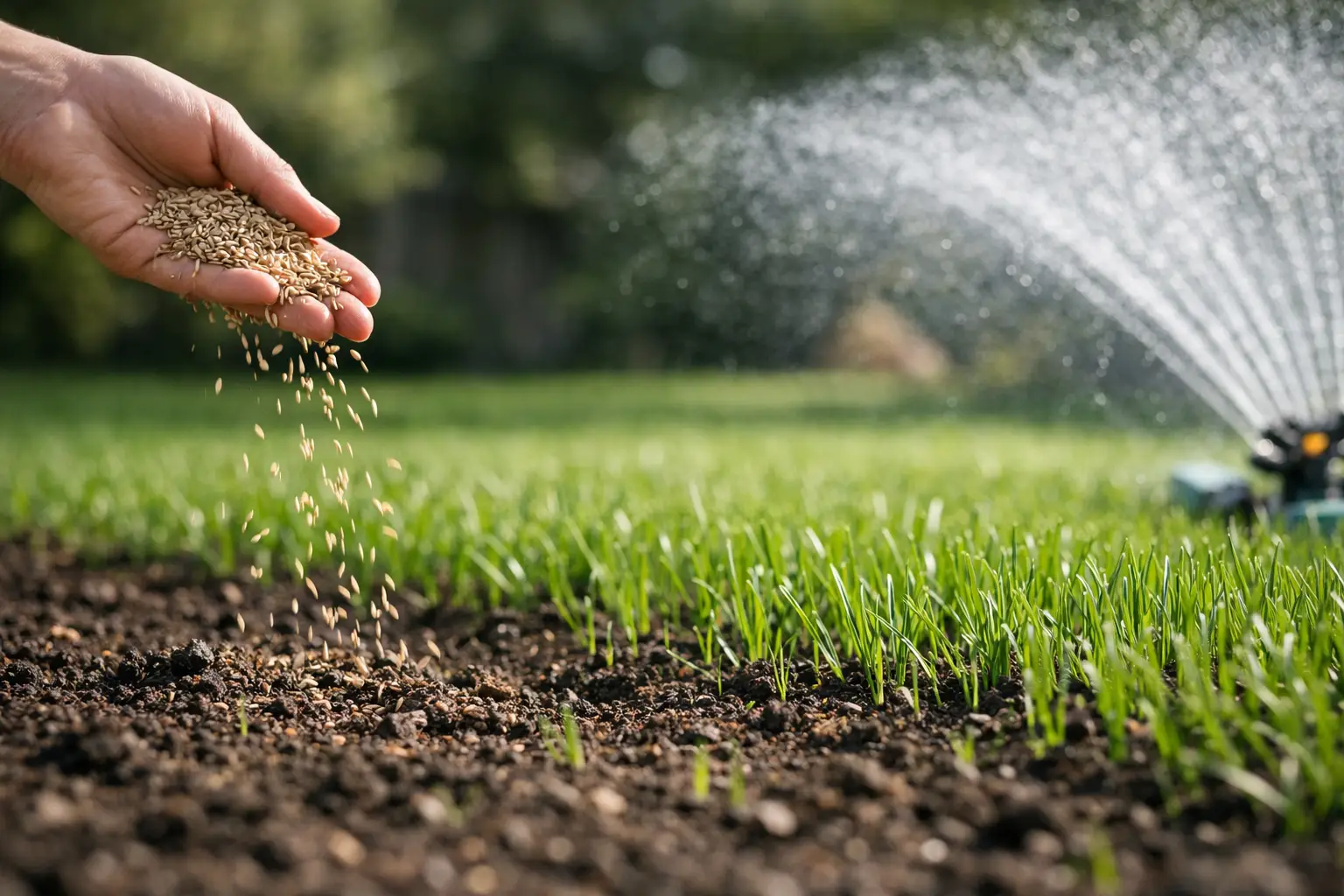
If you have ever sown a lawn and spent two weeks staring at bare soil, you will know that fast germinating lawn seed is not just a nice idea. It is often the difference between a tidy, usable lawn and a patchy surface that invites weeds, moss and frustration.
Speed matters, but so does what sits behind it. Quick establishment is not simply about buying the first box that claims rapid results. It depends on species, soil temperature, moisture levels, seed-to-soil contact and whether the grass is being asked to establish in full sun, heavy wear or partial shade. Get those factors right and you can see visible germination in as little as 7 to 14 days with the right blend.
What makes fast germinating lawn seed fast?
The short answer is species selection. Some grasses are naturally quicker out of the ground than others. Perennial ryegrass is the best-known example. It germinates rapidly, establishes strongly and copes well with wear, which is why it is widely used in sports turf, domestic lawns and professional landscaping.
Within that category, tetraploid ryegrass offers a further step up. The seed is larger, seedlings establish with notable vigour, and root development is often stronger in the early stage. That matters because rapid top growth without root support can leave a young lawn vulnerable as soon as the weather turns dry. A fast lawn is only useful if it also holds on.
By contrast, fescues are typically slower to germinate. They bring finer leaf texture, lower input requirements and better appearance in ornamental settings, but they do not usually win a race out of cold spring soil. That is why many high-performing lawn mixtures use a balance - ryegrass for speed and resilience, fescues for density and finish.
Fast germinating lawn seed is not always the same as the best seed
This is where plenty of people come unstuck. They shop for speed alone, then wonder why the lawn looks coarse six weeks later or struggles in shade. Fast germination is one performance trait, not the whole job.
If you are repairing worn family turf, a fast-establishing ryegrass-led mix makes good sense. It will fill quickly, stand up to traffic and reduce the window in which weeds can colonise open ground. If you are creating a front lawn where appearance matters as much as durability, a blend that includes finer fescues may be the better long-term choice even if germination is a touch less dramatic.
For contractors, the same principle applies on site. A programme driven by practical handover dates may need rapid establishment, but the end use still matters. Lawns around new-build plots, schools and communal areas need different characteristics from a fine private garden.
When fast lawn seed germinates quickest in the UK
In British conditions, soil temperature is often the limiting factor. Grass seed does not read the calendar. It responds to warmth and moisture.
The strongest sowing windows are usually mid-spring and early autumn. In spring, the soil begins to warm and there is often enough moisture to support even germination. In early autumn, the soil is still warm from summer, competition from many weeds starts to ease, and evaporation rates are generally lower. Both periods favour reliable establishment.
Summer can work, but only if irrigation is consistent. A fast seed blend can still fail if the top 10 mm of soil dries out repeatedly. Winter sowing is more unpredictable. Seed may sit dormant for weeks, and slow emergence leaves bare areas exposed to weather damage and contamination.
As a rule, if the soil feels cold and wet underfoot, expectations should be adjusted. The bag may say 7 to 14 days, but that assumes suitable conditions rather than wishful thinking.
How to get the quickest result from fast germinating lawn seed
The seed blend matters, but preparation matters nearly as much. Good seed thrown onto poor ground rarely gives a professional result.
Start with a clean, level seedbed. Remove weeds, old debris and any loose thatch. Break up compaction and rake the surface to create a fine tilth. You are aiming for a surface that allows the seed to settle into the top layer rather than sit exposed where birds, wind and sun can work against you.
Moisture management is the next factor. Newly sown grass needs the surface to remain evenly damp, not saturated. Heavy drenching followed by drying out is a poor pattern. Light, frequent watering usually produces better germination than occasional soaking, especially on lighter soils.
Nutrition also plays a part. A pre-seeder fertiliser with a balanced analysis such as 6-9-6 supports early root development without forcing soft, weak growth. Phosphorus is particularly useful at establishment stage because the seedling needs root energy before it needs aggressive leaf production.
Finally, do not bury the seed too deeply. Grass seed should be lightly raked in and firmed for contact, not planted like peas. Too deep and emergence slows. Too shallow and the seed dries out.
Overseeding versus new lawn establishment
Fast seed performs slightly differently depending on the job. On bare soil, germination is usually more straightforward because the seed can contact the surface directly. On an existing lawn, overseeding can be slower and less even if the seed sits in thatch or struggles to compete with mature grass.
For overseeding, mowing low beforehand and scarifying lightly often makes the difference. The objective is to open the canopy and expose soil so the seed has somewhere to sit and root. If you simply scatter seed over a thick sward, even a rapid-germinating mix will underperform.
Why some rapid seed mixes fail
There are three common reasons. The first is poor seed quality. Not all seed is cleaned, tested or blended to the same standard. A cheap bag may contain lower-performing cultivars, inconsistent seed size or a composition that is unsuitable for the site.
The second is mismatch. A fast ryegrass-heavy blend in dense shade is being asked to do the wrong job. It may germinate, but establishment will remain weak if light levels are not there. Equally, a fine ornamental mix on a hard-used family lawn may look good briefly, then thin out under wear.
The third is aftercare. People often focus on the sowing date and then cut corners on watering, fertiliser or first mowing. The establishment phase does not finish when the green haze appears. That is only the start.
Choosing the right fast germinating lawn seed for your lawn
A domestic back garden used by children and dogs needs a different seed mixture from a formal front lawn. Likewise, a contractor dealing with shaded boundaries or drought-prone banks should not rely on one generic mix for every site.
If rapid establishment is the priority, look for a blend led by perennial ryegrass or tetraploid ryegrass. If appearance and finer texture matter too, a mixture that combines dwarf perennial ryegrass with selected fescues often gives a better balance. If the site has difficult conditions such as partial shade or lighter, drier soil, choose a specialist mixture engineered for that setting rather than a one-size-fits-all product.
This is where trade-standard specification is useful. You are not just buying "fast". You are selecting for germination speed, wear tolerance, disease resistance, drought response and finish.
A note on tetraploid ryegrass
Tetraploid ryegrass deserves attention because it answers a common problem with fast seed. Many quick-establishing grasses can produce a decent-looking top in a hurry, but without enough root depth they lose momentum when conditions become less forgiving.
Tetraploids are valued because the larger seed carries more energy into establishment. In practical terms, that often means stronger early vigour, deeper rooting and better recovery. For anyone trying to get cover quickly without sacrificing resilience, that combination is hard to ignore.
At Ransley Pro Grow, this is exactly why tetraploid ryegrass sits at the centre of rapid-establishment thinking. It gives speed, but it also gives the sort of dependable structure that keeps a new lawn moving in the right direction after germination.
What to expect after germination
The first cut should wait until the grass is established enough to resist being pulled from the ground, usually when it reaches around 5 to 7 cm. Use a sharp mower and remove no more than a third of the leaf in one pass. Cutting too early or too hard can check growth and thin the new stand.
Traffic should also be limited at first. Fast germination does not mean instant maturity. Young plants still need time to tiller, knit together and build root mass. This is especially relevant on family lawns where the temptation is to use the space the moment it turns green.
You should also expect some unevenness early on. Different species within a blend germinate at different rates. Ryegrass may appear first, with fescues following behind. That does not mean failure. It usually means the mixture is behaving as designed.
Is fast germinating lawn seed worth it?
If your main problem is slow establishment, open soil and patch repair, yes - provided the seed is suited to the site and supported properly. Faster germination narrows the gap in which weeds invade, improves the odds of even coverage and gets a lawn into service sooner.
But speed on the label is not enough. The best result comes from pairing a quality seed blend with the right sowing window, careful preparation and sensible feeding. That is how you turn quick germination into a lawn that actually lasts.
If you want the lawn to come through cleanly and stay that way, stop chasing miracle claims and start with seed that is engineered for the conditions in front of you.