














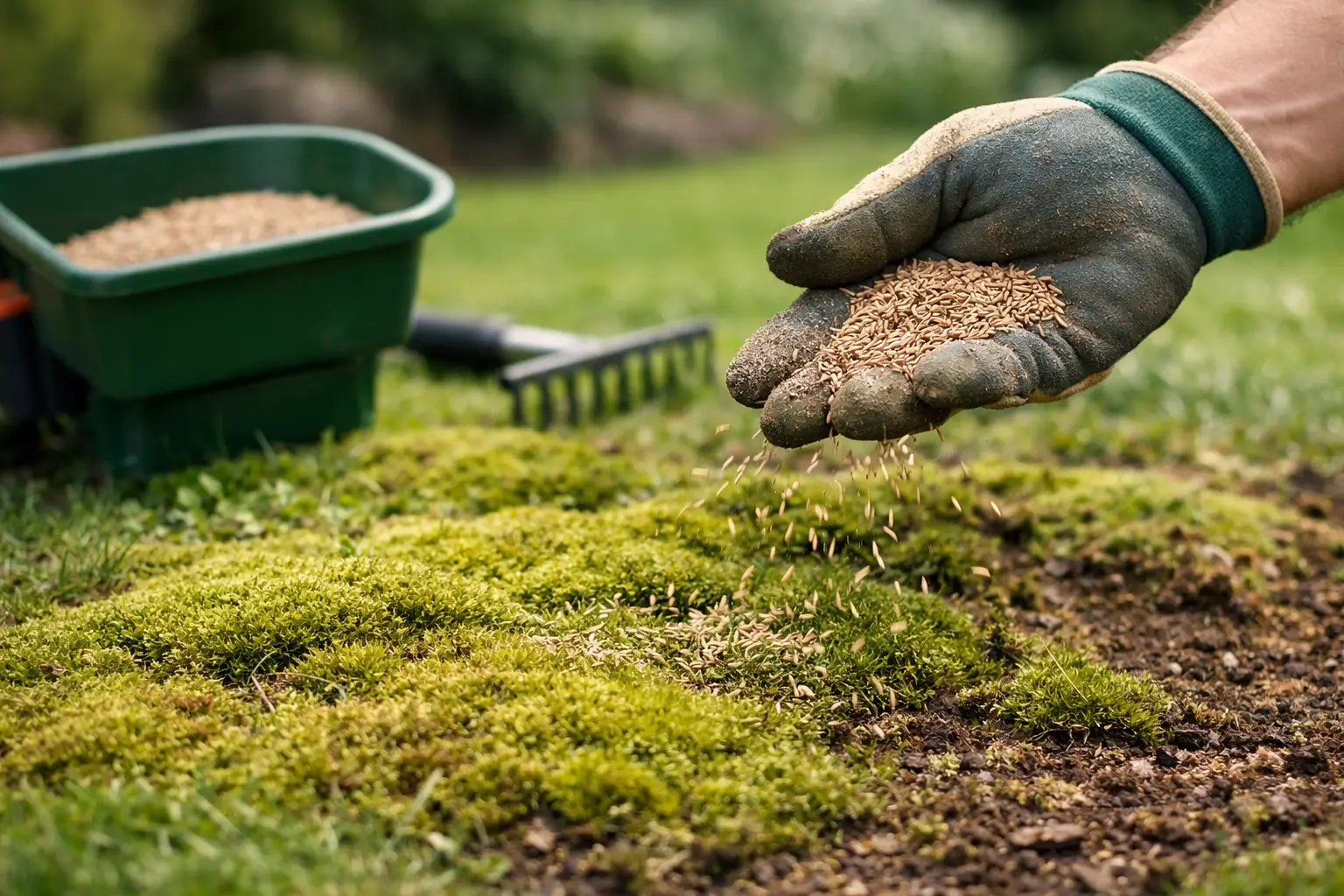
A mossy lawn often looks like an easy repair: scatter seed, add water and wait for green shoots. But can you seed over moss and expect a proper result? Not reliably. Moss forms a dense, moisture-holding layer over the soil, preventing seed from making the soil contact it needs to germinate and root. The seed may sprout briefly in trapped debris, then dry out, rot or pull away with the moss.
The correct approach is to remove the moss, address the conditions that allowed it to establish, then overseed into prepared soil. That order matters. Grass is not losing to moss because it is a weaker plant. It is losing because the lawn conditions favour moss more than turf.
Why grass seed will not establish over moss
Grass seed needs three things at the point of sowing: contact with soil, consistent moisture and enough light. A moss layer compromises all three. Its stems and organic matter hold seed above the soil surface, where roots cannot anchor. It can also keep the immediate surface wet while the soil beneath remains compacted, poorly drained or dry.
Moss itself does not usually kill grass. It exploits weak, thin turf. In UK lawns, the usual causes are shade, surface compaction, poor drainage, close mowing, low fertility and acidic soil. More than one factor is often involved. A north-facing lawn beneath trees, for example, may have shade, restricted air movement, root competition and compacted soil all at once.
Simply adding seed over this environment treats the visible symptom but leaves the cause in place. The new grass may germinate, particularly in mild autumn weather, but it will struggle through the following winter and moss will return to the gaps.
How to prepare a mossy lawn for seeding
Start by looking at the lawn rather than reaching immediately for a box of seed. Is the moss concentrated beneath trees, along a fence line, in a wet hollow or across the whole area? Its pattern is a useful diagnosis. Localised moss normally points to shade, drainage or wear. Moss across the entire lawn can indicate compacted ground, unsuitable mowing or a wider nutrient issue.
Kill or rake out the moss first
For a heavy infestation, apply a suitable moss control treatment and follow the product label precisely. High-iron moss treatments blacken moss, making it easier to identify and remove. Once it has died back, scarify or rake firmly to pull out the moss, thatch and loose debris.
Do not leave blackened moss sitting on the surface and sow into it. It is still a physical barrier. Collect the debris and compost it only where appropriate, rather than spreading it back onto the lawn.
If moss is light and loose, scarification alone may be enough. Avoid aggressive raking in very dry weather or when the ground is waterlogged, as this can tear healthy grass plants out of the soil and compact the surface further.
Relieve compaction and improve drainage
If water lingers after rainfall or the lawn feels hard underfoot, aeration is usually required. Use a hollow-tine aerator where compaction is significant. This removes small cores of soil and creates channels for air, water and roots. Solid-tine aeration can help on less compacted lawns, but it does not remove material and can compact heavy clay soils if carried out when they are too wet.
Brush a suitable free-draining topdressing into the aeration holes where drainage and surface levels need improvement. On clay ground, one application will not transform drainage permanently. Annual autumn aeration and topdressing is a more dependable programme.
Do not assume moss means the soil must be acidic. Moss can grow in a broad range of soil conditions. A soil test gives a better answer than applying lime as a routine fix. Raising pH unnecessarily can reduce nutrient availability and create a different set of lawn problems.
Restore a seedbed
After scarifying, lightly rake the exposed soil to create a fine, open surface. The aim is not to turn the lawn into a bare cultivated bed. You want enough loose soil for seed to settle in, while retaining the existing grass plants that will help the lawn recover.
Where scarification has revealed large bare patches, level them with a compatible lawn topsoil or fine topdressing before seeding. Avoid burying existing grass beneath a thick layer. A light dressing worked into the surface is more effective than smothering the sward.
When to overseed after moss removal
Early autumn is generally the strongest time to overseed a mossy lawn in Britain. Soil is still warm from summer, rainfall is more regular and weed competition is usually lower than in spring. September is often ideal, although local weather matters more than the calendar. Seed needs soil that is moist but not saturated, plus enough time to establish before persistent cold arrives.
Spring overseeding can also work from April into May, once frosts have eased and soil temperatures are rising. It has a narrower margin for error. Young grass must establish before dry spells, summer wear and annual weeds become more competitive.
If a moss treatment includes herbicide as well as moss control, check the label for its reseeding interval. Selective weedkillers can affect new seedlings, and sowing too soon wastes seed. Never guess at the waiting period. The approved label directions take priority over a general lawn-care timetable.
Choose seed for the conditions, not just the colour
The best seed mix depends on why moss developed. A hard-wearing lawn that receives regular use benefits from durable perennial ryegrass, while fine fescues help provide texture and perform better in lighter shade. Deep shade beneath dense evergreen canopies may be unsuitable for a conventional lawn regardless of the seed used. In those areas, reducing shade where practical or choosing an alternative ground cover can be the more sensible long-term decision.
For quick repair, a professional overseeding mixture with tetraploid ryegrass can be useful. Its larger seed, rapid establishment and deeper rooting habit give it an advantage where a lawn needs to recover from moss removal and wear. Under suitable temperatures and moisture, rapid ryegrass blends can germinate in around 7-14 days. That is not a guarantee, however. Cold soil, drought, poor seed-to-soil contact and shade will slow establishment.
Apply seed evenly at the rate specified for overseeding, not new-lawn establishment. Too little seed leaves gaps; too much creates crowded seedlings that compete for light and moisture. Rake lightly after sowing, then firm the surface with the back of a rake or a lawn roller where conditions allow. The objective is firm contact between seed and soil, not compacted ground.
A balanced pre-seeder fertiliser can support early root growth where soil fertility is low. A 6-9-6 NPK formulation supplies phosphorus for rooting without pushing soft, excessive leaf growth. Apply only at the stated rate and avoid using a high-nitrogen summer feed on newly sown grass. Seedlings need roots before they need a dramatic flush of top growth.
Watering and first cuts make the difference
Keep the seeded surface consistently damp until germination, using a fine spray that does not wash seed into lines or puddles. In dry early autumn or spring conditions, this can mean light watering once or twice daily. As seedlings root, water less often but more deeply to encourage roots down into the soil.
Keep off the lawn while seedlings are young. Mow for the first time when new grass reaches roughly 5-7 cm, using a sharp mower blade and removing only the top third. Do not scalp it. Moss thrives where grass is cut too short and cannot produce enough leaf to support healthy roots.
For shaded or moss-prone lawns, maintain a slightly higher mowing height through the season. A taller sward captures more light, shades the soil surface and improves grass resilience. Clear fallen leaves promptly in autumn, as a wet layer of leaves reduces light and encourages the same damp conditions moss prefers.
Prevent moss from returning
A successful overseed is the beginning of the repair, not the end. Feed established grass according to the season, aerate compacted areas, manage shade and keep mower height sensible. Where trees create permanent deep shade and heavy root competition, accept the site limitation rather than repeatedly spending money on seed that cannot thrive.
For most lawns, the dependable sequence is simple: remove the moss, open the soil, improve the growing conditions and seed into contact with bare ground. Give the new grass a fair start, and it can occupy the space that moss has been using.