




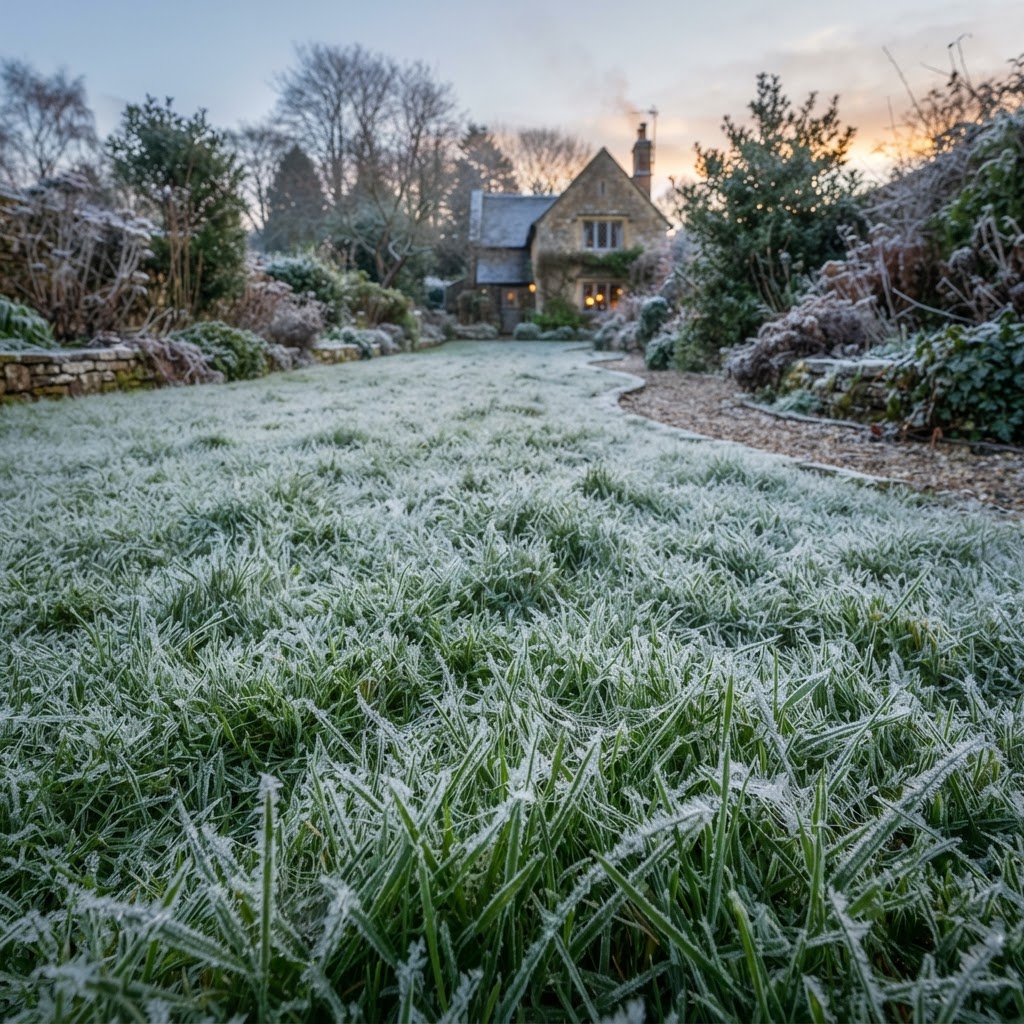

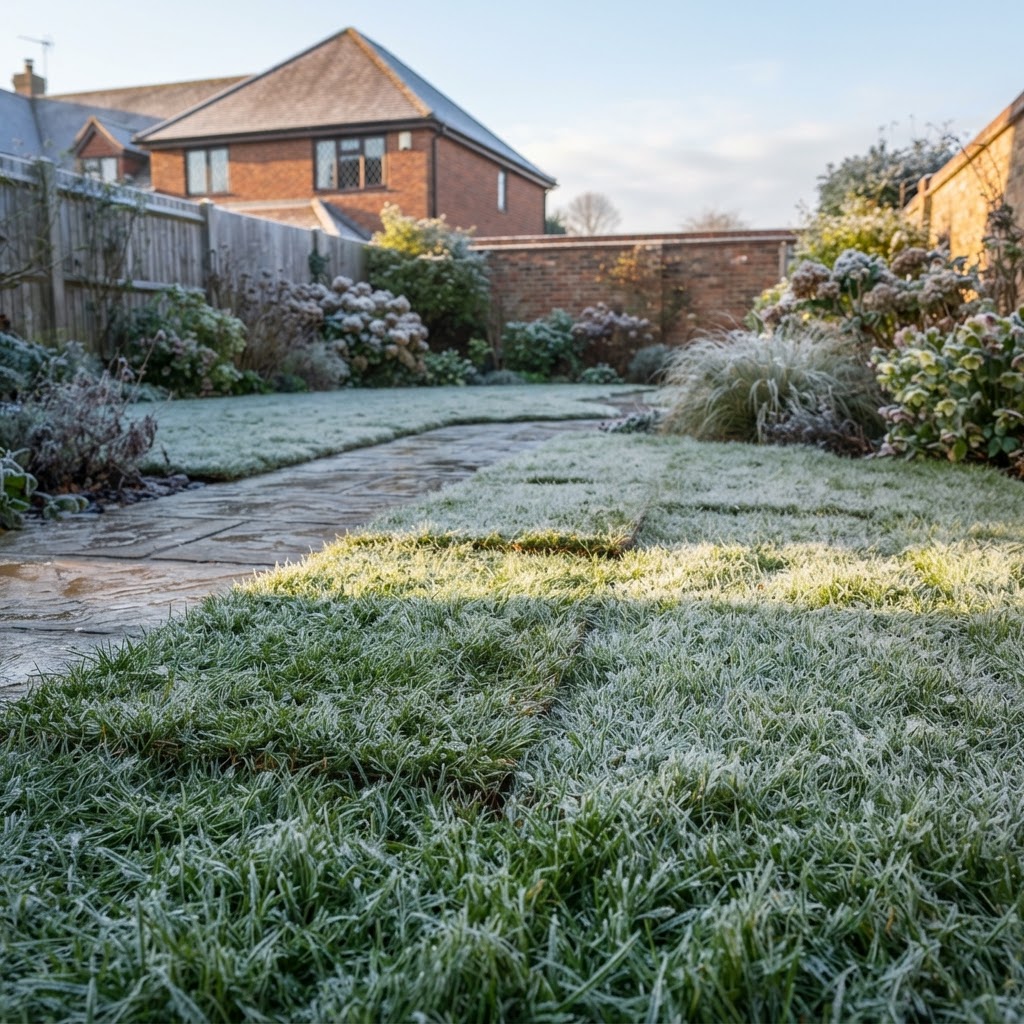


A late-season lawn repair can look like a sensible job on Saturday, then wake up under a white frost on Sunday. So, can grass seed survive frost? Usually, yes: dry, unsprouted grass seed is remarkably tolerant of cold. The greater risk is not the frost itself, but sowing when soil temperatures are too low for reliable germination, or when newly emerged seedlings are exposed to repeated freezing and thawing.
For a lawn that establishes evenly, treat soil temperature and weather pattern as the deciding factors, not simply the month on the calendar. A mild November in Kent may offer better germination conditions than a cold April further north.
Can grass seed survive frost before it germinates?
Most quality lawn seed can survive a frost while it remains dormant. In fact, grass seed is routinely stored in cool, dry conditions, and many species have evolved to sit in the soil through cold weather before germinating in spring.
The seed itself contains a protected embryo. Provided it is dry or only lightly moist, a brief frost will not normally kill it. What changes is the pace of establishment. Once temperatures drop, the seed may simply wait for warmer conditions rather than germinate. This is not necessarily a failure, but it can leave bare soil exposed to winter rain, bird activity and weed invasion.
The situation becomes less predictable where seed has absorbed moisture and begun the germination process. A hard frost at this point can damage the developing root and shoot, particularly if it is followed by saturated soil or repeated freeze-thaw cycles. Seedlings that have only just emerged have far less tolerance than dormant seed.
Soil temperature matters more than air temperature
Grass seed does not respond to a pleasant afternoon air temperature in the same way a gardener does. It responds to the temperature around the seed in the upper layer of soil.
For dependable results, aim to sow when soil temperatures are consistently above 8°C. Perennial ryegrass can begin to germinate at lower temperatures, often around 5-6°C, but establishment will be slow and uneven. Fine fescues are generally slower again in cool ground. At 10-18°C, most lawn mixtures have the conditions needed to germinate far more reliably.
A short overnight frost does not automatically mean the soil has become too cold. Heavy or damp soil holds warmth better than dry, sandy ground, while sheltered urban gardens can remain several degrees warmer than exposed sites. A basic soil thermometer, checked at roughly 5cm depth in the morning, removes the guesswork.
As a practical rule, wait if the ground is frozen, waterlogged, or if several hard frosts are forecast. If days are mild, soil remains workable and overnight frost is light and occasional, seed can still be sown with reasonable expectations - especially when using a fast-establishing ryegrass-based mixture.
What frost does to newly germinated grass
Once seedlings are visible, they are no longer protected in the same way as seed. A light frost may only slow growth, but several hard frosts can scorch leaf tips, damage tender roots and reduce plant numbers across the lawn.
The main problem is movement in the soil. Water expands as it freezes, lifting fine soil particles and shallow roots. When the ground thaws, seedlings can be left loose, exposed or sitting in small depressions that hold water. This is known as frost heave, and it is especially common in finely cultivated, light soils.
Young grass also has a limited root system. If winter rain follows frost, compacted or poorly drained ground may stay saturated for days. Roots require oxygen as well as moisture, so cold, wet conditions can cause more harm than the frost alone.
Avoid walking on frosted or waterlogged new grass. Foot traffic compresses the surface and can shear tiny plants from the soil. Keep pets, wheelbarrows and routine garden work off the area until the turf has rooted firmly.
When to sow grass seed in the UK
Early autumn remains the most dependable sowing window for most UK lawns. Soil is still warm after summer, rainfall is more regular and annual weeds are less aggressive than in spring. September is often ideal, with October still workable in many areas if soil temperature holds above 8°C.
Spring sowing can also produce excellent results, usually from April into May. The trade-off is that soil may be cold after a long winter, while dry spells and weed pressure increase as the season progresses. Spring seed needs closer attention to watering, particularly on free-draining ground.
Winter sowing is best reserved for specific circumstances. If you are repairing a small patch in a mild spell, the seed may remain dormant until conditions improve. That can be acceptable, but do not expect a 7-14 day result. For larger renovations or professional handovers, it is wiser to wait until weather and soil conditions support active growth.
In exposed gardens, on higher ground or in northern areas, shift the timing later in spring and earlier in autumn. Local conditions always override a calendar recommendation.
How to sow when a light frost is possible
If the forecast is mostly mild but includes an isolated light frost, preparation makes the difference between seed that waits safely and seed that is washed or lifted away.
Start with a level, firm seedbed. Remove stones, dead vegetation and surface debris, then loosen the top few centimetres of soil. Rake it level and lightly firm it with a roller or by treading it in overlapping passes. The surface should be firm enough to leave only a shallow footprint, not compacted into a hard pan.
Apply seed evenly at the stated rate for the mixture. Under-seeding creates thin cover and gives weeds room to establish; over-seeding forces young plants to compete for light, nutrients and moisture. Rake gently so most seed sits just beneath the surface, then firm again to create good seed-to-soil contact.
Water only when the soil is dry and the forecast allows it. The aim is consistently moist soil, not a wet surface that can freeze or puddle. In cool weather, you may need far less irrigation than in late spring. Check beneath the surface before reaching for the hose.
A light covering of suitable soil improver or fine topdressing can help protect seed from birds and surface drying, but do not bury it deeply. Grass seed needs light and oxygen close to the surface. Heavy layers of compost, soil or mulch delay emergence and can encourage damping-off in wet weather.
Choose species for the conditions, not the label alone
No grass mixture is immune to winter weather, but species selection affects how quickly a lawn establishes and how it copes afterwards. Perennial ryegrass is valued for rapid germination, wear tolerance and its ability to make useful growth in cooler conditions. Tetraploid ryegrass varieties have larger seed and vigorous root development, making them particularly useful where rapid establishment is required.
Fine fescues bring a finer appearance and good tolerance of lower fertility, shade or drier soils, depending on the variety. They are valuable in balanced lawn mixtures, but they are not the fastest answer to a late autumn repair. A mixture of dwarf perennial ryegrass and fescues often gives the practical balance needed for domestic lawns and hard-working landscaped areas.
Feed with care. A pre-seeder fertiliser such as a balanced 6-9-6 formulation can support root development at sowing without pushing excessive soft leaf growth. Avoid high-nitrogen feeds late in autumn. They can encourage lush top growth that is more vulnerable to cold, while doing less to build the root resilience a new lawn needs.
If frost arrives after sowing
Do not panic or re-seed immediately. Allow the ground to thaw naturally and inspect the area after a few milder days. If seed remains in place and the surface has not been washed out, leave it alone. Germination may simply be delayed.
Where frost has lifted the soil, lightly firm the area once it is dry enough to work. If heavy rain has moved seed into channels or bare pockets, rake those patches level and add a measured amount of seed. Avoid turning the whole bed over again, as this can bury viable seed too deeply.
For established seedlings with browned tips, wait before making a judgement. If the crown and roots remain healthy, new growth often appears when temperatures improve. A gentle first cut only becomes appropriate once the grass is well rooted and has reached around 7-8cm high. Remove no more than one-third of the leaf blade, using a sharp mower.
A lawn does not need a rush job in cold weather. It needs firm ground, viable seed, enough warmth to root and the patience to let the season do its work. If frost is becoming a regular feature, protect the seedbed from disturbance now and plan the finishing work for the first reliable spell of spring growth.