














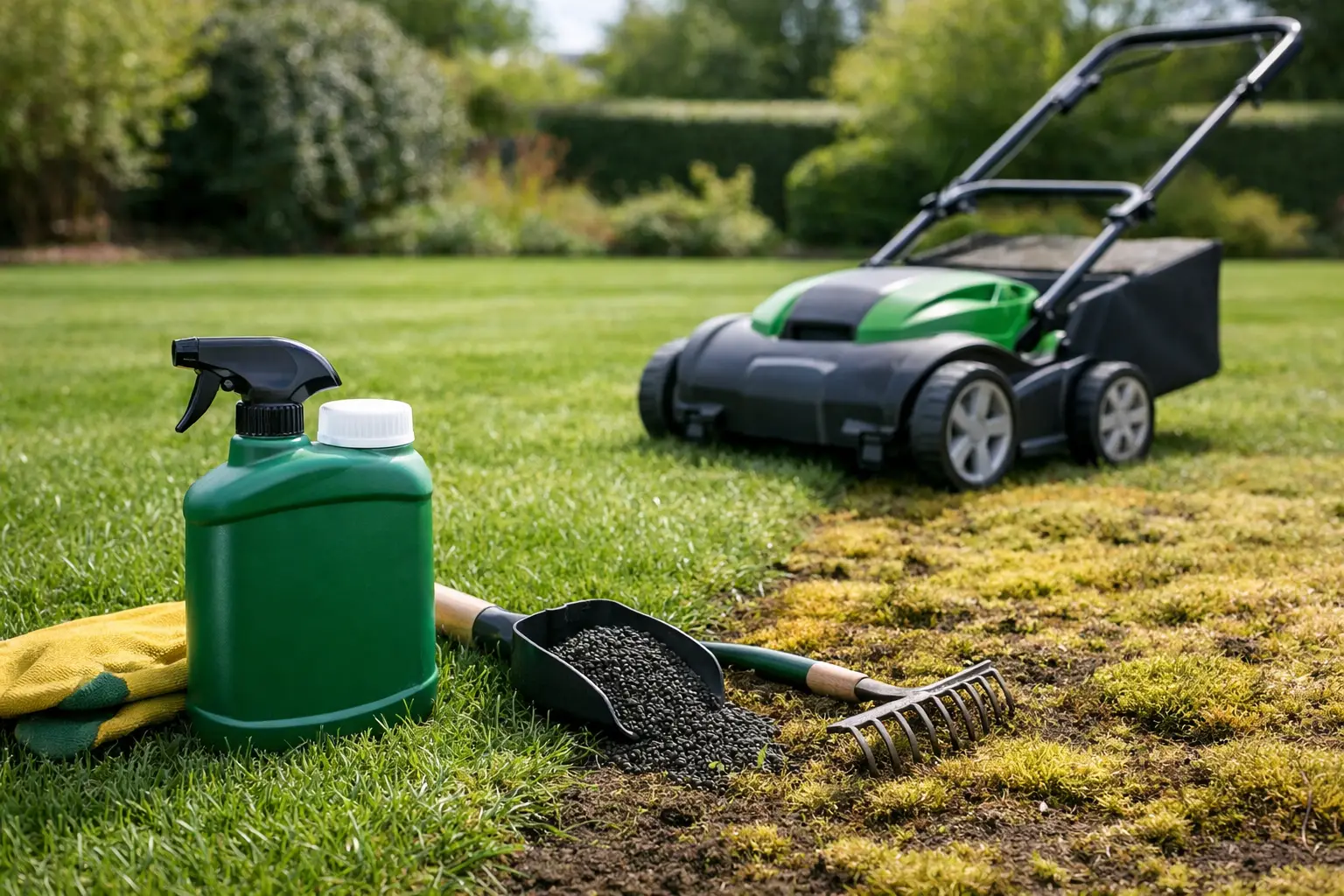
A lawn that suddenly feels soft underfoot, looks dull green rather than grass green, and stays wet long after rain is usually telling you the same thing - moss is moving in. Finding the best moss killer for lawns is only part of the job. If you choose the wrong treatment, or apply the right one at the wrong time, the moss may blacken off but the underlying problem remains.
Moss is less a cause than a symptom. It takes hold where grass is weak, light is limited, drainage is poor, or soil fertility is out of balance. That is why the best results come from matching the treatment to the lawn condition rather than simply buying the strongest product on the shelf.
What is the best moss killer for lawns?
For most UK lawns, the best moss killer for lawns is an iron-based treatment, usually sulphate of iron or a high-iron granular blend. It works quickly, blackens moss within a short period, and helps improve grass colour at the same time. For lawns with broader issues such as low vigour, weeds and moss together, a multi-action product can be the better option because it treats several pressures in one pass.
That said, there is no single answer for every site. A shaded back garden in Leeds, a compacted new-build lawn in Kent, and a fine ornamental sward maintained by a contractor all need slightly different thinking.
Why iron-based moss killers are usually the first choice
Iron-based products have earned their place because they are effective, predictable and well suited to established grass. Sulphate of iron alters conditions on the leaf surface and rapidly desiccates moss tissue. In practical terms, that means visible dieback quickly, often within 24 to 48 hours depending on weather and severity.
There is another benefit. High-iron treatments tend to deepen turf colour by supporting chlorophyll production, so the lawn often looks sharper as the moss declines. That cosmetic lift matters for homeowners, but it also helps contractors present a cleaner finish after treatment.
The trade-off is that iron does not correct compaction, drainage, shade or poor feeding. It removes the symptom efficiently, but you still need to strengthen the grass afterwards.
Types of moss killer for lawns
The right format matters almost as much as the active ingredient. Most lawn moss control products fall into three useful categories.
Liquid moss killers
Liquid treatments are useful when you want fast coverage and accurate application, particularly on smaller lawns or where moss is patchy rather than widespread. They can be applied by knapsack or watering can, depending on the formulation. This gives good contact with the moss and tends to produce quick visual results.
They suit gardeners who want control over dose rate and professionals treating awkward shapes, edges or isolated heavy patches. The drawback is that liquids can be less convenient on larger domestic lawns if you do not have suitable equipment.
Granular moss killers
Granular treatments are often the most practical choice for routine domestic use. Spread evenly across the lawn, they are simple to apply and are particularly effective where moss is spread through the sward rather than sitting in obvious clumps.
Many granular products combine iron with fertiliser, which makes them useful in spring and early autumn when grass is actively growing. A trade-standard multi-action granular treatment can be especially effective if the lawn needs feeding as well as moss control.
Combined weed, feed and moss products
These are designed for lawns with more than one problem at once. If moss is present alongside daisies, plantain, clover or generally weak turf, a combined product reduces the need for separate applications.
This can save time, but only if the lawn is in a suitable growth phase. Weed control components need active leaf growth, and some products are best held back in drought, frost or very cold periods. As ever, timing is part of the result.
How to choose the best moss killer for lawns
The best choice depends on what is causing the moss and what you want the lawn to look like six weeks from now, not just two days from now.
If the moss is light and the grass is otherwise healthy, a straightforward iron treatment is usually enough. You kill the moss, rake it out, and the surrounding grass fills back in with a little feeding and careful mowing.
If the lawn is thin, pale and undernourished, a moss killer with fertiliser makes more sense. The grass needs help closing the gaps before moss returns.
If broadleaf weeds are mixed through the lawn as well, a multi-action treatment is often the practical answer. Products engineered for this purpose give a more complete reset, especially on family lawns where maintenance windows are limited.
If the site is heavily shaded or poorly drained, product choice alone will not solve the issue. You may still use iron to clear the moss, but long-term control will depend on aeration, overseeding with shade-tolerant grass species, adjusting mowing height and, where possible, improving light and airflow.
When to apply moss killer
Spring and early autumn are generally the best treatment windows in the UK. The soil is moist, the lawn is growing, and the grass has a fair chance to recover once the moss has been removed.
Early spring treatments help tidy the lawn before the main growing season. Early autumn is equally effective because moss often builds through summer in shaded or damp areas, and autumn conditions favour recovery work such as scarifying and overseeding.
Avoid treating during frost, prolonged drought, or when the lawn is heavily stressed. A moss killer may still blacken the moss, but recovery will be slow and the result can look untidy for longer.
A practical application sequence
For most established lawns, the process is straightforward. Apply the moss killer to a dry lawn with mild conditions forecast. Wait for the moss to blacken. Then scarify or rake out the dead material. If the lawn is thin afterwards, overseed and feed to encourage rapid infill.
This last stage is where many results fall away. Killing moss creates space. If grass does not colonise that space quickly, moss usually will.
Why moss keeps coming back
Repeated moss problems nearly always point to weak grass competition. In the UK, the usual causes are shade, compaction, acidity, poor drainage, low fertility and mowing too short.
Shade is a common one. Grass needs light to maintain density. In deeper shade, choosing a shade-tolerant seed blend is often more effective than simply repeating moss treatment.
Compaction is another major factor, especially on newer properties, heavily used lawns, and soils with a high clay content. If water sits on the surface and roots stay shallow, moss has an opening. Hollow tine or solid tine aeration can make a marked difference.
Nutrition also matters. A hungry lawn cannot compete. A well-timed seasonal feed supports stronger tillering, better colour and improved recovery after scarifying.
The mistake of treating moss without repairing the lawn
A blackened lawn after moss treatment can look alarming, but that is not failure. It is simply the point at which dead moss is more visible. The real measure of success is what happens next.
If you rake out the debris and leave bare patches exposed, the lawn will remain open. This is where overseeding and appropriate feeding turn a moss treatment into a renovation. Professional users know that control and recovery belong in the same plan.
This is also why trade-standard products tend to outperform generalist approaches. They are designed not just to suppress the problem, but to support the grass that must replace it.
A better way to think about moss control
The best moss killer for lawns is the one that fits the condition of the turf, the season and the recovery work that follows. For many lawns, that will be a high-iron treatment. For tired, mixed-problem lawns, it may be a combined granular formulation such as a triple-action product engineered for feeding, weed control and moss knockdown in one application.
What matters most is precision. Apply at the right time, use the correct rate, remove the dead moss, and then strengthen the sward so grass becomes the dominant plant again. That is how you turn a short-term cosmetic fix into lasting improvement.
For homeowners aiming for a cleaner, denser lawn and contractors needing dependable results, the soundest approach is the old one: treat the symptom, correct the cause, and give the grass every advantage. If you need professional-grade lawn care products built around that principle, Ransley Pro Grow offers formulations designed for reliable moss control and strong turf recovery.
A lawn rarely asks for miracles. More often, it asks for the right product at the right moment, followed by a bit of proper groundsmanship.