














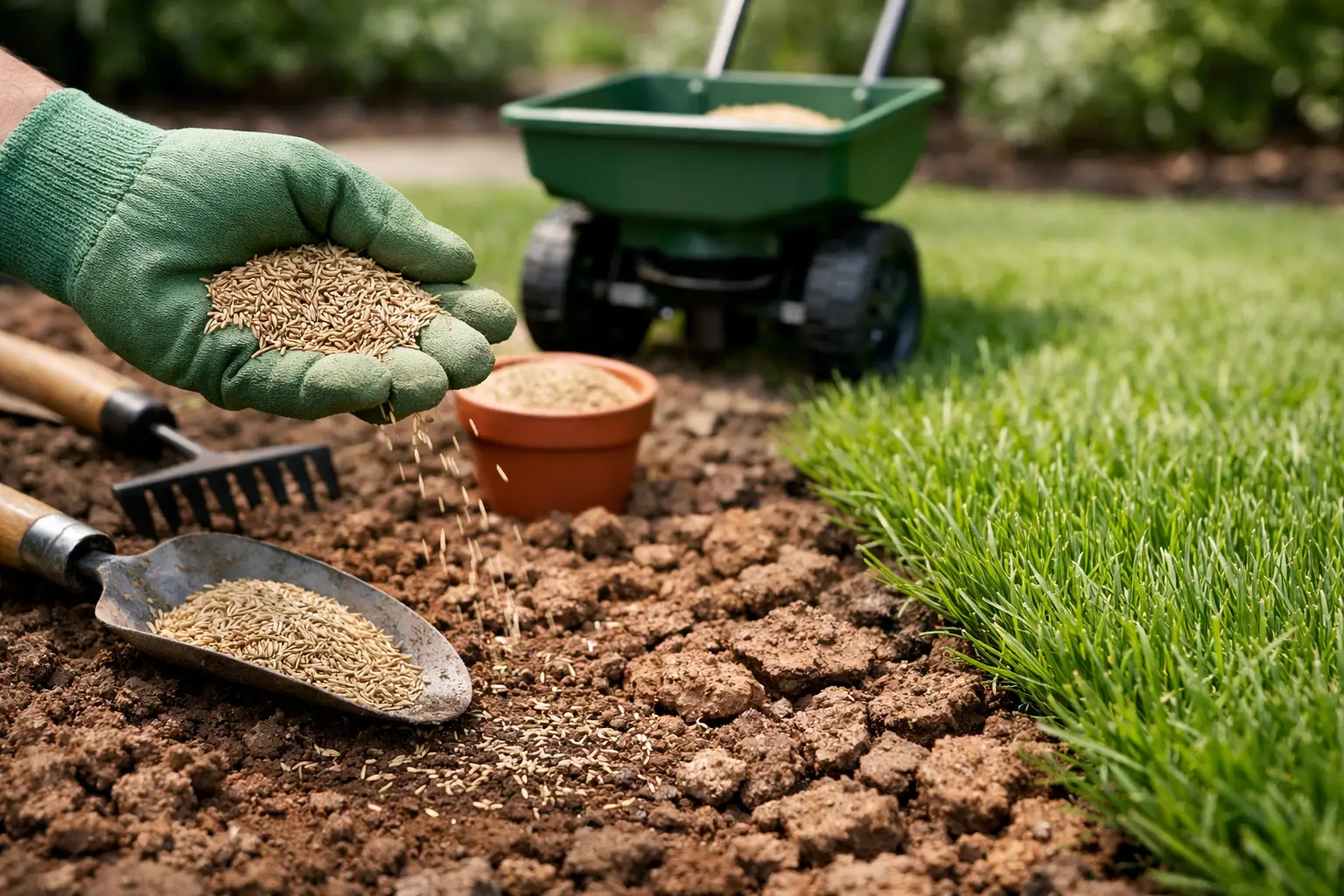
Clay soil tells on bad seed quickly. If the ground stays wet in winter, bakes hard in summer and turns sticky underfoot after rain, the wrong lawn mix will struggle from the start. Choosing the right lawn seed for clay soil is less about chasing a pretty label and more about matching grass species to the conditions beneath your boots.
In most UK gardens, clay is not a disaster. In fact, it holds nutrients well and can support a very strong lawn once it is managed properly. The trouble is structure. Clay particles are fine and compact easily, which restricts air movement, slows drainage and makes root development harder. That means seed choice and ground preparation need to work together.
What lawn seed for clay soil actually needs to do
A suitable seed mix for clay has to cope with two opposite pressures. In wet periods, it needs enough disease tolerance and root strength to handle slow drainage. In dry spells, it needs to push into firm ground and keep performing when the surface sets hard.
That usually points towards a blend rather than a single species. Hard-wearing perennial ryegrass is often the backbone because it establishes quickly, tolerates wear and forms a durable surface. On heavier soils, quality ryegrass cultivars can give dependable germination and good recovery, especially where children, pets or regular foot traffic are involved.
Fescues also have a place, though the balance matters. Strong creeping red fescue and chewings fescue can improve density and fineness of leaf, but on very compacted or poorly drained clay they should not be asked to do all the heavy lifting. A lawn made entirely from fine fescues may look elegant in ideal conditions, yet it can be slower to establish and less forgiving where the soil is tight and traffic is frequent.
If you are choosing lawn seed for clay soil in a family garden, a ryegrass and fescue blend is often the practical answer. It gives you the speed and resilience of ryegrass with some of the texture and knit of fescues. For professionals renovating lawns to a higher visual standard, the exact ratio may shift depending on usage, shade and maintenance regime.
Best grass types for clay soil
Perennial ryegrass for strength and speed
Perennial ryegrass is usually the first species to consider on clay. It germinates quickly in suitable temperatures, establishes a serviceable cover fast and stands up well to wear. Modern dwarf perennial ryegrass varieties are far removed from coarse older types. They offer a tighter sward, improved colour and better visual quality without losing durability.
Tetraploid ryegrass can be especially useful where rapid establishment matters. Larger seed size, vigorous early growth and deeper rooting can help a new lawn get ahead before weeds and moss exploit bare ground. That does not mean it solves poor drainage on its own, but it does give the lawn a stronger start.
Fescues for density and finish
Fescues bring refinement. They can improve sward density, reduce the coarse look of a rye-dominant lawn and contribute useful tolerance in mixed conditions. On clay, they work best as part of a balanced mixture rather than as a romantic ideal of a fine lawn. If the site is lightly used and managed carefully, you can lean more heavily into fescues. If the lawn is expected to cope with football, garden furniture and regular traffic, ryegrass should remain prominent.
Species to use more selectively
Browntop bent can produce a very fine finish, but it is typically better suited to specialist turf and higher-input maintenance than the average domestic clay lawn. Smooth-stalked meadow grass can contribute strength and recovery, though it is slower to establish and often better used in professional-grade mixtures where patience and precise aftercare are part of the plan.
How to choose the right mix for your site
Not all clay soils behave the same way. Some are merely heavy and fertile. Others are badly compacted, shaded and waterlogged for months at a time. The right choice depends on how the lawn is used and how much preparation you are prepared to do.
If you want a hard-wearing family lawn, favour a mix with a strong proportion of perennial ryegrass. If appearance matters as much as durability, choose a blend that softens that ryegrass base with quality fescues. If the area is shaded as well as clay-heavy, a standard sunny-lawn mix may underperform even if it is otherwise suitable for heavier ground.
This is where many lawn failures start. People buy seed for one problem and ignore the others. Heavy soil, shade, low fertility, dog wear and poor drainage all ask different things of the plant.
Preparing clay soil before sowing
Good seed cannot compensate for bad preparation. On clay, preparation is the difference between a lawn that establishes cleanly and one that sits in the ground sulking.
Start by assessing drainage honestly. If water stands for days after rain, you may have a drainage issue rather than a seed issue. In those cases, cultivation alone may not be enough. Aeration, improving falls, or installing proper drainage may be needed before sowing becomes worthwhile.
For most domestic sites, the aim is to relieve compaction and create a workable top layer. Dig or cultivate the top 100 to 150mm where practical. Break up pans and remove rubble. If the soil is very dense, incorporating sharp sand and quality organic matter into the upper profile can help improve structure, though this needs doing properly and at meaningful volume. A token scattering achieves very little.
Rake to a fine tilth at the surface, but do not reduce the whole area to dust. Clay that is overworked when wet will smear and cap. Clay worked bone dry will break into hard lumps. Timing matters. You want it moist enough to cultivate, not sticky.
A pre-seeder fertiliser is often worthwhile at this stage. A balanced analysis such as 6-9-6 supports early rooting without forcing weak, lush top growth. That is particularly useful on clay, where strong roots do more for long-term success than a fast burst of soft green leaf.
Sowing lawn seed for clay soil
The best sowing windows in the UK are usually spring and early autumn, with autumn often having the edge. Soil warmth remains good, moisture is more reliable and weed pressure is typically lower than in late spring. On clay, autumn also reduces the risk of young seedlings drying out in a sudden hot spell.
Sow evenly in two passes at right angles to each other. Lightly rake the seed in so it makes proper contact with the soil, then firm the area with a roller or by treading boards across the surface. Seed left sitting proud on heavy ground is vulnerable to drying, birds and patchy germination.
Keep the surface consistently damp during establishment. That does not mean saturating it. On clay, overwatering can be just as harmful as neglect because it further restricts oxygen around the seed. The target is steady moisture, not puddling.
Aftercare on heavy soil
Once the lawn is up, resist the urge to pamper it into weakness. The first cut should happen when the grass is tall enough to trim cleanly without tugging, usually when it reaches around 5 to 7cm. Cut it down lightly with a sharp mower. Never remove too much in one go.
As the lawn matures, clay soil benefits from regular aeration. That is one of the few maintenance jobs that genuinely changes how the soil behaves over time. Autumn hollow tining or solid tining can improve air exchange, drainage and root depth, especially where lawns are repeatedly trodden or mown in wet conditions.
Feeding should also match the season. High nitrogen has its place in spring and summer, but on heavy soil you do not want excessive soft growth heading into colder, wetter months. Autumn fertilisers with lower nitrogen and higher potassium help strengthen the plant rather than simply pushing top growth.
If moss is a recurring problem, treat the cause as well as the symptom. Clay lawns often grow moss because they stay wet, compacted and shaded. Moss control products can be effective, but unless drainage, aeration and seed density improve, the moss will usually return.
Common mistakes with clay lawns
The biggest mistake is assuming any "hard-wearing" seed will do. Wear tolerance matters, but so does rooting ability, disease resistance and the capacity to establish in a tight soil.
The second is sowing into compacted ground and hoping rainfall will sort it out. It will not. Seed needs contact, oxygen and a workable surface.
The third is overcorrecting with sand. Sand can help improve a clay profile when used in the right way and quantity, but dressing heavy clay with a thin layer of the wrong material often creates more problems than it solves. It is better to improve structure systematically than to apply cosmetic fixes.
For homeowners and contractors alike, the most reliable route is simple. Choose a trade-standard ryegrass and fescue blend suited to the lawn's use, prepare the soil properly, feed for root development and stay on top of aeration once the lawn is established. That approach is far more dependable than chasing a miracle product.
A good clay-soil lawn is built from the ground up. Get the species, preparation and timing right, and clay stops being an obstacle and starts acting like what it really is - a fertile base for a dense, durable sward.